 Get Insights

LFP Battery Safety for Medical Devices: Risks Worth Reviewing Early
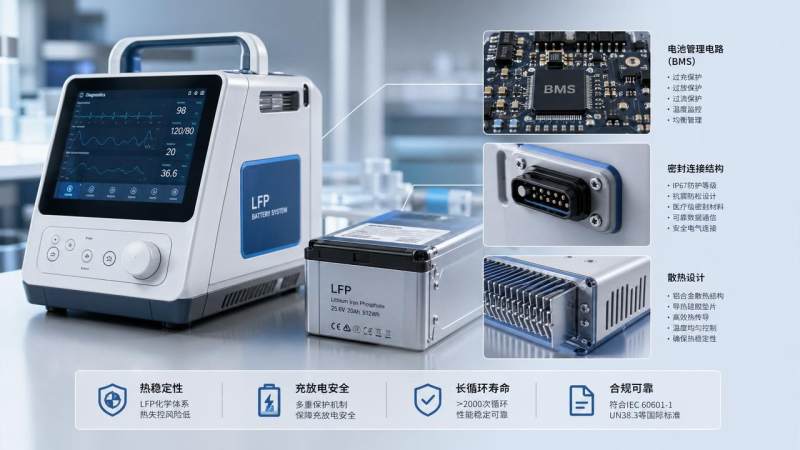
In regulated healthcare environments, lfp battery safety for medical devices deserves early technical review rather than late-stage correction. From thermal stability and charge behavior to MDR/IVDR alignment and lifecycle reliability, battery choices can directly affect device performance, validation, and procurement confidence. For technical evaluators, understanding these risks early helps separate marketing claims from engineering reality and supports safer, more defensible sourcing decisions.
Why does lfp battery safety for medical devices attract so much early scrutiny?
Technical evaluators focus on battery chemistry early because battery risk rarely stays isolated inside the power subsystem. In medical products, a failure in charging behavior, temperature control, enclosure integrity, or state-of-health estimation can cascade into inaccurate readings, interrupted therapy, transport delays, or field recalls. That is why lfp battery safety for medical devices is not simply a component question. It is a system-level quality, compliance, and lifecycle question.
LFP, or lithium iron phosphate, is often selected because it is widely regarded as more thermally stable than some other lithium-ion chemistries. That characteristic matters in portable monitors, infusion systems, diagnostic carts, laboratory tools, and connected care devices that may be used for long shifts, frequent charging, and transport between departments. However, a safer chemistry on paper does not automatically produce a safe medical device in practice. Cell selection, pack architecture, battery management system design, charger compatibility, sterilization exposure, and misuse scenarios all shape the real-world outcome.
For organizations such as hospital procurement teams, MedTech startups, and laboratory planners, early review also reduces downstream cost. If battery assumptions are wrong, design verification, transport certification, thermal testing, and risk documentation may all need to be repeated. Independent benchmarking groups like VitalSync Metrics are valuable precisely because they translate vendor claims into engineering evidence, helping decision-makers compare what is promoted versus what is actually validated.
What are the main safety risks to review before selecting an LFP battery for a medical device?
The main risks are less dramatic than marketing discussions suggest, but more operationally important. Thermal runaway risk may be lower with LFP than with some alternatives, yet heat generation under abnormal charging, internal short conditions, mechanical abuse, or poor ventilation still deserves close review. A device used in a crowded hospital ward or mobile diagnostic unit may experience ambient temperature swings, blocked airflow, and repeated partial-charge patterns that affect long-term safety.
Another critical area is charge management. Overcharge tolerance, balancing strategy, low-temperature charging behavior, and charger-device communication can all influence degradation and hazard probability. In medical use, the risk is not only fire or swelling. It can also be silent runtime loss, unexpected shutdown, false battery percentage reporting, or unstable power delivery to sensitive sensors and processors.
Mechanical integration is equally important. If the pack sits near imaging electronics, pumps, analyzers, or wireless modules, vibration, drops, fluid ingress, cleaning agents, and enclosure stress may affect electrical isolation and connector reliability. For reusable devices, service access and replacement procedures matter too. A chemistry can be safe, but a poorly controlled replacement workflow can introduce major field risk.
Finally, there is the documentation risk. Many teams ask whether the chemistry is safe, when the more relevant question is whether safety has been demonstrated under intended use, foreseeable misuse, and post-market conditions. For lfp battery safety for medical devices, evidence quality is often more important than headline chemistry choice.
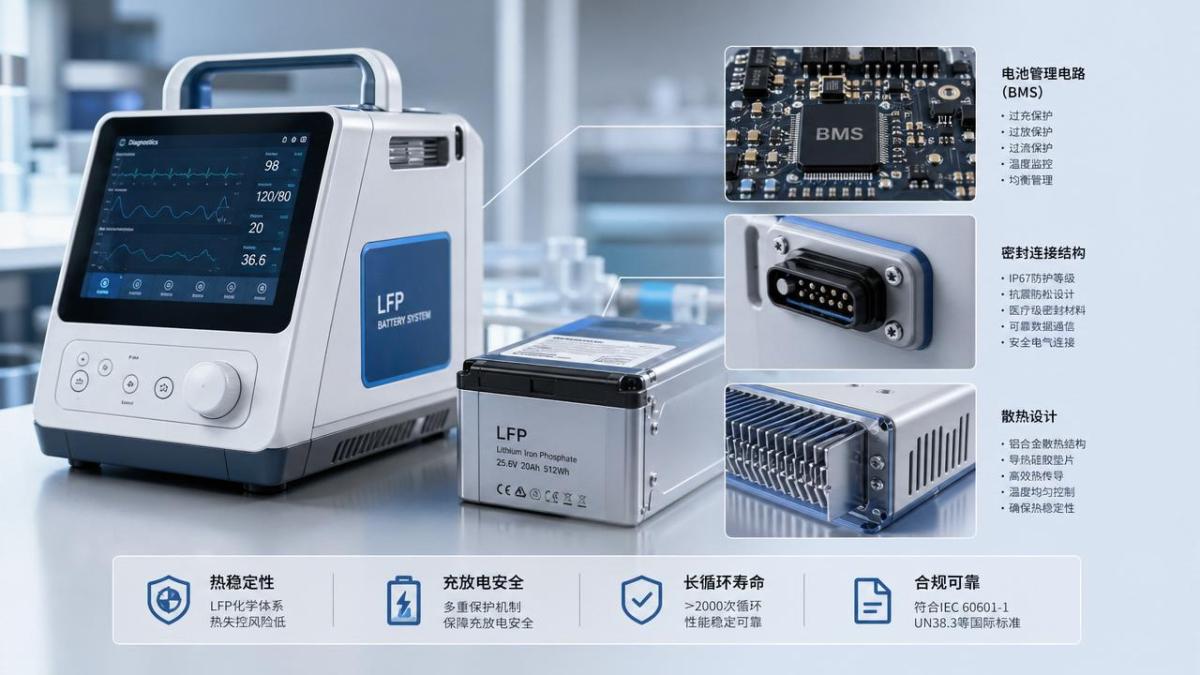
How is LFP different from other lithium-ion chemistries in medical applications?
LFP is commonly compared with NMC and other lithium-ion formats because each chemistry creates a different tradeoff between safety margin, energy density, size, and operating behavior. In medical applications, that tradeoff should be evaluated against the device mission rather than against generic battery rankings.
LFP often offers stronger thermal stability, longer cycle life, and a flatter discharge curve. These traits can support devices that are charged frequently, stored for backup use, or expected to deliver reliable runtime over multiple years. However, LFP typically has lower energy density, which may increase battery volume or weight. For handheld devices, ambulatory products, or compact wearable platforms, that can be a serious limitation.
The flatter voltage profile can also create design challenges. It may complicate state-of-charge estimation if the battery management algorithm is weak, leading to misleading runtime displays. In a consumer product that might be an inconvenience. In a clinical workflow, it can affect staffing decisions, transport readiness, and trust in the device.
The comparison below helps technical evaluators frame the selection question in a practical way rather than relying on broad chemistry claims.
Which technical checks matter most when evaluating lfp battery safety for medical devices?
A strong evaluation should move from chemistry-level assumptions to evidence-based system checks. First, verify cell provenance and consistency. A battery pack built from reputable cells with traceable manufacturing data is easier to validate and defend during audits than one sourced through fragmented channels. Variability between lots can undermine both safety and runtime predictions.
Second, examine the battery management system in detail. Technical evaluators should ask how overvoltage, undervoltage, overcurrent, cell imbalance, short circuit, and overtemperature events are detected and handled. It is not enough to confirm that protection exists. The response thresholds, redundancy logic, fail-safe behavior, event logging, and fault communication to the main device should all be understood.
Third, review charging architecture. Is the charger external or embedded? Is charging allowed during operation? What happens if users connect a nonapproved power source? How does the system behave after repeated shallow charging or long storage? These practical questions often reveal reliability gaps earlier than laboratory spec sheets do.
Fourth, connect battery risk to use-case stress. A bedside monitor, a transport ventilator accessory, and a laboratory analyzer may all use LFP, but their duty cycles differ. Some need high peak current, others need standby resilience, and some must tolerate frequent disinfection chemicals or near-continuous AC connection. Good assessment links battery design to actual workflow stress, not abstract averages.
Fifth, require lifecycle data rather than initial performance snapshots. lfp battery safety for medical devices should include retention of capacity, internal resistance growth, calibration drift in battery gauging, and behavior at end of service life. Many field problems emerge only after the first year of use, when the battery still “works” but no longer behaves predictably.
What compliance and documentation questions should procurement and engineering teams ask?
In regulated environments, battery selection must support both safety claims and documentation discipline. Teams should ask whether the battery subsystem has been assessed within the overall risk management file, including foreseeable misuse, transport exposure, environmental storage, service handling, and end-of-life replacement. MDR and IVDR expectations do not prescribe one chemistry, but they do demand defensible evidence around safety, performance, and traceability.
It is also wise to ask how the manufacturer supports change control. If a cell supplier changes process, form factor detail, firmware logic, or pack materials, what triggers revalidation? In medical procurement, the long-term problem is often not original approval but uncontrolled drift after commercialization. Technical integrity depends on whether equivalent parts are truly equivalent.
Documentation should also cover transportation and storage boundaries, charging instructions, replacement criteria, and incident logging. For fleet-managed devices, battery serial traceability and field analytics can be especially useful. A vendor that can show failure trend data, service return patterns, and degradation modeling will usually inspire more confidence than one relying only on nominal cycle-life claims.
This is where independent benchmarking can strengthen decisions. VSM’s data-driven approach reflects an important market need: translating manufacturing and performance variables into standardized technical evidence that procurement teams can compare across suppliers without being trapped by presentation quality or brand positioning.
What common mistakes do teams make when assessing lfp battery safety for medical devices?
The first mistake is assuming that LFP automatically resolves battery safety concerns. It reduces certain chemistry-related risks, but integration errors, poor thermal design, weak connectors, or inaccurate battery gauging can still create unacceptable medical risk. Safer chemistry is helpful, not sufficient.
The second mistake is focusing only on catastrophic failure. In healthcare settings, non-catastrophic failure may be more frequent and more disruptive. Shortened runtime, unexpected lockout, slow charging, swelling that impairs enclosure fit, or inability to pass power self-tests can all damage clinical workflows and service economics.
The third mistake is validating under ideal laboratory conditions while ignoring use extremes. Devices may be left on charge for long periods, moved between warm and cool zones, operated during charging, or cleaned with aggressive agents. If validation does not reflect these realities, the confidence level is overstated.
The fourth mistake is treating the battery as a commodity purchase. In truth, lfp battery safety for medical devices is tied to firmware, enclosure design, user training, service process, and supply continuity. A lower purchase price can become expensive if it creates retesting, complaints, or replacement complexity.
How should a technical evaluator decide whether an LFP-based design is suitable?
Start by matching the battery profile to the clinical mission. If the device benefits from thermal stability, long cycle life, and predictable fleet service intervals, LFP may be a strong candidate. If the product is extremely size-constrained or highly weight-sensitive, the energy-density penalty may need closer review. The key is to decide based on mission fit, not chemistry reputation.
Next, score the design against a practical screening list:
- Is there traceable evidence for cell quality, pack design, and battery management performance?
- Has the charging strategy been validated under realistic workflow and environmental conditions?
- Can the device maintain safe and stable operation as the battery ages?
- Are service, replacement, transport, and storage controls clearly documented?
- Is there a disciplined change-control process for suppliers, firmware, and pack revisions?
If several of these questions are answered vaguely, the issue is not just battery choice. It is overall design maturity. That distinction matters for procurement directors and startup teams alike, because it separates promising prototypes from scalable medical products.
What should teams clarify first before procurement, partnership, or validation moves forward?
Before approving a supplier or locking a design, teams should clarify the intended duty cycle, charging model, environmental range, service concept, expected life, and regulatory evidence package. They should also ask which test results are based on the exact production-intent configuration rather than on similar reference hardware. For lfp battery safety for medical devices, this distinction can determine whether confidence is earned or assumed.
A useful closing approach is to request targeted evidence instead of general assurance: pack-level abuse response, thermal mapping in enclosure, battery gauge accuracy over aging, charger interoperability boundaries, replacement traceability, and change-notification commitments. If further confirmation is needed on technical direction, validation scope, sourcing risk, implementation timeline, or collaboration model, those are the first questions worth discussing in detail. They expose the real engineering truth faster than broad safety claims and help technical evaluators make sourcing decisions with stronger clinical and operational confidence.
Recommended News
- 2026.11.10FDA Issues Final Guidance on IVD Validation for Emerging Pathogen EmergenciesDr. Hideo Tanaka (Imaging Systems Analyst)
- 2026.11.10Choosing Minimally Invasive Surgical Instruments in Europe: Key Buying CriteriaDr. Alistair Thorne (Senior Biomedical Engineer)
- 2026.11.09WHO Releases Draft Profile for Wearable Physical Activity MonitorsLydia Vancini (Regulatory Compliance Lead)
The VitalSync Intelligence Brief
Receive daily deep-dives into MedTech innovations and regulatory shifts.