 Get Insights

How to Evaluate Compact Biosignal Sensors for Reliable Wearable Vital-Sign Monitoring
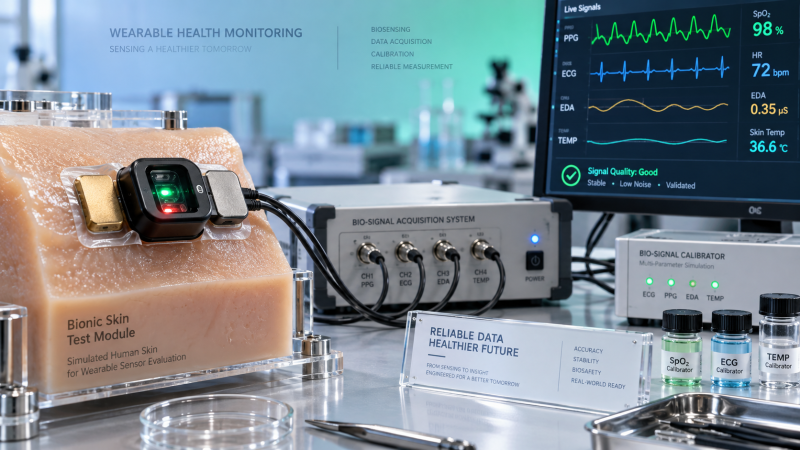
How to Evaluate Compact Biosignal Sensors for Reliable Wearable Vital-Sign Monitoring
Selecting compact biosignal sensors for wearable vital-sign monitoring requires more than comparing a few headline specifications. A sensor can look excellent in a controlled demonstration yet become unreliable when the wearer walks, sweats, changes posture, applies inconsistent pressure, or uses the device for days rather than minutes. For clinical, laboratory, and long-term remote-monitoring programs, the real question is not whether a sensor can detect a signal. It is whether the complete sensing chain can produce interpretable, repeatable data under the conditions the intended user will actually encounter.
That distinction affects every engineering decision: electrode architecture, optical path, analog front end, mechanical enclosure, firmware, wireless behavior, battery strategy, and data-quality rules. It also changes procurement. A small form factor, low unit cost, or attractive datasheet may be valuable, but none is a substitute for evidence that performance remains stable across the target population and use environment.
The most useful evaluation process starts by defining what “reliable” means for the intended application. A wellness wearable that trends heart rate during rest has a different evidence burden from a patch intended to support clinical observation, arrhythmia screening, respiratory monitoring, or laboratory-grade physiological research. Treating these as equivalent is one of the fastest ways to choose the wrong platform.
Begin with the physiological claim, not the sensor category
“Biosignal sensor” is a broad label. Electrocardiography (ECG), photoplethysmography (PPG), electrodermal activity, bioimpedance, temperature, electromyography, and accelerometry each have different coupling mechanisms, artifact sources, sampling needs, and validation paths. Even within one modality, intended use matters. A PPG channel designed to provide pulse timing is not automatically appropriate for oxygen saturation estimation, and an ECG front end that produces a visible waveform is not necessarily sufficient for morphology-based analysis.
Before reviewing suppliers, write an application profile that is specific enough to reject unsuitable options. It should state the physiological parameters required, intended wear location, expected duration of use, user activity level, ambient conditions, reference method for comparison, and the consequence of a missing or corrupted reading. Also define whether the device needs continuous measurement, scheduled spot checks, trend analysis, event capture, or real-time alerting. These choices establish the signal-quality threshold more effectively than generic language such as “medical grade.”
A practical requirement is to separate measurement availability from measurement accuracy. A wearable may return a numerical value frequently, but a high availability rate has little value if the system cannot identify when motion, poor contact, or low perfusion makes that value untrustworthy. The ability to flag low-confidence segments can be as important as the nominal accuracy of accepted segments.
Assess the entire signal path
Compact biosignal sensors should be evaluated as a system, not as isolated sensing components. A useful review follows the signal from tissue to final output: body interface, transducer, analog front end, digitization, onboard processing, transmission, cloud or host processing, and the quality-control logic surrounding each stage. A weakness anywhere in that path can dominate real-world performance.
For electrical signals such as ECG or EMG, examine electrode material, geometry, placement tolerance, contact impedance behavior, lead configuration, input impedance, common-mode rejection, noise performance, and protection circuitry. Dry electrodes may simplify repeated use, but their stability can depend heavily on pressure, skin condition, hair, movement, and long-term mechanical wear. Hydrogel electrodes may provide more consistent coupling in some settings, while creating questions around skin tolerance, adhesion life, packaging, and replacement workflow.
For optical sensing, the discussion should extend beyond LED wavelengths and photodiode sensitivity. The mechanical relationship between the optical assembly and skin is often decisive. Stray light, sensor lift, enclosure compression, skin tone variation, tissue thickness, peripheral perfusion, temperature, and motion can all alter the waveform. A vendor should be able to explain the optical stack, sampling approach, ambient-light management, and the conditions under which its algorithm suppresses or rejects artifacts.
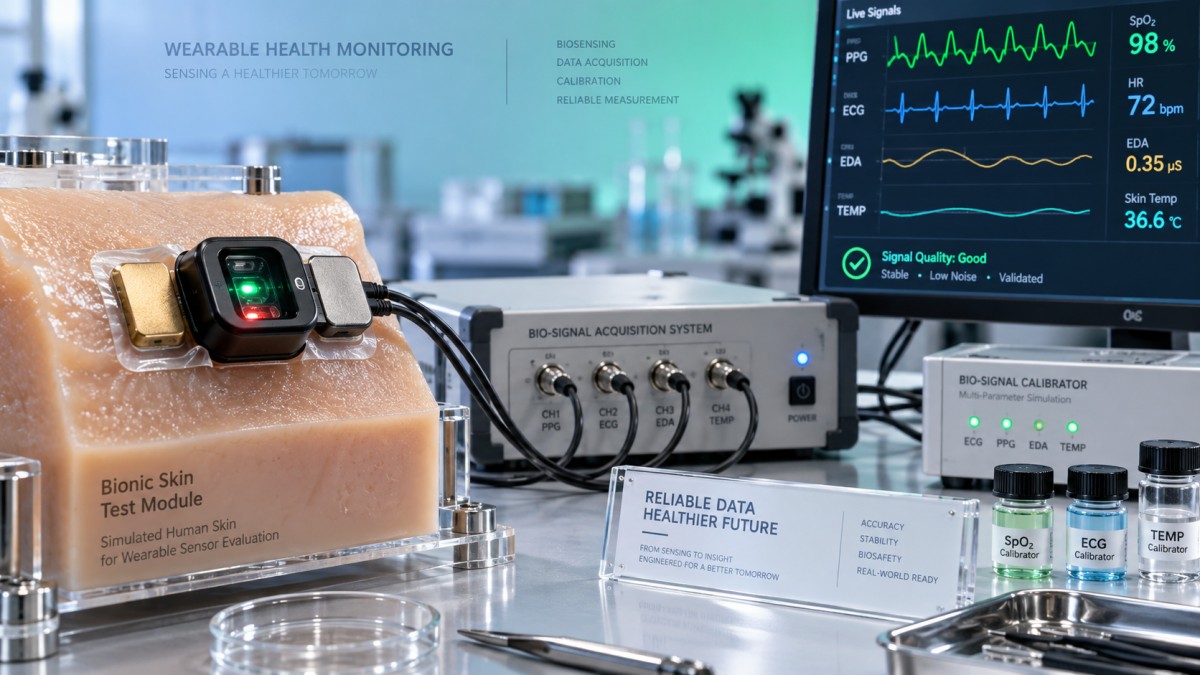
In either modality, ask for raw or minimally processed signal examples in addition to summary metrics. A polished dashboard can conceal clipping, baseline drift, periodic interference, packet loss, or aggressive smoothing. Reviewing waveform segments from representative conditions makes it easier to distinguish true physiological stability from post-processing that merely creates a stable-looking output.
Motion artifact is an engineering problem, not a footnote
Motion is usually where promising wearable concepts become difficult products. It introduces mechanical displacement, variable pressure, cable or flex stress, optical path changes, muscle interference, and movement frequencies that may overlap with the signal of interest. An accelerometer can support artifact detection or adaptive filtering, but its presence alone does not prove that the sensor handles movement well.
Testing should represent the intended use rather than rely on one generic “motion test.” A chest patch, wrist device, finger clip, ear-worn monitor, and smart textile experience motion differently. Relevant tasks might include sitting, walking, stair climbing, hand movement, speaking, sleeping, changing posture, and routine device handling. If the intended population includes frail patients, workers, athletes, or people with tremor, those conditions should shape the test protocol instead of being treated as edge cases.
Ask three connected questions: What artifact conditions were tested? How is poor-quality data identified? What does the device do when data quality falls below the acceptable threshold? A responsible answer may include rejection, a confidence indicator, a remeasurement prompt, or a clearly defined gap in the record. An implausibly continuous stream of values during difficult conditions deserves closer scrutiny.
Mechanical design and skin contact determine long-term usability
In wearable monitoring, the body interface is part of the measurement instrument. Compactness can improve acceptance, but a smaller device may create higher local pressure, poorer alignment, reduced battery volume, or less stable contact. Conversely, a larger module may collect a better signal but be removed by the user before enough data is captured. Selection requires an explicit trade-off between signal integrity and adherence to the wear protocol.
Evaluate attachment and contact over the full claimed wear period. Consider sweat exposure, repeated flexing, garment friction, bathing restrictions, sleep position, temperature changes, adhesive edge lift, and the practical ability to place the device consistently. For reusable products, inspect how cleaning, disinfection, charging, and repeated attachment affect surfaces, seals, contacts, and sensing performance. For single-use patches, examine shelf-life assumptions, packaging protection, adhesive handling, and lot-to-lot consistency.
Materials require the same discipline. Skin-contact components may need biological evaluation appropriate to their nature and duration of contact; ISO 10993 is commonly relevant to this assessment, but the exact scope depends on the device and its intended use. Do not accept a general material declaration as a substitute for documentation tied to the finished, patient-contacting configuration.
Power, storage, and connectivity must be tested together
Battery claims are only meaningful when the operating profile is known. Continuous optical illumination, high sampling rates, on-device signal processing, frequent Bluetooth transmission, retransmission after connection loss, and local data storage all consume energy differently. A device that lasts comfortably in a static bench test may perform very differently when paired with a phone moving in and out of range.
Request a power budget for the proposed configuration, not just a generic runtime statement. It should identify sensing duty cycle, processing load, radio behavior, storage capacity, charging assumptions, and low-battery behavior. Consider what happens when connectivity fails: Does the device buffer raw data, derived values, or nothing at all? Is there a timestamp strategy that allows records to be reconstructed? How are firmware updates controlled, and can they alter signal-processing behavior after deployment?
These questions are particularly important when an algorithm runs partly on a mobile application or cloud service. The measured physiological signal, the displayed metric, and the clinical interpretation may reside in different components. A technical review should establish where each transformation occurs and which version of software produced a given result.
Use evidence packages that can survive a design review
Datasheets are useful screening tools, not validation packages. For a serious selection, request traceable evidence that links the sensor configuration to its stated performance. The evidence need not be identical across projects, but it should be sufficiently detailed to examine test setup, reference equipment, inclusion and exclusion criteria, wear location, environmental conditions, signal-processing version, missing-data treatment, and limitations.
For medical-device development, regulatory review should be aligned to the final intended use and target market. In the European context, wearable monitoring devices may fall under the Medical Device Regulation (MDR), while IVDR applies to in vitro diagnostic devices rather than wearable biosignal monitoring by default. Requirements related to risk management, software lifecycle processes, electrical safety, electromagnetic compatibility, cybersecurity, usability, and clinical evaluation must be assessed for the actual product architecture. Naming a standard is not evidence of conformity; the relevant test reports, technical documentation, and quality processes matter.
Compare suppliers on reproducibility and change control
A prototype supplier can be technically inventive yet unsuitable for scaled deployment. The concern is not simply manufacturing volume. It is whether the supplier can maintain controlled performance when LEDs, electrodes, adhesives, printed circuits, firmware libraries, or assembly partners change. Small changes in component binning, optical alignment, adhesive formulation, or calibration procedures may alter a wearable’s behavior without changing its external appearance.
During selection, ask which parameters are controlled in production, how units are calibrated, what end-of-line tests are performed, and how deviations are investigated. Review component obsolescence plans and notification procedures for material or firmware changes. If a sensor is integrated into a regulated device, the integrator needs enough visibility to assess whether a supplier change triggers additional verification or documentation work.
This is where independent benchmarking can be useful. VitalSync Metrics (VSM) approaches wearable and life-science sourcing as an engineering-verification exercise rather than a comparison of marketing claims. A structured benchmark can normalize test conditions, inspect waveform quality alongside mechanical and manufacturing variables, and document where a proposed sensor performs well, where evidence is incomplete, and what should be tested next. The objective is not to declare a universal winner; it is to reduce avoidable uncertainty before a design is committed.
Make the final decision with a pilot that is designed to fail early
The strongest final comparison is usually a focused pilot using the intended form factor, firmware configuration, wear location, and workflow. It should challenge the assumptions most likely to fail: variable placement, extended wear, motion, low battery, intermittent connectivity, skin diversity, temperature changes, and repeated setup by non-specialist users. A pilot that only confirms operation in ideal conditions adds little decision value.
Define acceptance criteria before reviewing the results. Include signal availability, agreement with the appropriate reference method, data-loss behavior, comfort-related discontinuation, device failures, and the rate at which the system correctly identifies unusable data. Equally important, decide which limitations are acceptable for the intended use. No compact wearable is immune to artifact. The better choice is often the one that makes its boundaries visible, manages failure states predictably, and can demonstrate stable production control.
Reliable wearable vital-sign monitoring is built from evidence, not sensor labels. When the evaluation connects physiology, mechanics, electronics, algorithms, manufacturing, and regulatory responsibilities, compact biosignal sensors can be assessed on the terms that matter: whether they continue to produce defensible information after the lab demonstration ends.
Recommended News
- 2026.11.15Choosing Materials for Sheet Metal Parts: Strength, Corrosion and CostDr. Alistair Thorne (Senior Biomedical Engineer)
- 2026.11.14EU Updates MDR and IVDR Harmonised Standards Lists, Including Radiation SterilisationDr. Alistair Thorne (Senior Biomedical Engineer)
- 2026.11.14Choosing a Medical Supplier Platform: How to Verify Suppliers and Compare CostsDr. Alistair Thorne (Senior Biomedical Engineer)
The VitalSync Intelligence Brief
Receive daily deep-dives into MedTech innovations and regulatory shifts.