 Get Insights

How to Choose Automated Cryogenic Sample Storage for High-Throughput Biobanks
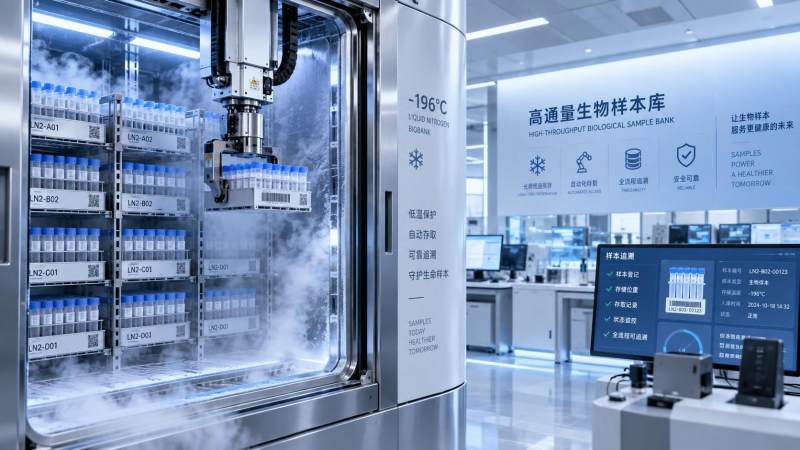
For a high-throughput biobank, automated cryogenic storage should be selected as an operating system for sample preservation, not as a freezer with a robotic arm. A system can offer impressive tube capacity and fast nominal retrieval times yet still create risk if it cannot maintain stable thermal conditions during busy retrieval periods, reconcile inventory reliably, or recover safely from an automation fault.
The right choice depends first on the collection’s purpose and access pattern. A long-term archive with occasional batch pulls has different requirements from a discovery biobank supporting frequent single-tube requests, repeat aliquoting, and time-sensitive research workflows. Technical evaluators should begin with the sample journey: how material enters the store, how it is identified, how often it is accessed, what happens when an exception occurs, and how it remains defensible years after initial deposition.
Start with the operating profile, not the capacity figure
Capacity is easy to compare and easy to overvalue. It is usually expressed as a maximum number of tubes under a specified format and storage configuration. That number may say little about usable capacity once a biobank reserves locations for quality-control material, retains space for growth, separates cohorts, accommodates multiple tube geometries, or protects locations needed for reprocessing and exception handling.
A more useful question is: what throughput must the system sustain while preserving sample identity and temperature control? Build the evaluation around the real request profile. Consider annual intake, peak daily deposits, routine retrieval volume, the proportion of single-tube versus rack-level requests, expected concurrent users, and the service-level expectation for urgent requests. A system that performs efficiently for planned batch output may be poorly matched to unpredictable, small-volume retrieval work.
Access frequency also changes the significance of thermal architecture. Where samples are accessed regularly, the system should minimize unnecessary exposure of the stored collection. Traditional manual storage often introduces repeated cabinet opening, rack handling, and variable operator practice. Automated inventory cryogenic sample storage can reduce those exposures, but the reduction is meaningful only when the automated process isolates the retrieval path from the broader inventory and manages transfers consistently.
- Define the expected mix of intake, storage, retrieval, return, and disposal transactions.
- Separate average workload from peak demand, especially where clinical or project deadlines create concentrated retrieval periods.
- Identify tube formats, rack designs, barcode placement, fill levels, and label durability before treating any capacity model as comparable.
- Set a practical utilization limit rather than planning to run the installation at its theoretical maximum.
Growth planning deserves the same discipline. Buying for the largest conceivable future collection can impose unnecessary operating cost and complexity today. Buying only for present volume can force disruptive migration later. Modular expansion, compatible satellite units, and a documented migration strategy are often more valuable than a single headline capacity number.
Temperature performance must be assessed during transactions
For cryogenic storage, a setpoint alone does not establish sample protection. Evaluators need to understand the temperature environment experienced by material during storage, loading, picking, unloading, and fault recovery. The relevant question is not simply whether a chamber reaches cryogenic conditions, but whether samples remain within the biobank’s defined thermal limits throughout normal and abnormal operations.
The answer will differ by sample type, container, intended downstream use, and internal quality policy. Some collections may have stringent requirements around vapor-phase storage, while others have different validated handling limits. The procurement specification should therefore state the acceptable sample-temperature and exposure criteria in operational terms. It should also distinguish between environmental measurements inside the system and measurements that represent the condition of the sample or its immediate carrier.
Ask suppliers to explain where sensors are located, how alarms are configured, how temperature mapping is performed, and how thermal behavior is verified under realistic operating conditions. Retrieval activity, replenishment, frost management, prolonged queueing, and a partially loaded system can produce conditions that differ from steady-state demonstrations.
Liquid nitrogen management is part of this assessment. It affects operating safety, maintenance requirements, refill logistics, alarm strategy, facility ventilation, and contingency planning. The preferred design is not automatically the one with the lowest stated consumption. It is the design whose consumption, monitoring, refill method, and failure response can be supported reliably by the facility and its operating team.
Automation reliability includes the exceptions people do not see in a demonstration
Robotic handling reduces manual touchpoints, but it does not eliminate failure modes. It moves many risks into gripper control, vision or barcode reading, tube positioning, rack mechanics, transfer interfaces, software state management, and recovery procedures. A selection process that focuses only on successful automated picks will miss the conditions that determine whether the system is manageable over its service life.
Technical teams should request a clear explanation of how the platform handles failed scans, unreadable labels, missing tubes, misoriented tubes, damaged racks, duplicate identifiers, unavailable locations, interrupted transfers, and power or network disruption. These are not edge cases from a governance perspective. Every unresolved exception can affect chain of custody, delay a research workflow, or create an inventory discrepancy that consumes substantial staff time to investigate.
Recovery should be evaluated as a workflow, not merely as a supplier assurance. Who can intervene? Can authorized staff retrieve a critical sample manually? What evidence is retained when an intervention occurs? Does the system reconcile its recorded state after restoration? Can work continue in a controlled reduced-capacity mode if one subsystem is unavailable?
Availability claims should also be interpreted carefully. A quoted uptime figure may exclude planned maintenance, site utility failures, user-caused stoppages, or the time required to resolve inventory exceptions. Ask for the definition behind the metric and focus on the operational consequence of a disruption. A biobank may tolerate delayed routine retrievals but not loss of traceability, uncontrolled warming, or inability to access priority samples during a critical event.
Inventory traceability is a system-level requirement
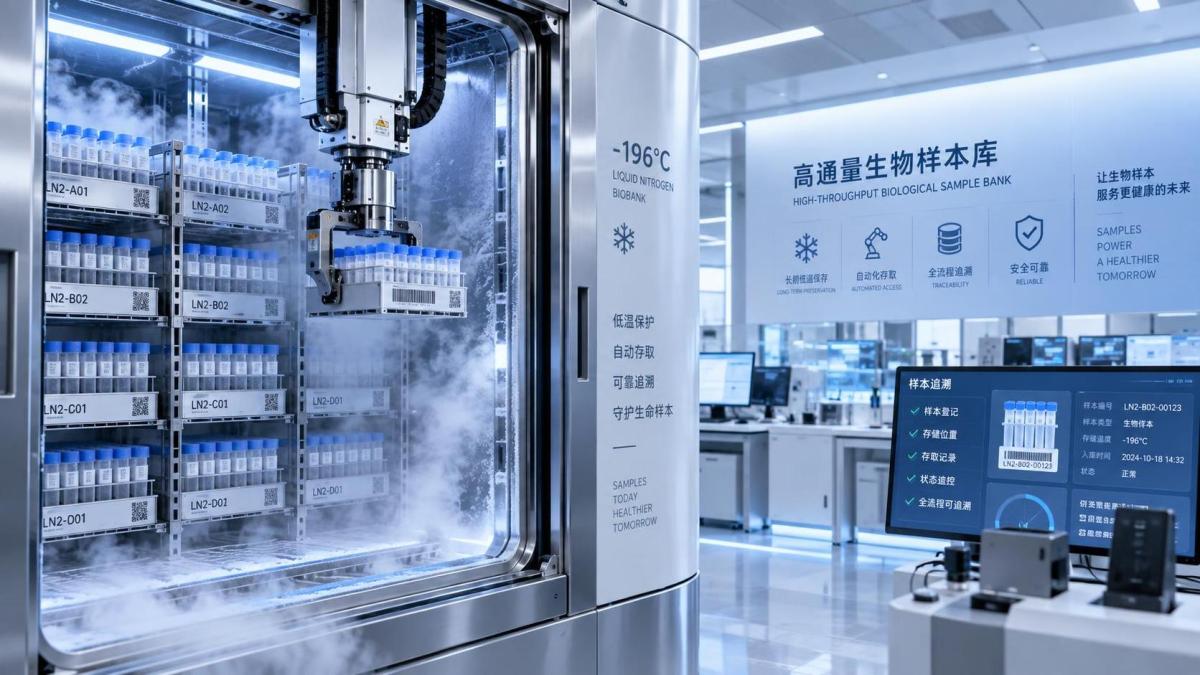
High-throughput automation is only as useful as the inventory record attached to it. The storage platform needs to maintain a reliable relationship among the physical tube, its barcode, the rack and position, the storage location, and the sample metadata held in the laboratory information management system or biobank information system.
That relationship should not depend on operators manually reconciling separate spreadsheets, queue exports, and device logs. Before selection, map the required data exchanges: accessioning, sample registration, storage confirmation, request creation, retrieval confirmation, return-to-store events, disposal, quarantine status, and audit reporting. Then determine whether integration will be direct, middleware-based, or managed through controlled file exchange. Each route can work, but the ownership of validation, error handling, and change control needs to be explicit.
Interface documentation matters because storage equipment often remains in service longer than surrounding software releases. Evaluators should establish whether the vendor provides stable interface specifications, version control, test environments, audit logs, and a process for handling upgrades. A system that integrates quickly during commissioning but becomes difficult to maintain after a software update can create a long-term operational burden.
Traceability also depends on barcode performance at cryogenic conditions. Labels and direct marks must remain readable after the storage and handling conditions the collection will experience. Verify supported symbologies, scanning method, scan verification rules, and the process for tubes whose identity cannot be read automatically. The practical objective is not zero exceptions. It is ensuring that exceptions cannot silently become identity errors.
Compare contamination control and workflow boundaries
Automation can improve contamination control by reducing manual handling and limiting access to the main inventory. Yet the storage system is only one part of the chain. Incoming material may arrive from different laboratories, external sites, or processing streams with different quality controls. Returned samples, temporary staging, quarantine material, and damaged containers require defined paths that do not compromise the main collection.
Technical assessment should cover the physical separation of these workflows, the cleaning and decontamination approach for accessible components, and the handling of a compromised tube or rack. The biobank should decide in advance whether suspect material can enter the automated store, where it is held, and what record is created before release or disposal.
For collections governed by controlled access, privacy obligations, clinical study requirements, or quality frameworks, auditability has equal importance. The solution should support the site’s documented procedures for user authorization, role segregation, change records, sample movement history, alarm review, and data retention. Compliance should be assessed against the biobank’s intended use and governance model rather than inferred from broad claims about laboratory suitability.
Validate the installation as a facility project
Automated cryogenic storage is tightly coupled to its environment. Floor loading, clearance, delivery route, ventilation, oxygen monitoring, power quality, emergency power arrangements, network resilience, drainage where relevant, and nitrogen supply all influence whether the system can operate as designed. These constraints should be reviewed before a preferred system is selected, not after a purchase order converts them into expensive site changes.
Acceptance criteria should be written into the procurement and implementation plan. They should cover installation qualification, temperature mapping, barcode and inventory verification, representative throughput testing, alarm tests, power-loss behavior, restoration procedures, interface testing, user access controls, and documented training. The protocol should use the actual tube and rack formats intended for operation whenever possible. Demonstrations with idealized consumables do not validate a biobank’s own workflow.
A structured factory acceptance test can expose configuration gaps early, but it cannot replace site acceptance. Conditions at the final facility determine utility performance, network behavior, workflow handoffs, and emergency response. The validation record should show that the complete operating process works, including the points where automated equipment meets people, software, and facility infrastructure.
A defensible selection is based on failure response as much as normal performance
When systems appear similar on capacity and retrieval speed, the better choice is often the one with clearer evidence around thermal control during transactions, traceable exception handling, recoverability, integration ownership, and maintainability. Those areas determine how much operational uncertainty the biobank must absorb after commissioning.
Technical evaluators should score the platform against their own sample-risk model and workflow priorities, then require suppliers to demonstrate the highest-risk scenarios rather than relying on standard presentations. A cryogenic store is expected to protect samples for years. The selection process should establish how it behaves when requests are heavy, labels fail, utilities are interrupted, interfaces change, and staff need to intervene. That is the level at which automated storage becomes a credible foundation for a high-throughput biobank.
Recommended News
- 2026.10.14Clinic Supplier Comparison: Evaluating Cost, Delivery Reliability, and SupportDr. Alistair Thorne (Senior Biomedical Engineer)
- 2026.10.13Engineering Performance Testing Services: Evaluating Test Methods and AccuracyDr. Alistair Thorne (Senior Biomedical Engineer)
- 2026.10.12Preparing for an ISO 13485 Audit: When to Use External QMS SupportDr. Julian Rossi (RehabTech Specialist)
The VitalSync Intelligence Brief
Receive daily deep-dives into MedTech innovations and regulatory shifts.