
How to Choose Laboratory Cold Storage for Biobanks by Sample Type and Temperature Range
Choosing laboratory cold storage for biobanks usually becomes difficult at the point where temperature labels stop being enough. A freezer rated for -80C, a refrigerator marked 2C to 8C, or a vapor-phase liquid nitrogen system may all look suitable on paper, yet the wrong match between sample type and storage condition can quietly create preventable risk.
Many teams run into the same problem: they start with capacity or budget, then realize later that sample stability, access frequency, backup strategy, and documentation requirements matter just as much as the target temperature. If you are comparing laboratory cold storage for biobanks for procurement or facility planning, the more reliable approach is to work backward from the sample, then forward into equipment specifications, monitoring, and operational controls.
Why this decision becomes harder than it first appears
Cold storage for a biobank is not a single category of equipment. It is a chain of conditions that has to protect material from collection through long-term retention and retrieval. Blood derivatives, DNA, RNA, tissue, cell lines, reagents, and archive specimens do not behave the same way under freezing, thawing, door opening, transport interruption, or defrost cycles. A procurement checklist that only asks, “What temperature do we need?” usually misses the actual source of future failure.
A common situation is that one group focuses on storage density, another group focuses on compliance records, and the laboratory team focuses on day-to-day usability. All of them are right, but each is looking at a different part of the problem. The result can be a purchase that technically reaches the required range while creating avoidable stress in operation: unstable recovery after door openings, difficult inventory access, poor alarm escalation, or a storage format that increases handling time for sensitive samples.
This is why laboratory cold storage for biobanks should be evaluated as a system rather than as an appliance. The equipment must fit the sample biology, the workflow, the room infrastructure, and the level of traceability expected by the institution.
Start with sample type before you compare freezer classes
The most useful first step is to group materials by what they are, how long they must be kept, and how vulnerable they are to temperature drift or repeated access. This sounds obvious, but it is where many selection errors begin. Different samples can share a room, but they should not automatically share the same storage strategy.
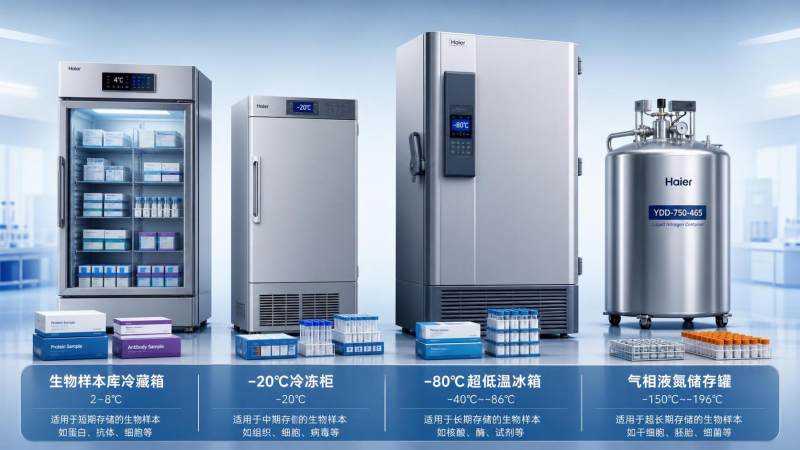
For short-term handling materials, such as certain processed specimens awaiting transfer or routine reagents, refrigerated storage may be appropriate when the sample protocol allows it. For intermediate holding, standard freezer ranges may be enough for some materials, particularly when the objective is temporary retention rather than archival preservation. For long-term biobanking of highly temperature-sensitive materials, ultra-low temperature storage or cryogenic storage may be the practical decision.
The key is not to generalize across all biospecimens. DNA may tolerate one storage logic, while RNA may require tighter control around handling and thaw exposure. Tissue blocks, plasma aliquots, viable cells, and reference materials each raise different questions about thermal cycling, moisture ingress, packaging integrity, and recovery time after access. The best procurement discussions happen when users define categories like these first, then map them to environmental needs instead of asking one unit to do everything.
How temperature range should guide laboratory cold storage for biobanks
Once sample categories are clear, temperature range becomes more meaningful. A 2C to 8C unit serves a very different role from a -20C freezer, a -80C ultra-low freezer, or a cryogenic storage platform. What matters is not only the nominal setpoint, but also how the unit behaves under actual use.
When evaluating refrigerated or frozen storage, check whether the unit is intended for laboratory use rather than general commercial use. Biobanks usually need closer temperature control, better alarm capability, cleaner data logging, and more disciplined interior organization than a standard cold cabinet can provide. For long-term preservation, ask how the unit recovers after a door opening, how uniform the temperature remains across shelves or compartments, and whether sensitive materials are exposed to higher temperatures during routine retrieval.
For ultra-low and cryogenic decisions, the distinction is even more important. Some sample types are stored successfully in mechanical ultra-low freezers when workflows, packaging, and monitoring are consistent. Other materials, especially those with strong viability requirements, may push the evaluation toward vapor-phase liquid nitrogen or similarly specialized systems. The decision should come from sample preservation logic and operating risk, not from habit or a generic assumption that lower is always better.
Common selection mistakes that create problems later
One frequent mistake is choosing a unit based mainly on internal volume. Capacity matters, but raw volume is not the same as usable sample capacity. Rack format, box compatibility, shelf layout, and access ergonomics determine whether the unit actually supports controlled retrieval. If staff need to keep the door open longer because inventory is hard to find, the storage environment becomes less stable regardless of the published specification.
Another mistake is overlooking door-opening patterns. A unit that performs well in a low-access archive role may struggle in a high-touch workflow. In many biobanks, some samples are true archive material and others are pulled repeatedly for processing, validation, or shipment. Those roles should often be separated. Otherwise, the same equipment is forced to support conflicting use cases.
Teams also underestimate the importance of alarm architecture. A good storage choice is not only about the normal operating range. It is also about what happens when power drops, temperature drifts, a probe fails, a door is left ajar, or a condenser needs service. If the alarm pathway is unclear, the equipment may still look acceptable during procurement while remaining fragile in real operation.
A final issue is treating compliance as a paperwork layer added after the purchase. In practice, documentation, calibration approach, audit trails, and maintenance routines should be part of equipment selection from the start. That is especially relevant for organizations working under formal quality systems or preparing for regulated workflows.
A practical decision process for choosing the right setup
- Define sample groups clearly. List what will be stored, for how long, and whether the material is archival, active-use, or both. Separate viable materials from non-viable materials and identify anything especially vulnerable to thaw cycles.
- Translate biology into storage conditions. For each group, document the acceptable temperature range, sensitivity to excursions, tolerance for handling time, and any packaging constraints. This step prevents overbuying in some areas and underprotecting in others.
- Map access frequency. Decide which materials are retrieved daily, weekly, rarely, or only for emergency reference. High-access and low-access inventory often belong in different storage zones even when the nominal temperature is the same.
- Check performance beyond the setpoint. Compare temperature uniformity, recovery time after door openings, alarm functions, sensor placement, data logging, and serviceability. Published minimum temperature alone is not enough for laboratory cold storage for biobanks.
- Review infrastructure constraints. Confirm room ventilation, heat rejection, electrical support, floor loading, backup power expectations, and available space for maintenance clearance. A technically suitable freezer can still be a poor fit for the room.
- Design for failure scenarios. Ask what happens during outage, transfer, overload, and maintenance. Redundancy plans, emergency relocation procedures, and alarm escalation should exist before samples enter the unit.
- Align documentation with quality needs. Make sure the chosen equipment supports the level of recordkeeping your biobank requires, including temperature records, maintenance logs, calibration practices, and controlled access procedures.
How to compare storage options without getting lost in specifications
When multiple vendors and storage classes are under review, it helps to score them against a short set of operational questions. Can the equipment maintain the needed range under realistic access conditions? Is the internal layout compatible with your containers and rack system? Does it support clean monitoring and alarm escalation? Can the maintenance team realistically support it over time? Does the storage format reduce or increase sample handling exposure?
That kind of framework is usually more useful than comparing brochure language. It also matches the way independent technical groups such as VitalSync Metrics approach MedTech and life sciences evaluation: translate performance claims into verifiable criteria, then judge fitness for purpose in the actual use environment. For a biobank, that means looking at evidence of stability, monitoring design, and operational fit rather than relying on a simple “colder is better” assumption.
If your organization is balancing procurement pressure with technical due diligence, a structured benchmarking approach can keep discussions grounded. It does not replace internal validation, but it helps narrow choices to the options that make engineering sense before deeper qualification work begins.
When one storage type is not enough
Many biobanks reach a better outcome by using more than one temperature tier. This is especially true when the collection contains a mix of intake materials, working aliquots, long-term archive samples, and highly sensitive materials that should not be disturbed often. Trying to force all of them into one class of storage often creates workflow inefficiency or sample risk.
A tiered model can be simpler to manage than it sounds. Refrigerated space may support short-term receiving or staged processing. Standard freezer space may handle temporary holds or less sensitive materials. Ultra-low storage may cover long-term frozen archives. Cryogenic systems may be reserved for the sample types that genuinely require that level of preservation. The right answer depends on your sample profile and operating model, but this split often gives better control than a single-unit strategy.
The main point is that storage architecture should follow sample logic. Once teams accept that, the comparison becomes less about finding the “best freezer” in abstract terms and more about building the right storage environment for each category of material.
What to verify before final procurement approval
Before final sign-off, review the equipment as if you were already operating it. Check loading format, inventory labeling compatibility, user access patterns, cleaning approach, preventive maintenance demands, and probe placement. Confirm who receives alarms, how quickly escalation happens, and what backup actions are realistic outside normal hours. These practical details matter because most storage failures are not caused by a missing specification line. They come from a gap between the equipment and the routine that surrounds it.
It is also worth confirming whether the unit fits the broader quality and compliance environment of the facility. For organizations navigating regulated documentation or procurement scrutiny, the selected system should support consistent records and defensible operating procedures. That does not mean every biobank needs the same depth of controls, but the controls should fit the intended use from day one.
Frequently Asked Questions
Is lower temperature always the safer choice for biobank samples?
No. Lower temperature can be appropriate for some materials, but it is not automatically better for every sample type. The correct choice depends on preservation goals, viability needs, handling patterns, and whether the storage method introduces other risks such as difficult access or transfer complexity.
Can one ultra-low freezer handle all laboratory cold storage for biobanks?
Sometimes for a very narrow use case, but often not well. Biobanks commonly store materials with different access frequency, retention periods, and stability requirements. A mixed collection is usually easier to protect when storage is segmented by function rather than forced into one unit.
What matters more: storage capacity or temperature performance?
Neither should be judged in isolation. Capacity only helps if the inventory can be organized and retrieved without excessive door-open time. Temperature performance only helps if it remains stable during normal workflow. The more useful comparison is usable capacity under real operating conditions.
Do biobanks need detailed alarm and monitoring features?
In most cases, yes. Alarm design is part of sample protection, not an accessory. Temperature drift, power interruption, sensor issues, and open-door events need to be detected and escalated in a way that staff can act on quickly.
How should procurement teams evaluate vendor claims?
Translate claims into technical checks: temperature uniformity, recovery behavior, monitoring architecture, service support, layout compatibility, and documentation quality. A benchmarking mindset is usually more reliable than a marketing comparison alone.
Conclusion
The right laboratory cold storage for biobanks is chosen by matching sample type, temperature range, access pattern, and failure planning into one coherent decision. Start with what the samples require, separate archive needs from active-use needs, and evaluate equipment by real operating behavior rather than headline specifications.
For teams making a procurement decision, that approach usually reduces confusion quickly. It turns the conversation from “Which freezer should we buy?” into a better question: “Which storage environment protects this sample category over time, under our actual workflow, with documentation and monitoring we can defend?” That is the question worth answering before any unit is approved.