 Get Insights

Laboratory Cold Storage Cost Factors: Budgeting Energy, Backup, Monitoring, and Maintenance
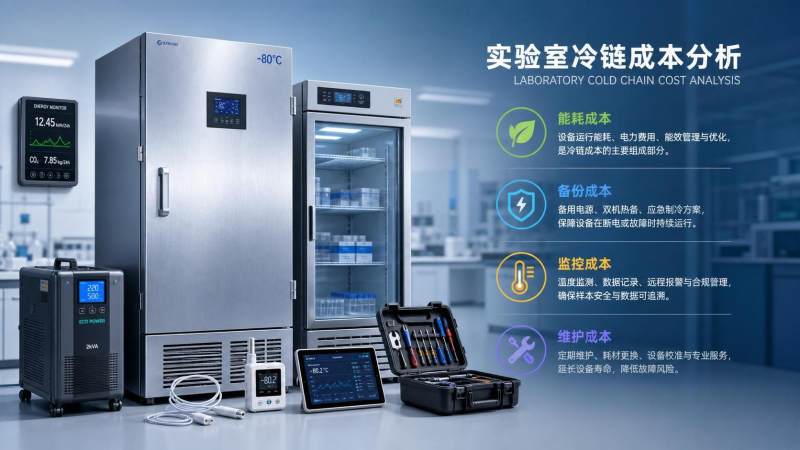
Laboratory Cold Storage Cost Factors: Budgeting Energy, Backup, Monitoring, and Maintenance
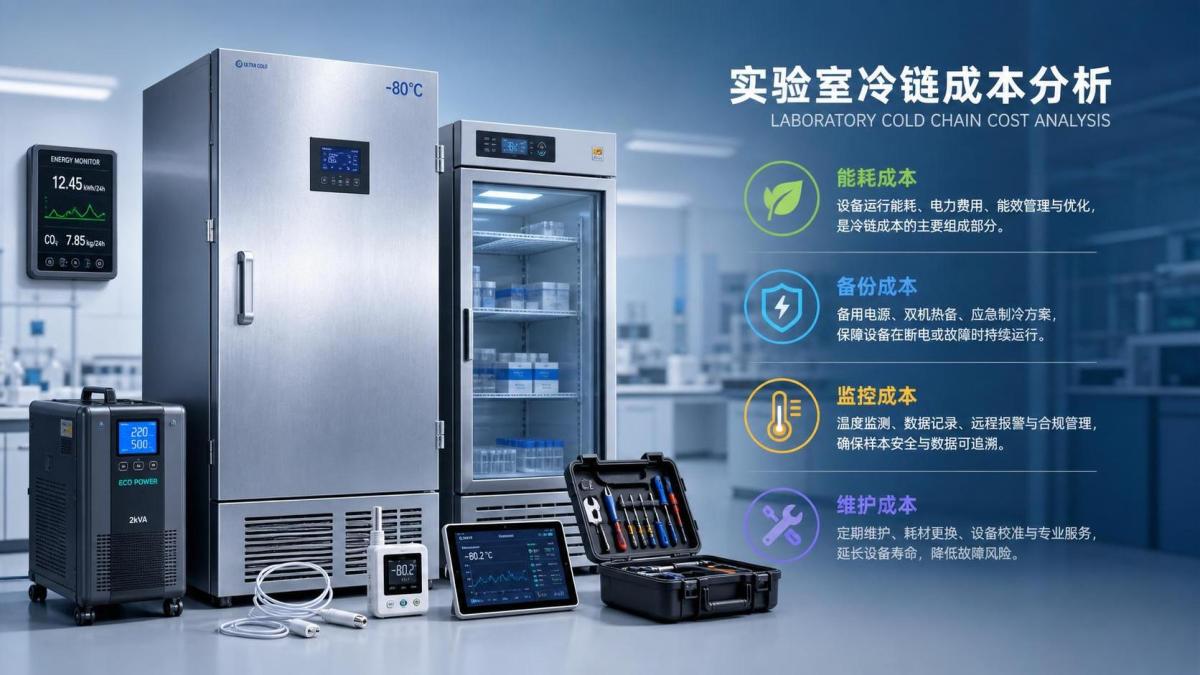
For finance teams, equipment price is only the visible part of the decision.
The larger issue is how laboratory cold storage cost factors shape operating expense, downtime exposure, and replacement timing.
That is where many budgets drift off course.
A freezer or refrigerator may look competitively priced at purchase.
Yet energy draw, emergency backup, alarm coverage, and service demands often determine the real financial outcome.
In healthcare and laboratory settings, cold storage also carries a direct risk to samples, reagents, vaccines, and research continuity.
That changes the procurement conversation from simple capex control to total cost discipline.
This article breaks down the main laboratory cold storage cost factors and shows how to budget them with fewer surprises.
Start with total cost of ownership, not sticker price
The first budgeting mistake is treating cold storage as a one-line equipment purchase.
A better approach is to map laboratory cold storage cost factors across the full operating life.
That usually means seven to ten years, depending on usage intensity and service history.
A basic TCO model should include purchase price, delivery, installation, qualification, utilities, consumables, monitoring, maintenance, and failure contingency.
It should also reflect the financial impact of product loss or workflow disruption.
From a procurement perspective, this creates a fairer comparison between lower-cost units and higher-spec systems.
In practice, a cheaper unit can become the more expensive choice within two or three years.
Core budget lines to capture early
- Base equipment cost and any optional configurations
- Site preparation, electrical work, and commissioning
- Annual energy consumption under realistic load conditions
- Backup systems for power failure or compressor loss
- Remote monitoring, alarms, data logging, and validation
- Preventive maintenance, calibration, and emergency service
- Expected downtime costs and inventory loss exposure
Energy use is one of the most persistent laboratory cold storage cost factors
Energy often becomes the largest hidden cost after purchase.
That is especially true for ultra-low temperature freezers, high-door-opening environments, and facilities with rising utility tariffs.
When evaluating laboratory cold storage cost factors, energy data should be requested in kWh per day or per year.
Ask for testing conditions as well.
Ambient temperature, setpoint, loading level, and door-opening frequency all affect actual consumption.
A published figure without context can mislead budgeting.
More importantly, energy efficiency is not only about utility savings.
Lower heat rejection can reduce HVAC burden in tight laboratory spaces.
That secondary effect should be included when comparing platforms.
Questions that improve energy budgeting
- What is the measured annual energy use at the target setpoint?
- How does power draw change during pull-down and recovery?
- Does the unit require extra room cooling during peak summer loads?
- Are there local rebates or sustainability requirements affecting selection?
Backup protection is a cost line, but it is really a risk control line
Power interruptions and mechanical failure are not rare events.
That is why backup planning sits near the center of laboratory cold storage cost factors.
The right backup level depends on the value and recoverability of stored material.
Some sites can tolerate short disruption.
Others hold irreplaceable samples, regulated materials, or temperature-sensitive product with a very narrow safety window.
In those cases, backup should be budgeted as part of system architecture, not as a future add-on.
Typical backup cost categories
- UPS support for alarms, controls, and communications
- Generator integration for longer outages
- CO2 or LN2 backup systems for critical low-temperature storage
- Redundant storage capacity for emergency transfer
- Validation of holdover time during a failure event
A useful budgeting move is to compare backup cost against the financial value of contents in one fully loaded unit.
That usually sharpens internal approval quickly.
It also reframes laboratory cold storage cost factors around avoided loss, not just added expense.
Monitoring costs are easier to justify than incident costs
Continuous monitoring used to be treated as optional in smaller projects.
That is much harder to defend now.
Among laboratory cold storage cost factors, monitoring has a modest budget impact but a strong effect on accountability and response speed.
A proper setup generally includes local alarms, remote alerts, audit trails, and temperature data retention.
In regulated environments, this may also support quality documentation and investigation readiness.
The key is to budget beyond hardware sensors alone.
Software licensing, connectivity, calibration, user training, and escalation workflows all matter.
What to verify in monitoring proposals
- 24/7 alert delivery paths and response acknowledgment
- Battery backup for communication continuity
- Sensor calibration intervals and replacement costs
- Integration with facility systems or compliance platforms
- Historical reporting for audits and root-cause review
Maintenance planning separates stable budgets from reactive budgets
Maintenance is one of the most underestimated laboratory cold storage cost factors.
Many approvals account for warranty coverage but ignore post-warranty service economics.
That creates a gap in years three through seven, when service events often become more frequent.
Preventive maintenance can include gasket checks, filter cleaning, defrost management, compressor assessment, calibration, and alarm verification.
The exact scope varies by storage type and usage pattern.
What matters financially is response time, parts availability, and technician coverage in the local market.
A lower-cost brand with weak service access can create expensive downtime very quickly.
A simple maintenance budgeting table
Procurement decisions improve when technical claims are verified
Another issue behind laboratory cold storage cost factors is data quality.
Some supplier claims are based on ideal conditions that do not reflect field performance.
That makes benchmarking essential, especially for energy, temperature stability, recovery time, alarm behavior, and material durability.
This is where an evidence-led review can materially improve approval quality.
VitalSync Metrics supports this need by translating technical performance into standardized, decision-ready analysis.
For organizations balancing procurement discipline with compliance expectations, verified engineering data reduces ambiguity.
It also helps explain why two similar-looking units may carry very different long-term cost profiles.
A practical budgeting framework for laboratory cold storage cost factors
A strong approval case usually combines financial logic with technical risk evidence.
That keeps laboratory cold storage cost factors tied to operational reality.
A practical framework looks like this:
- Define storage criticality by material value, regulatory exposure, and recovery difficulty.
- Model five-year and ten-year ownership cost, not just acquisition cost.
- Use real energy assumptions based on site conditions and operating behavior.
- Price backup and monitoring as core requirements for critical inventory.
- Review local service capability before approving lower-priced alternatives.
- Request benchmarked performance data where supplier claims affect cost assumptions.
When these steps are followed, budgeting becomes more predictable.
Just as importantly, procurement decisions become easier to defend internally.
The real goal is not simply to buy cold storage at a lower price.
It is to control laboratory cold storage cost factors in a way that protects both budget accuracy and operational continuity.
Recommended News
- 2026.11.10FDA Issues Final Guidance on IVD Validation for Emerging Pathogen EmergenciesDr. Hideo Tanaka (Imaging Systems Analyst)
- 2026.11.10Choosing Minimally Invasive Surgical Instruments in Europe: Key Buying CriteriaDr. Alistair Thorne (Senior Biomedical Engineer)
- 2026.11.09WHO Releases Draft Profile for Wearable Physical Activity MonitorsLydia Vancini (Regulatory Compliance Lead)
The VitalSync Intelligence Brief
Receive daily deep-dives into MedTech innovations and regulatory shifts.