 Get Insights

How to Evaluate a Centrifuge Systems Factory for Medical Device Production
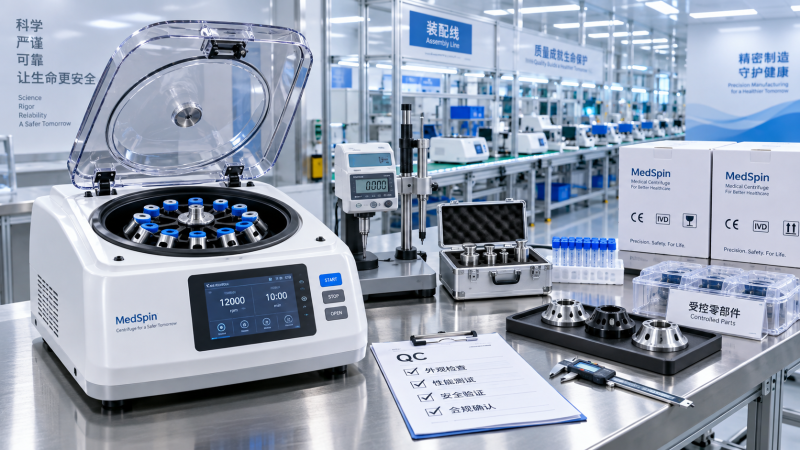
A centrifuge systems factory should not be evaluated as a conventional equipment supplier. In medical device production, the central question is whether the manufacturer can repeatedly build the same controlled product, preserve objective evidence of that control, and manage changes without creating an unrecognized regulatory or clinical risk.
A low quotation, a polished catalogue, and even an ISO certificate do not answer that question. A centrifuge can appear mechanically simple while combining high rotational energy, rotor-life limitations, software-controlled operating parameters, sample-containment requirements, electrical safety obligations, and application-specific documentation. The cost of choosing the wrong factory is rarely confined to replacement equipment. It can include delayed validation, failed incoming inspection, documentation remediation, service disruption, field corrective action exposure, and difficulty supporting a regulatory submission.
The most reliable evaluation starts by separating the factory’s claimed capability from the evidence it can provide for the exact centrifuge configuration being sourced.
Establish what the centrifuge is intended to be before assessing the factory
“Medical centrifuge” is not a single regulatory category. The intended purpose determines much of the compliance path, applicable standards, validation burden, and documentation expected from the centrifuge systems factory.
A benchtop unit used only for general laboratory preparation may be regulated differently from a system intended to prepare patient specimens for in vitro diagnostic examination, isolate blood components, support cell-processing workflows, or perform a defined therapeutic or clinical procedure. In the European Union, equipment with an intended in vitro diagnostic purpose may fall within the scope of the IVDR, while devices with other medical intended purposes may be governed by the MDR. A laboratory product should not be assumed to be an IVDR or MDR device merely because it is sold into a hospital or laboratory.
This distinction is commercially important. A factory may be capable of producing a robust laboratory centrifuge but lack the design documentation, post-market processes, labeling control, technical file support, or change-management discipline required for a regulated medical-device configuration. Conversely, a factory may offer a CE-marked product whose approved intended use does not match the buyer’s planned workflow.
Before requesting quotations, define the procurement requirement in operational terms:
- Intended use and specimen or material type;
- Whether the unit will be marketed as a finished device, supplied as an OEM subsystem, or used internally in a controlled process;
- Required rotor types, tubes, adapters, buckets, lids, and containment features;
- Speed, relative centrifugal force, temperature range, acceleration and deceleration profiles, and imbalance tolerance;
- Data, connectivity, user access, audit trail, and cybersecurity expectations where software is involved;
- Destination markets and the regulatory role each party will hold;
- Installation, qualification, calibration, maintenance, and service-documentation requirements.
Without this definition, suppliers will quote against different assumptions. Apparent price differences may simply reflect different rotors, different containment design, different documentation packages, or a different interpretation of regulatory responsibility.
Read the quality management system beyond the certificate
ISO 13485 certification is a useful starting point, but it is not proof that every centrifuge model is suitable for every medical application. The certificate should be checked for the legal entity, manufacturing site, scope, certification body, and validity period. A certificate covering “manufacture of laboratory equipment” may not demonstrate control of medical-device design, software, sterile-barrier activities, or outsourced critical processes.
The more important question is whether the quality system is visible in the factory’s records. Request controlled examples, with confidential information redacted if necessary, rather than accepting policy statements. Useful evidence includes a device master record or equivalent build specification, incoming-inspection criteria, production travelers, batch or serial-number traceability, nonconformance records, corrective and preventive action procedures, complaint handling, supplier qualification, and change-control forms.
A capable factory can explain how a specific serial number is linked to its motor, controller, rotor, safety components, firmware revision, test results, and release decision. If it can identify the final assembly number but cannot reconstruct which critical components or software version were installed, its traceability may be insufficient for a controlled medical-device supply chain.
Special attention should be paid to segregation and status control. Finished equipment, rejected materials, reworked assemblies, quarantined parts, and released inventory must be distinguishable in physical and electronic workflows. Weak status control creates a basic but serious risk: an unapproved component or unverified rework can be incorporated into a released unit without a clear record.
For supply into the United States, quality-system expectations also need to be viewed in light of FDA’s Quality Management System Regulation, which became effective on February 2, 2026 and aligns 21 CFR Part 820 more closely with ISO 13485:2016. Alignment does not eliminate the need to determine which FDA requirements apply to the specific product, establishment role, and market route.
Engineering control matters more than the published maximum speed
Maximum RPM and RCF are easy to compare, but they are not sufficient indicators of centrifuge quality. Rotor dynamics, lid interlocking, imbalance detection, overspeed prevention, braking behavior, thermal control, and component aging determine whether the machine remains safe and usable over time.
A credible factory should be able to show how engineering requirements move from design input to verification. That chain should include:
- Defined performance requirements for speed accuracy, timer accuracy, temperature control where applicable, and braking profiles;
- Safety requirements for lid locking, rotor recognition, overspeed protection, imbalance response, and fault handling;
- Verification methods, acceptance limits, test equipment identification, and retained results;
- Design review records showing that safety and usability risks were considered before production release;
- Control of engineering changes after verification has been completed.
For laboratory centrifuges, IEC 61010-2-020 contains particular safety requirements relevant to laboratory centrifuges. It should not be treated as a universal proof of medical-device compliance, but it is highly relevant when evaluating the design and test discipline behind rotating equipment. Where the centrifuge qualifies as medical electrical equipment, the applicable electrical safety framework may differ; IEC 60601-series claims should therefore be assessed against the actual intended use rather than accepted as a generic marketing advantage.
Risk management should be connected to the physical product. ISO 14971 provides a recognized framework for medical-device risk management, but a risk-management file has limited value if it does not address credible centrifuge hazards: rotor failure, incorrect rotor installation, tube breakage, aerosol release, hot or cold surface exposure, electrical faults, firmware malfunction, mis-set operating parameters, and use of incompatible consumables.
Ask how the factory verifies rotor compatibility. A centrifuge platform can support multiple rotors and adapters, but each permitted combination affects load limits, balance requirements, achievable RCF, clearance, and braking behavior. A broad compatibility claim without controlled configuration evidence creates avoidable liability for both the supplier and the purchaser.
Rotor manufacture and lifecycle control deserve a separate review
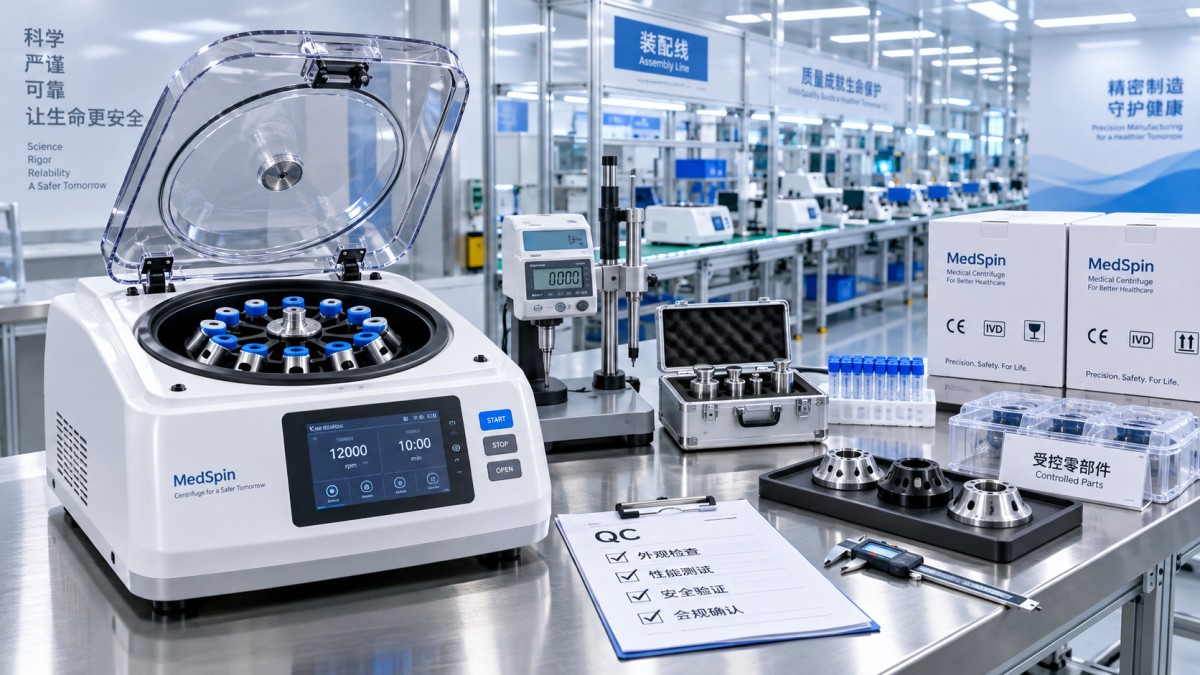
The rotor is not an accessory in the ordinary procurement sense. It is a critical rotating component whose material condition, manufacturing consistency, inspection history, and use limitations can affect safety. An attractive system price can conceal a weak rotor-control program.
Evaluation should cover the rotor material, machining or molding process, surface treatment, corrosion resistance, balancing method, identification marking, inspection criteria, and defined service life. If the factory relies on an external rotor supplier, the purchaser should determine whether that supplier is qualified, audited where appropriate, and subject to documented incoming verification.
Material certificates alone are not enough. The critical issue is whether the factory translates material specifications into controlled production and release checks. For example, a rotor’s dimensional tolerances, bore condition, locking interface, protective coating, and balance characteristics need defined acceptance criteria. If destructive or fatigue testing is used for design verification, the manufacturer should be able to explain how the verified design is maintained in production without implying that every production rotor has undergone the same test.
Also examine the instructions for use and maintenance controls. Rotor replacement intervals, inspection guidance, cleaning compatibility, decontamination restrictions, and allowable disinfectants are not minor documentation details. Inappropriate cleaning chemicals or unreported damage can shorten rotor life. A factory that provides vague maintenance language transfers too much operational risk downstream.
Validation must match the supplied configuration
“Validated” is often used imprecisely. A factory may have validated a production process, performed type testing on one model, and calibrated final test equipment, yet still lack evidence for the exact configuration under quotation.
For a finished system, distinguish among design verification, process validation, software validation where applicable, and installation or operational qualification required at the receiving site. These activities answer different questions:
- Design verification confirms that documented design outputs meet defined inputs.
- Process validation demonstrates that a process consistently produces output meeting predetermined requirements when full inspection cannot adequately assure quality.
- Software validation addresses software used in the device and, where relevant, software used in quality-system processes.
- Site qualification confirms that the installed unit operates as required in the buyer’s environment.
Factory acceptance testing should be specified rather than assumed. The protocol should identify the equipment configuration, test conditions, acceptance criteria, instruments used, deviations, reviewer approval, and final release status. A generic test report with only “pass” entries provides limited value if it does not identify the actual rotor, firmware, and configured accessories shipped with the unit.
Calibration control is equally significant. Speed, temperature, timer, and electrical test instruments should have defined calibration status and traceability appropriate to their use. It is reasonable to ask whether the final test results are linked to calibrated instruments and whether out-of-tolerance calibration events trigger an assessment of potentially affected product.
Software and digital integration change the supplier-risk profile
Digital controls can improve consistency, but they introduce configuration and cybersecurity considerations. A centrifuge with programmable protocols, user accounts, network connectivity, USB export, remote diagnostics, or laboratory information system integration should be assessed as more than a motor-driven instrument.
The factory should be able to identify the firmware version shipped with each device, control software release approval, retain regression-test evidence, and prevent unauthorized loading of unapproved software. If process data or patient-related information can be exported, responsibilities for data handling and access control should be defined contractually.
Buyers should not require advanced connectivity by default. A disconnected system with controlled local settings may create fewer validation and cybersecurity obligations than a connected platform. The correct choice depends on whether digital functions deliver a measurable workflow or traceability benefit in the intended environment.
Price comparison should be replaced by a lifecycle cost comparison
The lowest unit price is often the least informative procurement metric. Centrifuge cost should be compared across the expected ownership period, including rotor and adapter replacement, preventive maintenance, calibration, installation qualification, training, spare parts, warranty exclusions, field-service response, documentation updates, and end-of-life support.
A quotation should clearly separate the base instrument from essential operating components. Common sources of unplanned cost include required rotors, buckets, tube adapters, aerosol-tight lids, refrigeration options, validation documentation, factory acceptance testing, export packaging, installation, and software licenses. If a quote omits these items, it is not necessarily cheaper; it is incomplete.
Serviceability is especially relevant for cross-border sourcing. Ask where critical spare parts are stocked, whether motors, control boards, lid-lock components, and rotors have stated lead times, and whether repairs can be completed by trained local engineers. A supplier that can only offer depot repair may be acceptable for noncritical laboratory use but unsuitable for a workflow where downtime interrupts controlled production or specimen processing.
Contract terms should state the notification period for component substitutions, firmware changes, manufacturing-site transfers, and specification revisions. A factory may regard a revised motor supplier or controller board as an internal efficiency change. For a regulated buyer, it may trigger requalification, technical-file assessment, or change notification to downstream customers. The contract should define which changes require prior written approval and what supporting evidence must be supplied.
Use the audit to test consistency, not presentation quality
A factory audit is most useful when it follows one product from incoming components to shipment. Select a recent production serial number and ask the factory to retrieve its records. The objective is not to inspect every document; it is to determine whether documentation, physical controls, and staff explanations agree.
Trace one rotor, one motor, one control board, and one final test record. Verify that serial numbers match, inspection status is clear, test instruments were within calibration, deviations were dispositioned, and final release was performed by authorized personnel. Then ask about the most recent relevant engineering change. The answer will show whether change control is a functioning process or a document maintained for audits.
Warning signs include refusal to identify subcontracted critical processes, incomplete device history records, undocumented rework, quality certificates issued to a different legal entity or site, broad regulatory claims unsupported by intended-use documentation, and final testing based solely on visual inspection or a brief power-on check.
A dependable centrifuge systems factory does not need to claim that every configuration is suitable for every medical use. Its value lies in being precise about what it manufactures, what it has verified, which controls are in place, and where the boundaries of its responsibility sit. That precision is what allows a buyer to calculate total cost realistically, protect validation schedules, and build a supply relationship that remains defensible when the product, market, or regulatory scrutiny changes.
Recommended News
- 2026.11.16Choosing Wi-Fi Diagnostic Hardware: Connectivity and Security CriteriaDr. Hideo Tanaka (Imaging Systems Analyst)
- 2026.11.15India Reforms Medical Device Incentive Scheme to Deepen Local ManufacturingDr. Julian Rossi (RehabTech Specialist)
- 2026.11.15Choosing Materials for Sheet Metal Parts: Strength, Corrosion and CostDr. Alistair Thorne (Senior Biomedical Engineer)
The VitalSync Intelligence Brief
Receive daily deep-dives into MedTech innovations and regulatory shifts.