 Get Insights

AI for semiconductor precision engineering: yield gains or hype?
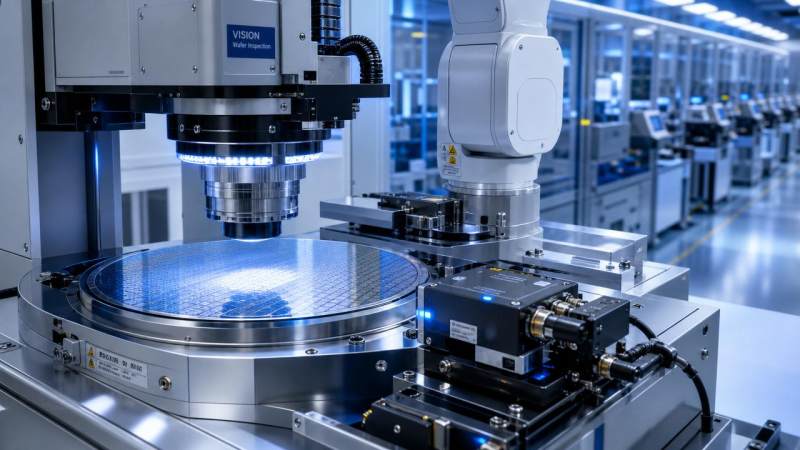
Can AI in precision engineering for semiconductor manufacturing truly raise yield, or is it another overpromised innovation? For quality control and safety managers, the answer lies in measurable process stability, defect detection accuracy, equipment reliability, and compliance-ready traceability. This article cuts through the hype to examine where AI delivers real engineering value, where risks remain, and how data-driven validation should guide every adoption decision.
What AI in precision engineering for semiconductor manufacturing really means
In practice, AI in precision engineering for semiconductor manufacturing is not a single tool, nor is it a magic layer added on top of existing production. It is a set of data-driven methods used to monitor, predict, optimize, and document highly sensitive fabrication steps where nanometer-scale variation affects final yield. These methods usually combine machine learning, computer vision, statistical process control, digital twins, and anomaly detection with equipment telemetry, metrology outputs, and manufacturing execution system data.
The reason this topic matters is simple: semiconductor production is a precision discipline where minor drift can translate into wafer loss, delayed qualification, or hidden reliability risk. Etch profiles, lithography overlay, deposition uniformity, vibration, contamination, and thermal instability all have cumulative effects. AI becomes relevant when conventional rule-based monitoring cannot keep up with process complexity, data volume, and multi-variable interactions.
For quality control teams, the key question is not whether AI sounds advanced, but whether it improves process capability, shortens root-cause analysis, and reduces escaped defects. For safety managers, the concern is broader: whether automated decisions remain explainable, controlled, auditable, and aligned with equipment safety and data governance requirements.
Why the industry is paying close attention
Semiconductor manufacturing has always depended on precision engineering, but today’s environment adds more pressure. Device architectures are denser, tolerances are tighter, and production economics are less forgiving. At the same time, fabs are expected to improve throughput, conserve energy, limit unplanned downtime, and maintain consistent quality across global supply chains. Under those conditions, AI in precision engineering for semiconductor manufacturing is attracting attention because it promises earlier detection of instability and faster operational learning.
However, not all attention is justified. Some deployments are marketed as intelligent transformation when they are really dashboards with weak models or poorly curated datasets. This is where a benchmarking mindset matters. Organizations such as VitalSync Metrics (VSM), although rooted in MedTech and life sciences evaluation, reflect a broader engineering principle that also applies here: claims should be tested against validated signal quality, repeatability, and long-term reliability rather than presentation language.
Where yield gains are real
The strongest case for AI in precision engineering for semiconductor manufacturing appears when data streams are rich, process physics are stable enough to model, and outcomes can be validated against measurable quality indicators. In these conditions, AI can support yield gains in four meaningful ways.
1. Earlier process drift detection
Traditional thresholds often detect problems after the process has already moved beyond ideal conditions. AI models can identify subtle correlations across temperature, pressure, chamber history, vibration, and metrology signatures before visible defects emerge. That means more time to intervene, less wafer loss, and a tighter feedback loop between engineering and operations.
2. Better defect inspection at scale
Computer vision systems trained on defect libraries can classify particle contamination, pattern distortion, edge anomalies, and surface irregularities more consistently than manual review alone. This does not eliminate human oversight, but it improves speed and screening coverage. For quality managers, the value is not only in faster detection but also in improved defect taxonomy and trend visibility.
3. Predictive equipment reliability
Yield is often lost because equipment remains nominal on paper while real operating conditions degrade. AI models can link maintenance history, sensor behavior, and chamber performance to likely failure modes. If validated correctly, this reduces unplanned downtime and prevents quality events caused by latent tool instability.
4. More complete traceability
AI can organize large process datasets into usable evidence for deviation review, lot genealogy, and root-cause investigation. This matters for quality and safety because a model is valuable only if teams can reconstruct what happened, when it happened, and which signals justified the intervention.
Where hype still exceeds engineering value
Despite strong use cases, hype appears whenever AI is introduced without process discipline. The most common failure is weak data quality. If sensors are poorly calibrated, timestamps are inconsistent, labels are incomplete, or metrology systems vary across tools, then even a sophisticated model will produce unstable conclusions. In that situation, the project may generate attractive visualizations without improving yield.
A second issue is explainability. Black-box recommendations are difficult to trust in a high-risk manufacturing environment. Quality control personnel must know whether a flagged event reflects a true process shift, a sensor artifact, or a training bias. Safety managers also need assurance that automated actions cannot create secondary hazards, such as incorrect equipment states, uncontrolled shutdowns, or masked warning conditions.
Third, not every process step produces enough clean data for useful model training. Rare failure modes, product mix changes, recipe revisions, and new equipment installations can all weaken model performance. AI in precision engineering for semiconductor manufacturing works best when its deployment scope matches the maturity of the process and the integrity of the historical dataset.
Typical application areas and their value to control teams
The practical value of AI depends on where it is applied. Quality control and safety teams should evaluate each application by expected gain, verification burden, and operational risk.
What quality and safety managers should verify before adoption
A disciplined adoption path begins with engineering evidence, not vendor enthusiasm. First, define the target metric. Is the goal better first-pass yield, lower scrap, reduced excursion rate, improved Cp/Cpk, fewer nuisance alarms, or stronger traceability? AI in precision engineering for semiconductor manufacturing should be tied to one or two measurable outcomes rather than broad transformation claims.
Second, test data integrity. Review sensor calibration status, signal continuity, missing values, labeling quality, and alignment between process events and metrology records. A model built on inconsistent production history will not become reliable simply because it uses more variables.
Third, require controlled validation. Compare AI-supported decisions against baseline methods over a defined period. Examine defect escape rate, alarm precision, maintenance accuracy, and process stability before and after implementation. Quality teams should insist on confidence intervals, not just average gains.
Fourth, establish governance. Every model should have version control, retraining criteria, access rules, rollback procedures, and documented ownership. Safety managers should also ensure that AI recommendations do not bypass interlocks, permit-to-work controls, or standard incident escalation paths.
A realistic decision framework
A useful way to judge AI in precision engineering for semiconductor manufacturing is to ask three questions. Can the process be measured well? Can the model be validated against meaningful production outcomes? Can the operation act on the output safely and consistently? If the answer to any one of these is no, then the project is not yet ready for scale, regardless of how promising the concept appears.
This framework helps separate real yield engineering from hype. AI adds value when it strengthens the chain from signal acquisition to decision quality. It becomes hype when it obscures weak metrology, replaces engineering judgment with opaque scoring, or creates dependency on poorly governed automation.
Conclusion and next-step guidance
So, does AI in precision engineering for semiconductor manufacturing deliver yield gains or mostly hype? The evidence points to both possibilities, depending on execution. When grounded in reliable data, narrow use cases, rigorous validation, and compliance-ready traceability, AI can improve defect detection, process stability, and equipment reliability in ways that genuinely support higher yield. When deployed as a branding exercise without clean data or governance, it often adds complexity without dependable benefit.
For quality control and safety managers, the practical path is clear: start with measurable pain points, benchmark data quality, validate models against real production outcomes, and demand transparent engineering evidence. That is the same discipline behind credible technical benchmarking in other regulated, high-stakes sectors. In the end, the right question is not whether AI is innovative, but whether it can prove stable, repeatable, and trustworthy performance where precision matters most.
Recommended News
- 2026.11.10FDA Issues Final Guidance on IVD Validation for Emerging Pathogen EmergenciesDr. Hideo Tanaka (Imaging Systems Analyst)
- 2026.11.10Choosing Minimally Invasive Surgical Instruments in Europe: Key Buying CriteriaDr. Alistair Thorne (Senior Biomedical Engineer)
- 2026.11.09WHO Releases Draft Profile for Wearable Physical Activity MonitorsLydia Vancini (Regulatory Compliance Lead)
The VitalSync Intelligence Brief
Receive daily deep-dives into MedTech innovations and regulatory shifts.