 Get Insights

ISO 13485 Audit Stages Explained: What to Prepare From Gap Assessment to Certification
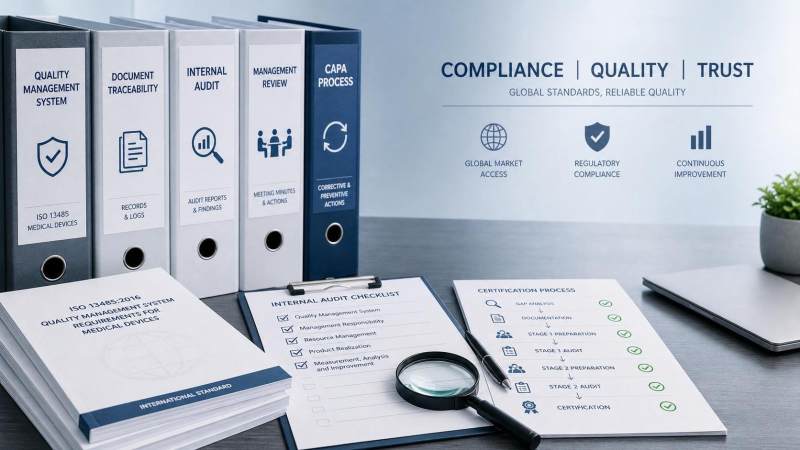
Why do ISO 13485 audit stages matter before certification even starts?
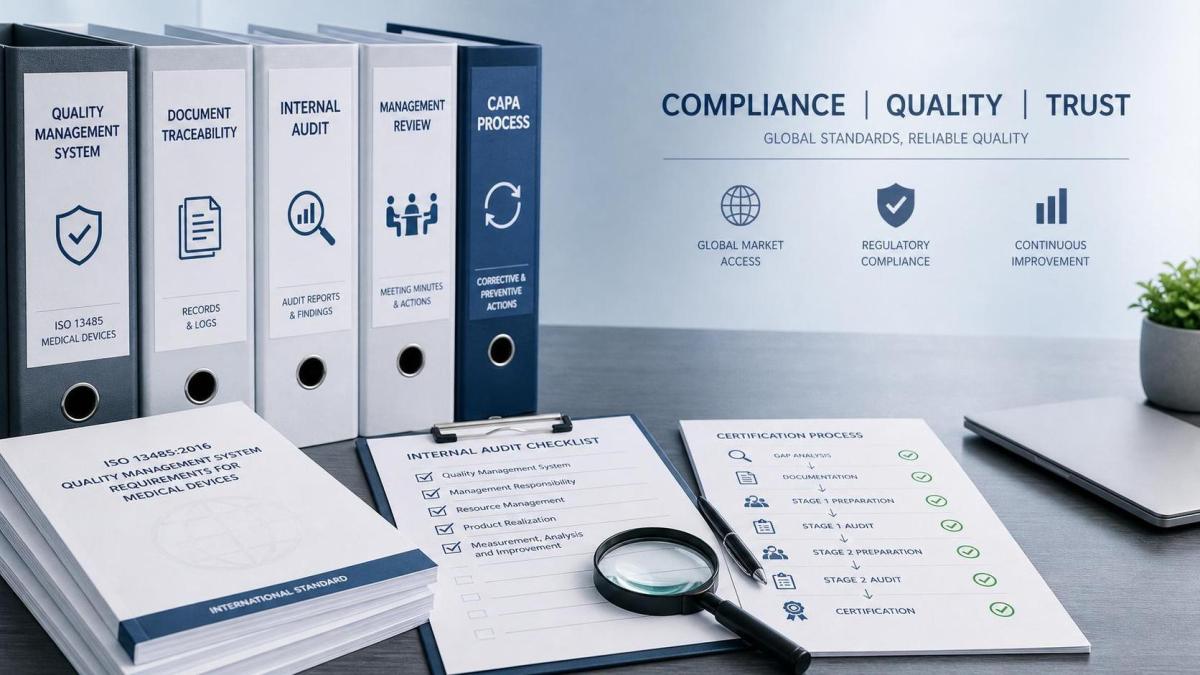
ISO 13485 audit stages shape the entire path to certification, not just the final audit week.
In medical device operations, weak preparation usually appears long before an auditor arrives.
Missing validation logic, uncontrolled records, and vague supplier oversight often surface during early reviews.
That is why understanding ISO 13485 audit stages is really about building evidence, discipline, and traceability over time.
The sequence usually moves from gap assessment to system implementation, internal audit, Stage 1, Stage 2, and certification decision.
Each step asks a different question.
- Does the quality system match ISO 13485 requirements on paper?
- Is the system actually implemented across departments?
- Can the organization prove control with records and objective evidence?
In practice, the most efficient teams treat audit readiness as an engineering control problem.
They map processes, define owners, measure deviations, and close gaps before certification becomes urgent.
This approach aligns with the broader healthcare shift toward technical verification over marketing claims.
That same mindset is central to organizations like VitalSync Metrics, where performance claims are expected to stand on documented evidence.
What should be done during the gap assessment stage?
The gap assessment is the first serious checkpoint in the ISO 13485 audit stages.
Its purpose is simple: compare current practice against required controls, then identify what is missing.
A useful gap assessment goes beyond document collection.
It should test whether procedures, records, training, and operational behavior are consistent with each other.
The most common review areas include:
- Quality manual structure and scope definition
- Document and record control rules
- Risk management links to design and production
- Supplier qualification and monitoring
- Complaint handling, CAPA, and post-market feedback
- Validation of software, processes, and measurement systems
A strong gap assessment also assigns severity to each finding.
Some gaps block certification directly, while others mainly affect audit confidence or timing.
More often than expected, teams discover that procedures exist but have no usable records behind them.
That is a critical warning sign because ISO 13485 audit stages rely on evidence, not intent.
A concise decision table helps keep the assessment practical.
When does documentation become audit evidence rather than admin paperwork?
This usually happens during implementation and internal audit, the middle of the ISO 13485 audit stages.
At that point, procedures must be active, not merely approved.
Auditors look for a consistent chain: requirement, process, execution, record, review, and correction.
If one link fails, readiness becomes questionable.
A useful preparation method is to build evidence packs by process.
For example, design control should include plans, inputs, reviews, verification, validation, change history, and design transfer records.
Production controls should show approved instructions, equipment status, monitoring data, and nonconformance handling.
Internal audits are especially important here because they simulate the certification logic.
They should challenge process owners, sample records, and test whether actions were actually effective.
The common mistake is making internal audits too polite.
A friendly checklist exercise does not prepare anyone for real ISO 13485 audit stages.
A better standard is this: if an external reviewer asks for proof within five minutes, can the team produce it cleanly?
That expectation also mirrors how technical benchmarking environments operate.
Where performance claims matter, traceable data and reproducible records carry more weight than presentation quality.
Stage 1 and Stage 2 audits: what is the real difference?
Many teams know the names but misunderstand the purpose.
Within the ISO 13485 audit stages, Stage 1 is mainly a readiness review.
Stage 2 is the deeper evaluation of whether the quality management system works in practice.
Stage 1 usually focuses on scope, documentation, regulatory context, site preparedness, and internal audit status.
It can still reveal serious gaps, especially where procedures are incomplete or management review has not happened.
Stage 2 goes much further.
Auditors sample daily execution, interview personnel, trace records, and test whether controls remain effective under routine conditions.
The distinction is easier to manage when seen side by side.
If Stage 1 exposes structural weakness, delaying Stage 2 is often wiser than pushing through on schedule.
Rushed timing can turn manageable gaps into major nonconformities.
Where do teams usually fail across ISO 13485 audit stages?
The failure points are usually ordinary, which makes them easy to underestimate.
One recurring issue is weak connection between risk management and operational controls.
A risk file may exist, yet inspection limits, design inputs, or supplier requirements do not reflect it.
Another problem is incomplete control of outsourced processes.
External partners are often critical to production, sterilization, testing, or software support.
If oversight is informal, auditors notice quickly.
There is also a pattern of treating CAPA as a closure tool instead of a learning system.
When recurring issues are closed with short notes and no effectiveness checks, confidence drops.
The same applies to data integrity.
Uncontrolled spreadsheets, missing timestamps, and unclear review approvals can weaken multiple ISO 13485 audit stages at once.
A practical prevention list is often more useful than a long policy memo.
- Check whether every critical procedure has recent records.
- Confirm that process owners understand both the rule and the reason behind it.
- Review open deviations before auditors do.
- Test traceability from complaint to CAPA to design or production change.
- Verify that supplier files reflect actual purchasing risk.
How long do ISO 13485 audit stages take, and how should the timeline be planned?
There is no single timetable, but realistic planning prevents avoidable pressure.
For many organizations, gap assessment and remediation take the most time.
Not because auditors are involved, but because cross-functional discipline has to be built.
A typical sequence may look like this:
- Gap assessment: 2 to 6 weeks, depending on complexity and document maturity
- System remediation and record generation: 2 to 6 months
- Internal audit and management review: 2 to 4 weeks
- Stage 1 audit and response: 2 to 6 weeks
- Stage 2 audit and closure: 1 to 3 months
More important than speed is record maturity.
If new procedures have existed for only a few days, they usually cannot demonstrate stable implementation.
That is why the strongest schedules include time for real operating history.
In technical environments influenced by MDR, IVDR, and evidence-based procurement, shallow readiness is increasingly visible.
Certification is still important, but defensible process performance matters just as much.
What is the smartest next step before moving toward certification?
Start by mapping your current state against the full ISO 13485 audit stages, not only the certification visit.
That means identifying process owners, missing records, regulatory dependencies, and evidence gaps in one view.
Then decide which issues are structural and which are procedural.
Structural issues usually involve scope, validation strategy, supplier control, or risk linkage.
Procedural issues are often easier to close, but they still need consistent follow-through.
Where technical credibility matters, it helps to review not only compliance records but also performance evidence.
That perspective is especially relevant in healthcare supply chains where decisions increasingly depend on measurable engineering truth.
In simple terms, certification should confirm a system that already works.
It should not be the event that forces the system into existence.
If the next review is approaching, organize a focused gap assessment, test evidence retrieval, and challenge internal audit results with real operating samples.
That is usually the most reliable way to reduce audit risk and move toward certification with confidence.
Recommended News
- 2026.10.14Clinic Supplier Comparison: Evaluating Cost, Delivery Reliability, and SupportDr. Alistair Thorne (Senior Biomedical Engineer)
- 2026.10.13Engineering Performance Testing Services: Evaluating Test Methods and AccuracyDr. Alistair Thorne (Senior Biomedical Engineer)
- 2026.10.12Preparing for an ISO 13485 Audit: When to Use External QMS SupportDr. Julian Rossi (RehabTech Specialist)
The VitalSync Intelligence Brief
Receive daily deep-dives into MedTech innovations and regulatory shifts.