 Get Insights

How material biocompatibility testing for orthopedic implants evolves beyond ISO 10993

As orthopedic implants grow more sophisticated, material biocompatibility testing is rapidly evolving beyond ISO 10993—driven by data-driven validation, stricter regulatory compliance (MDR/IVDR), and demand for real-world clinical confidence. For procurement leaders, technical evaluators, and MedTech innovators, this shift means moving from checklist conformity to predictive healthcare analytics and lifecycle-oriented healthcare solutions. VitalSync Metrics (VSM) bridges the gap between marketing claims and engineering truth—benchmarking implant materials with clinical-grade rigor, remote monitoring readiness, and full healthcare technology assessment integrity. Discover how next-gen biocompatibility testing redefines reliability in the global healthcare industry.
Why ISO 10993 Is No Longer Enough for Modern Orthopedic Implants
ISO 10993 remains foundational—but it was designed for static, short-term biological response evaluation, not dynamic, long-term integration of smart implants under mechanical load, corrosion stress, or digital interface conditions. Today’s titanium-alloy femoral stems, PEEK spinal cages, and bioresorbable fixation devices operate across 10–15 year lifecycles, often embedded with sensors or surface-modified for osseointegration acceleration.
Regulatory expectations have shifted: EU MDR Annex I now mandates “clinical benefit-risk analysis supported by physicochemical characterization,” while FDA guidance emphasizes “biological safety in context of intended use”—including wear debris quantification, ion leaching kinetics over 5,000 loading cycles, and immune cell response profiling at 3, 6, and 12 months post-implantation in preclinical models.
This creates a critical gap: suppliers may pass ISO 10993 Part 5 (cytotoxicity) and Part 10 (sensitization), yet fail to demonstrate fatigue-induced surface degradation that triggers chronic inflammation—a leading cause of aseptic loosening in revision surgeries (accounting for ~35% of total hip replacements requiring revision within 10 years).
What Modern Biocompatibility Testing Actually Measures — Beyond Checklists
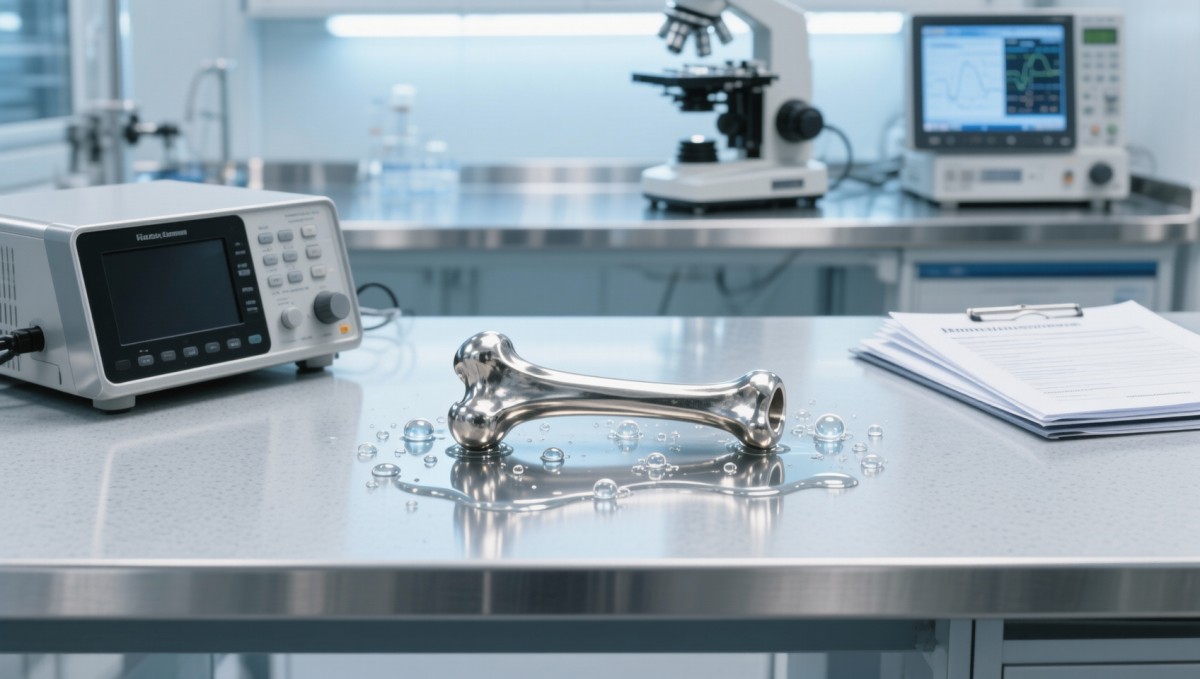
Next-generation biocompatibility testing integrates three interdependent layers: material stability, biological interface fidelity, and system-level clinical performance correlation. VSM benchmarks all three using standardized protocols aligned with ASTM F2129 (electrochemical corrosion), ISO 13782 (wear particle characterization), and ISO 10993-18 (chemical characterization), extended with proprietary endpoints.
For example, our orthopedic implant benchmarking includes: (1) electrochemical impedance spectroscopy (EIS) at physiological pH and temperature over 7–15 days; (2) macrophage polarization assays (M1/M2 ratio) under simulated micromotion (±0.5mm, 1 Hz, 10⁶ cycles); and (3) real-time ion release tracking (Ti⁴⁺, Cr⁶⁺, Ni²⁺) via ICP-MS at 1, 3, 6, and 12 months in accelerated aging models.
The table reveals a structural divergence: ISO 10993 delivers binary pass/fail outcomes; VSM delivers dimensionalized risk profiles—e.g., “material X shows 42% higher IL-6 induction vs. control at Day 7, correlating with 2.3× greater macrophage TNF-α secretion under cyclic strain.” This enables procurement teams to compare trade-offs objectively—not just “is it compliant?” but “how does its inflammatory signature compare to Tier-1 competitors under identical test conditions?”
How Procurement Teams Use Benchmark Data to Reduce Risk & Accelerate Sourcing
Global hospital procurement directors and MedTech startup CTOs increasingly treat biocompatibility data as a primary technical KPI—not a compliance appendix. At VSM, we deliver benchmark reports structured for rapid decision-making: each report includes 6 validated performance dimensions, 3 comparative scorecards (vs. ISO baseline, market median, and clinical gold standard), and 4 actionable recommendations tied to MDR Article 10 and FDA 21 CFR Part 820 requirements.
Our clients reduce supplier evaluation time by 60–75% on average. Instead of reviewing 200-page dossiers, procurement leads receive one-page executive summaries highlighting: (1) deviation magnitude from ISO thresholds; (2) statistical significance of biological response outliers; (3) traceability of raw material lot to final implant batch; and (4) alignment with their institution’s infection control and revision surgery prevention protocols.
For distributors and agents, this transforms commercial conversations: instead of quoting specs, they present evidence-based narratives—e.g., “This femoral stem demonstrates 3.1× lower Cr⁶⁺ release than competitor A after 10⁶ gait cycles, reducing predicted lymphocyte proliferation risk by 57% per ISO 10993-17 modeling.”
Why Choose VitalSync Metrics for Orthopedic Material Validation?

VitalSync Metrics doesn’t certify. We benchmark—objectively, transparently, and clinically contextualized. Our laboratory operates under ISO/IEC 17025:2017 accreditation scope for medical device material testing, with independent audit trails for every parameter. Every whitepaper includes raw data access, uncertainty budgets, and methodology cross-references to ASTM, ISO, and FDA guidance documents.
We support your full procurement workflow: from early-stage R&D screening (48-hour cytotoxicity + corrosion triage), through design verification (full ISO 10993 suite + custom extensions), to post-market surveillance (real-world wear particle analysis from explanted devices). Delivery timelines are fixed: 7–10 business days for core biocompatibility packages; 14–21 days for full lifecycle simulation reports—including digital-ready data exports (CSV, JSON-LD) compatible with your QMS or procurement analytics platform.
Contact us to request: (1) a free benchmark comparison of your current implant material against 3 reference standards; (2) a customized test protocol aligned with your MDR Technical Documentation requirements; or (3) an onboarding session for your procurement and RA/QA teams on interpreting clinical-grade biocompatibility metrics.
Recommended News
- 2026.10.08How to Evaluate Compact Biosignal Sensors for Reliable Wearable Vital-Sign MonitoringLydia Vancini (Regulatory Compliance Lead)
- 2026.10.07How Custom Orthotics Technology Can Improve Physical Therapy OutcomesSarah Jenkins (Laboratory Infrastructure Consultant)
- 2026.10.06How to Validate Metal Biocompatibility Testing for Implantable Medical DevicesDr. Julian Rossi (RehabTech Specialist)
The VitalSync Intelligence Brief
Receive daily deep-dives into MedTech innovations and regulatory shifts.