 Get Insights

How to Evaluate a Catalysts Manufacturer for Quality, Scale, and Custom Formulation Needs
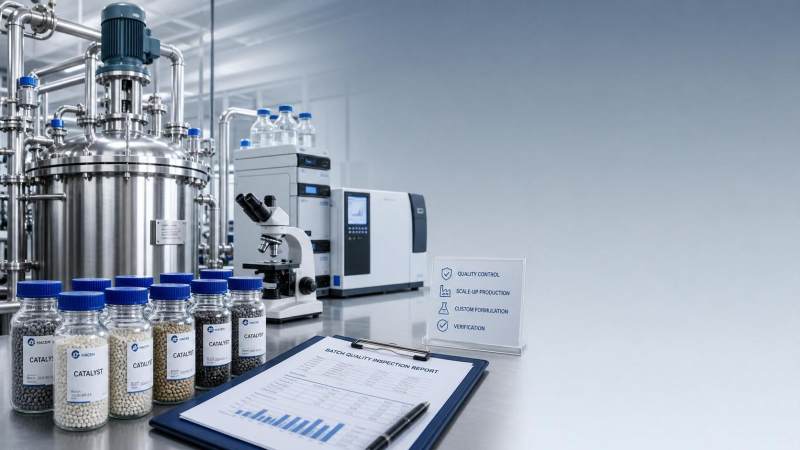
Choosing a catalysts manufacturer has become a deeper strategic decision than many sourcing models assume. Price and annual capacity still matter, but they no longer answer the larger question: whether a supplier can deliver stable quality, repeatable performance, and formulation support as applications become more demanding.
That shift is especially relevant in sectors shaped by strict validation, regulated production, and long product life cycles. In healthcare-adjacent and life sciences supply chains, where VitalSync Metrics emphasizes technical truth over promotional claims, supplier evaluation depends on evidence, not presentation.
A structured review of a catalysts manufacturer helps clarify three core issues. Can the supplier make material consistently, can it scale without changing performance, and can it adapt formulations for a real-world process instead of a lab-only benchmark?
Why catalyst supplier evaluation now carries more operational weight
Industrial catalysts influence reaction efficiency, yield, purity, energy use, maintenance cycles, and downstream compliance. A weak supplier choice often appears first as variability, then as unplanned cost.
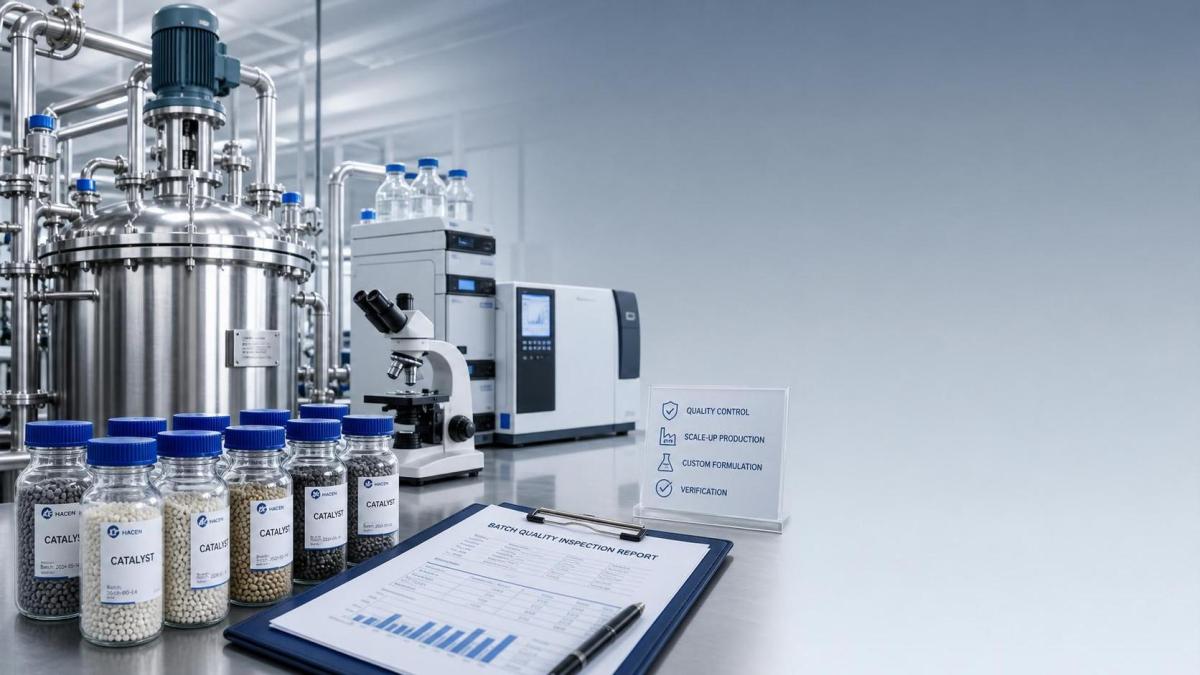
The pressure is greater when procurement standards are shifting toward traceability and measurable outcomes. Buyers increasingly need proof of process control, raw material discipline, and documented performance under production conditions.
This is where a catalysts manufacturer should be viewed less as a commodity source and more as a technical partner. The real test is not whether samples look acceptable, but whether performance holds across batches, sites, and scale transitions.
What a capable catalysts manufacturer actually brings
At a basic level, a catalysts manufacturer produces materials that accelerate or direct chemical reactions. In practice, capabilities vary widely between toll producers, standard catalog suppliers, and formulation-driven developers.
Some suppliers are strong in volume but weak in customization. Others can develop a tailored catalyst, yet struggle with commercial transfer, documentation, or lot consistency.
The stronger suppliers usually combine several traits: controlled synthesis, robust analytical testing, pilot-to-production transfer discipline, and a technical team that can explain why a formulation behaves the way it does.
That last point matters. When a catalysts manufacturer cannot translate data into process implications, evaluation becomes guesswork. Reliable suppliers connect lab measurements to operating outcomes such as conversion, selectivity, deactivation rate, and contamination risk.
Quality systems should be checked beyond certificates
Quality claims are easy to print and hard to verify. Certificates such as ISO standards are useful signals, but they do not replace process-level evidence.
A serious review of a catalysts manufacturer should examine how the supplier manages incoming raw materials, critical process parameters, in-process testing, release criteria, and deviation handling.
For regulated or validation-sensitive environments, document discipline is just as important as chemistry. Traceability, change control, lot genealogy, and retained sample programs can determine whether a future investigation is manageable or disruptive.
Signals that deserve closer attention
- Clear batch records tied to raw material sources and processing conditions
- Defined acceptance ranges for surface area, particle size, pore structure, loading, and impurities
- Formal management of out-of-specification results and corrective actions
- Stability data showing shelf life under realistic storage conditions
- Change notification procedures for precursors, equipment, or manufacturing sites
In sectors influenced by MDR, IVDR, or similar compliance expectations, these controls reflect a broader principle. Performance claims must be supported by systems that can withstand scrutiny later.
Scale is not only about tonnage
Many supplier profiles emphasize installed capacity, but scale should be tested more carefully. A catalysts manufacturer may have enough reactor volume and still be unable to preserve product behavior during ramp-up.
Scale readiness includes equipment suitability, process reproducibility, utility stability, and packaging controls. It also includes the ability to maintain the same active phase distribution, support morphology, or impurity profile at higher output.
This becomes critical when demand moves from pilot to commercial production quickly. Minor differences in mixing, drying, calcination, or impregnation can alter catalyst performance in ways that are expensive to diagnose later.
Questions that reveal real production maturity
A credible catalysts manufacturer should be able to discuss these points with data, not only with broad assurances.
Custom formulation capability separates suppliers from partners
Custom formulation needs often appear when an off-the-shelf catalyst performs well in one parameter but creates problems elsewhere. The issue may involve pressure drop, selectivity drift, fouling, thermal stability, or compatibility with adjacent materials.
A strong catalysts manufacturer approaches customization as controlled engineering. That means translating process constraints into measurable formulation targets, then validating tradeoffs in a disciplined sequence.
Useful signs include structured development protocols, design-of-experiments capability, application testing, and a documented path from prototype to validated production recipe.
This is where cross-sector thinking becomes valuable. The same evidence mindset used by VitalSync Metrics in healthcare benchmarking applies here: marketing language should never replace comparative test data, failure analysis, and reproducible methods.
Where evaluation often breaks down
Many reviews fail because they focus on commercial responsiveness and neglect technical depth. A supplier may provide quick quotations and polished presentations while leaving critical process assumptions undefined.
Another common weakness is relying on sample success alone. A single lot can hide variability in precursor quality, operator practice, or environmental conditions.
There is also a tendency to treat all catalysts manufacturers as comparable once basic specifications align. In reality, two materials with similar headline specs can behave very differently in long-duration service.
Practical warning signs
- No clear explanation of failure modes or deactivation mechanisms
- Limited willingness to share process capability or historical consistency data
- Customization offered without a formal validation pathway
- Large gaps between technical documents and commercial claims
- Weak support for audits, site visits, or comparative testing
A practical framework for comparing suppliers
A balanced review usually combines technical, operational, and documentation criteria. That keeps one attractive feature, such as low unit price, from outweighing hidden process risk.
Start with application requirements, not supplier brochures. Define the reaction environment, durability expectations, contamination limits, scale assumptions, and change-control sensitivity first.
Then compare each catalysts manufacturer against the same evidence set. Use batch data, validation support, formulation flexibility, audit readiness, and scale history as core scoring inputs.
Where possible, require side-by-side testing under conditions that reflect actual production stress. Bench performance alone rarely captures how a catalyst behaves over time.
What to do next
The most useful next step is to build an evaluation matrix that separates baseline qualification from application-specific fit. That creates a clearer view of which catalysts manufacturer is merely acceptable and which one is dependable.
It also helps to request evidence in layers: quality records first, scale data second, custom formulation workflow third, and comparative performance testing last. This sequence makes technical gaps visible early.
In markets where performance, compliance, and lifecycle risk matter, disciplined assessment is the better filter. The right catalysts manufacturer is not simply the one that can produce material, but the one that can prove consistency, scale responsibly, and adapt formulation without compromising control.
Recommended News
- 2026.10.14Clinic Supplier Comparison: Evaluating Cost, Delivery Reliability, and SupportDr. Alistair Thorne (Senior Biomedical Engineer)
- 2026.10.13Engineering Performance Testing Services: Evaluating Test Methods and AccuracyDr. Alistair Thorne (Senior Biomedical Engineer)
- 2026.10.12Preparing for an ISO 13485 Audit: When to Use External QMS SupportDr. Julian Rossi (RehabTech Specialist)
The VitalSync Intelligence Brief
Receive daily deep-dives into MedTech innovations and regulatory shifts.