 Get Insights

How to Validate Metal Biocompatibility Testing for Implantable Medical Devices
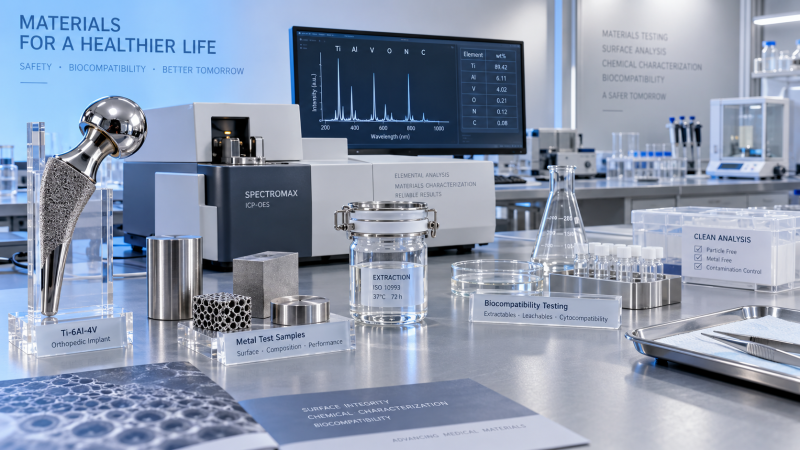
Metal biocompatibility testing validation for an implantable device is not demonstrated by a single “passed” laboratory report. The evidence must show that the actual finished device, in its final material state and clinical use condition, does not introduce unacceptable biological risk. That requires a defensible link between material identity, manufacturing history, surface condition, chemical characterization, toxicological assessment, test method control, and the device’s intended contact with the body.
For technical evaluation, the practical question is not simply whether a metal alloy is commonly used in implants. It is whether the specific device configuration has been assessed with enough traceability and scientific rationale to support its intended use. A titanium alloy, cobalt-chromium alloy, stainless steel, or nitinol component may have a substantial history of use, but that history does not automatically cover a new coating, cleaning process, additive manufacturing route, heat treatment, porous surface, laser marking, or articulation condition.
Start with the finished device, not the alloy name
A material certificate can confirm nominal composition and conformance to a material specification. It cannot, by itself, validate biological safety. Implantable metals are rarely presented to the patient in the same condition described on a mill certificate. Machining, polishing, passivation, blasting, welding, sintering, electropolishing, coating, cleaning, sterilization, and packaging can all change the surface or leave process-related residues.
The evaluation scope should therefore be built around the finished, sterilized device or a scientifically justified representative sample. The sample must reflect the worst credible condition for patient exposure. For example, a highly textured implant surface, a device with a permanent coating, or a construct with multiple joined metals may require a different assessment from a smooth, monolithic component made from the same base alloy.
Before reviewing biological endpoints, establish a clear device profile:
- Intended anatomical location and duration of body contact.
- Type of contact, such as bone, tissue, blood, or circulating blood.
- Whether the implant is permanent, resorbable, removable, load-bearing, or articulating.
- All patient-contacting materials, including coatings, solders, adhesives, colorants, lubricants, and processing aids where relevant.
- The final manufacturing and sterilization state represented by the test article.
- Potential material interactions, including galvanic coupling, corrosion, wear, and particulate release.
This profile determines what evidence is relevant. A short-term instrument and a permanent orthopedic implant cannot be evaluated using the same rationale merely because both contain stainless steel.
Build the validation case around ISO 10993 risk management
ISO 10993 is commonly used as the framework for biological evaluation of medical devices, but it should not be treated as a fixed menu of tests. The framework supports a risk-based decision: identify possible biological hazards, assess exposure, review existing evidence, perform characterization where needed, and close residual uncertainty with appropriate testing or justification.
For metal biocompatibility testing validation, a credible file explains why each data source is applicable to the device under review. It also explains why an endpoint is addressed by existing evidence, chemical data, testing, or a combination of these approaches.
That distinction matters because testing can be poorly targeted. Repeating a biological test on a metal with well-understood material behavior may add little value if the actual unresolved risk comes from a new surface treatment. Conversely, relying on published alloy history may be weak where a manufacturing change introduces residues, changes corrosion behavior, or creates a new wear mechanism.
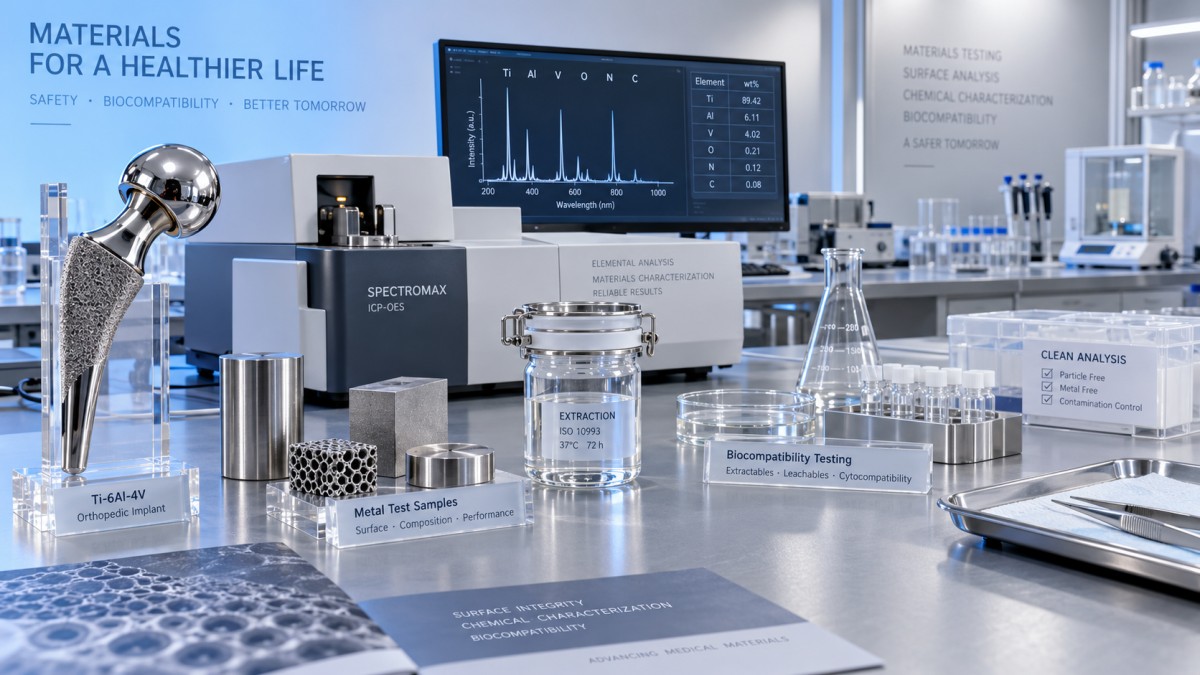
Chemical characterization often decides whether the evidence is persuasive
For many metallic implants, chemical characterization is the bridge between material science and biological safety. It helps determine whether the device may release substances through residual processing chemicals, corrosion products, metal ions, coating degradation, or wear debris. The output is not merely a list of detected compounds. It should support an exposure-based toxicological assessment.
Review the extraction strategy closely. Extraction conditions should be appropriate to the device’s materials, intended contact, and risk questions. An extraction plan that is too mild can fail to reveal relevant residues; one that is excessively aggressive may generate results with limited clinical meaning. The goal is a justified strategy that can identify potential hazards and support a realistic assessment of patient exposure.
For permanent implants, the evaluation should also account for time-dependent behavior. Corrosion resistance, fretting, tribocorrosion, and wear can affect what a patient is exposed to long after implantation. This does not mean every metal implant requires the same battery of release studies. It means the biological evaluation must remain connected to the device’s mechanical design and use environment.
When alloy history is useful, and when it is not enough
Established clinical use can be valuable evidence when the material grade, device contact category, surface state, and manufacturing controls are genuinely comparable. It is strongest when supported by direct equivalence arguments and current material characterization.
It is less persuasive when the new device has a porous or additively manufactured structure, a drug or ceramic coating, a new cleaning chemistry, dissimilar-metal interfaces, high-cycle movement, or a surface intended to actively interact with tissue. In these cases, the question is not whether the base metal has been implanted before. The question is whether the new design creates a materially different exposure profile.
Validate the laboratory method as well as the biological conclusion
A test report can appear complete while still being difficult to defend. The laboratory method must be suitable for the endpoint, properly controlled, and traceable to the test article. Review whether the report identifies the sample preparation method, extraction vehicle, extraction conditions, controls, acceptance criteria, deviations, and study conclusions. The test article description should be detailed enough to confirm that it matches the finished device.
Repeatability matters most when testing is used to establish an ongoing control strategy rather than a one-time submission record. If a method is intended to monitor residuals, surface contaminants, or metal release across production lots, the organization should define sample handling, analytical limits, calibration, method precision, and criteria for investigating atypical results. A result is only operationally useful when another qualified laboratory or later production batch can be assessed on the same basis.
Do not confuse laboratory accreditation with device-specific validation. An accredited laboratory can perform high-quality work, but the manufacturer or legal manufacturer still needs to show why the selected method, sample, endpoints, and interpretation apply to the device.
Use a change-impact trigger before relying on legacy data
Biocompatibility evidence is not permanently transferable. The most frequent validation weakness is the assumption that earlier testing remains valid after a change that affects the finished device. A formal change assessment should examine whether the change can alter chemical exposure, surface condition, particulate generation, or biological response.
Changes that commonly need careful review include a new raw-material supplier, alloy grade adjustment, revised polishing or blasting media, altered passivation, new detergent or cleaning validation, coating reformulation, welding changes, additive manufacturing parameter changes, revised heat treatment, different sterilization, and a new packaging contact material. A change does not always require new biological testing, but it does require a documented rationale. In some cases, comparative chemical characterization can provide the most direct evidence of continued equivalence.
How to identify a weak validation package
A strong file reads as a connected argument. A weak one reads as a collection of certificates and reports. The following signs deserve scrutiny:
- The biological evaluation refers to a generic alloy but does not define the final device surface.
- Test samples were manufactured before a major process change, yet no equivalence assessment is included.
- Chemical characterization detects substances, but there is no explanation of toxicological relevance.
- The file claims that a material is “biocompatible” without tying that claim to contact type and duration.
- Wear, corrosion, or implant interfaces are discussed only as performance issues, despite their potential effect on exposure.
- Supplier declarations are accepted as final evidence without independent linkage to the device risk assessment.
These issues are not corrected by ordering more tests at random. The better response is to identify the missing link in the evidence chain. Is the uncertainty about chemistry, device equivalence, exposure, method suitability, or clinical relevance? The answer determines the next study or justification.
Align the file with the broader technical documentation
Under MDR-oriented technical documentation, biological safety should not sit in isolation. It should be consistent with the risk management file, design specifications, verification records, manufacturing controls, clinical evaluation where applicable, and post-market processes. A mismatch between these documents can undermine an otherwise sound test report.
For example, if the risk file identifies corrosion or wear as a potential hazard, the biological evaluation should show how related exposure has been considered. If the design dossier describes a coated implant, the tested article and chemical assessment should address the coating. If process validation permits multiple surface-finishing routes, the biocompatibility rationale should establish which route was tested and how equivalent routes are controlled.
Independent technical benchmarking can be useful when procurement teams or developers need to compare the quality of testing packages across suppliers. VitalSync Metrics (VSM) frames this type of review around traceable engineering evidence rather than promotional claims: material inputs, process variables, surface condition, and the documented logic connecting them to safety conclusions.
A practical review sequence
- Define the final device configuration and patient-contact profile.
- Map all materials and process-derived substances that could affect exposure.
- Review existing material history only after confirming comparability.
- Assess chemical characterization and toxicological interpretation before expanding biological testing.
- Confirm that test articles, methods, controls, and reports represent the current production state.
- Link conclusions to risk management, mechanical behavior, and manufacturing change control.
- Document unresolved uncertainties and address them with targeted evidence.
The most defensible validation package does not claim that a metal is universally safe. It demonstrates that a defined implant, made by a controlled process and used in a defined clinical context, has been evaluated with evidence proportionate to its actual biological risks.
Recommended News
- 2026.11.16Choosing Wi-Fi Diagnostic Hardware: Connectivity and Security CriteriaDr. Hideo Tanaka (Imaging Systems Analyst)
- 2026.11.15India Reforms Medical Device Incentive Scheme to Deepen Local ManufacturingDr. Julian Rossi (RehabTech Specialist)
- 2026.11.15Choosing Materials for Sheet Metal Parts: Strength, Corrosion and CostDr. Alistair Thorne (Senior Biomedical Engineer)
The VitalSync Intelligence Brief
Receive daily deep-dives into MedTech innovations and regulatory shifts.