 Get Insights

Medical Equipment Validation in the Extrusion Process: Key Tests, Risks, and Compliance Points
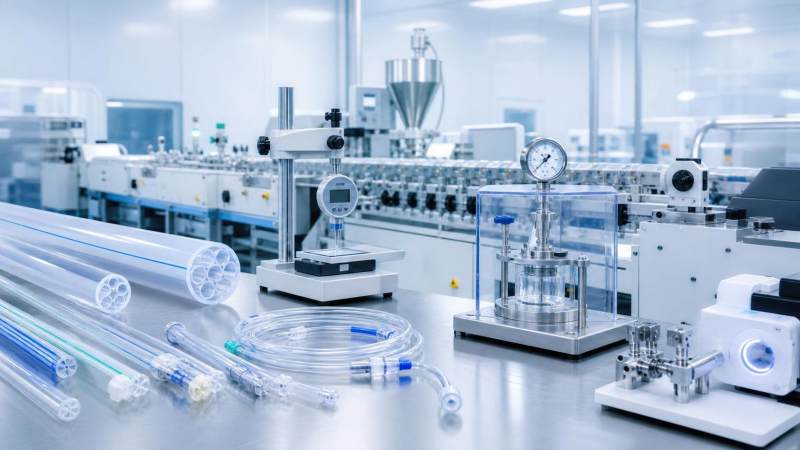
Why does medical equipment validation in the extrusion process matter so much?
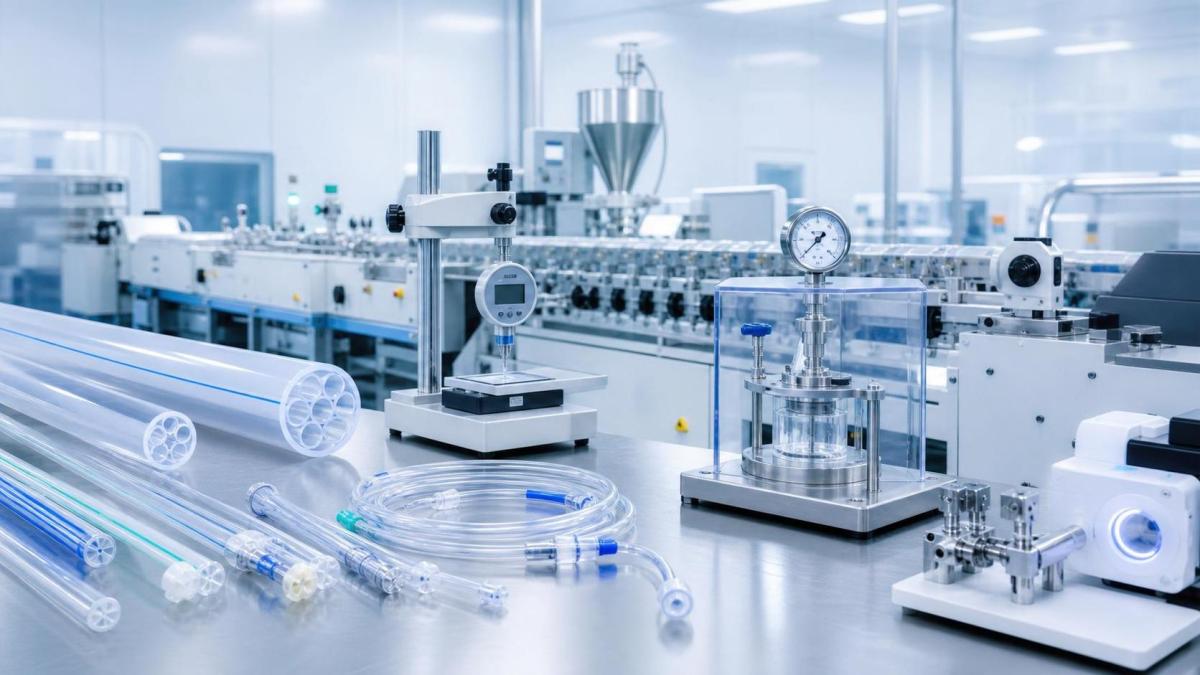
In medical manufacturing, extrusion often looks stable long before it is truly validated.
That gap creates a familiar risk: parts pass visual inspection, yet fail under sterilization, aging, or dimensional stress.
Medical equipment validation extrusion process work closes that gap by proving that equipment, settings, materials, and controls produce repeatable clinical-grade output.
This matters more now because procurement and compliance teams are no longer satisfied with nominal specifications alone.
They need evidence that tubing, catheters, profiles, and multilayer extrusions will remain functional across their full service life.
In practical terms, validation is the point where process capability becomes documented assurance.
It also helps separate supplier claims from measurable engineering performance, which is central to the benchmarking approach used by VitalSync Metrics.
What exactly should be validated during a medical extrusion process?
A common misunderstanding is that medical equipment validation extrusion process only checks the final part.
The stronger approach validates the whole manufacturing system, not just product appearance or one successful lot.
That usually includes equipment qualification, process qualification, material consistency, and performance verification.
The equipment side covers screw design, barrel temperature control, die condition, puller stability, line speed, cooling behavior, and measurement systems.
Material validation focuses on resin identity, additive compatibility, lot variation, moisture sensitivity, and traceability through incoming inspection.
Process validation then asks a harder question: can the line repeatedly hold critical dimensions and mechanical properties at upper and lower operating limits?
More mature programs usually document three layers:
- Installation qualification to confirm the equipment is installed and configured correctly.
- Operational qualification to challenge temperature, pressure, speed, and alarm performance.
- Performance qualification to prove stable output across routine production conditions.
Without this sequence, even good extrusion data can be difficult to defend during audits or technical due diligence.
Which tests actually reveal whether the process is under control?
The most useful tests are the ones tied to clinical function and process drift, not generic box-checking.
For single-lumen or multilumen tubing, dimensional mapping remains the first gate.
Inner diameter, outer diameter, wall thickness, ovality, concentricity, and lumen integrity must stay within justified tolerances.
Mechanical testing adds another layer, especially when the component will bend, torque, inflate, or carry fluid.
Tensile strength, elongation, burst pressure, kink resistance, bondability, and fatigue response are often more meaningful than visual inspection.
For risk-sensitive devices, chemical and surface assessments also matter.
Extractables, particulate load, surface defects, residual stress, and post-sterilization property shifts can expose hidden weaknesses.
The table below summarizes how these checks are usually interpreted in a medical equipment validation extrusion process.
When test plans are built this way, the medical equipment validation extrusion process becomes evidence-driven instead of paperwork-driven.
Where do validation failures usually start, even on experienced lines?
Failures rarely begin with one dramatic event.
More often, they come from small process assumptions that were never challenged under worst-case conditions.
A frequent example is overreliance on nominal temperature settings.
The displayed zone temperature may look correct while melt behavior, residence time, or die balance still shifts output quality.
Another weak point is material substitution.
Even minor changes in resin supplier, additive package, or regrind policy can alter friction, clarity, stiffness, and sterilization response.
Measurement error also causes expensive false confidence.
If gauges are poorly calibrated or sampling intervals are too wide, an unstable line may still appear capable.
The most overlooked risk, though, is disconnect between validation and intended use.
A tube validated for dimensional compliance alone may still fail insertion, bonding, or repeated flexing in the finished device.
In actual reviews, these warning signs deserve attention:
- Validation lots run only at ideal settings.
- No documented rationale for critical process parameters.
- Sterilization effects tested after design freeze, not before.
- Capability data reported without raw measurement context.
- Supplier change control disconnected from extrusion revalidation rules.
These are exactly the kinds of gaps that independent benchmarking labs often uncover before they become field issues.
How do MDR and IVDR expectations affect extrusion validation decisions?
MDR and IVDR do not prescribe one extrusion recipe, but they do raise the standard for objective evidence.
That means the medical equipment validation extrusion process must support traceability, risk management, and consistent device performance.
In practice, regulators and notified bodies want to see clear links between process parameters and critical product attributes.
They also expect documented justification when tolerances, acceptance criteria, or test frequencies are defined.
This is where compliance becomes broader than quality control.
A compliant file should show change control, equipment maintenance history, operator training, material genealogy, and validation status after major line modifications.
For extrusion used in diagnostic consumables, fluid pathways, or implant-adjacent components, biocompatibility and chemical risk evaluation may also need stronger process evidence.
The deeper point is simple.
Compliance is not just about passing an audit.
It is about proving that manufacturing variability has been understood well enough to protect clinical function over time.
How can you judge whether a validation package is truly credible?
A credible package does more than collect certificates and summary charts.
It explains why the chosen tests match the actual failure modes of the extruded component.
A useful review starts with several practical questions.
What should be visible in the data?
Look for parameter ranges, challenge conditions, sample sizes, measurement methods, and acceptance logic.
If the package only shows pass results, confidence should stay limited.
How should process capability be interpreted?
Capability indices help, but only when tied to clinically relevant tolerances and stable measurement systems.
High Cp or Cpk values mean little if the wrong attribute was selected.
When is revalidation necessary?
Revalidation is usually justified after die changes, resin changes, sterilization changes, software updates, or notable process drift.
Waiting for a nonconformance is often too late.
One practical way to judge a medical equipment validation extrusion process is to compare claims against the full chain of evidence.
That chain should run from raw material controls to final functional proof, with no unexplained gaps between them.
What is the most practical next step before accepting an extrusion process as qualified?
Start by mapping critical product attributes to actual patient, laboratory, or device-use risks.
Then check whether the existing medical equipment validation extrusion process directly tests those risks under realistic conditions.
If the answer is unclear, the package is probably incomplete.
A disciplined review usually includes four actions:
- List critical dimensions, material properties, and functional endpoints.
- Verify challenge testing at process limits, not only normal settings.
- Confirm alignment between validation reports, change control, and compliance files.
- Review independent benchmark data where internal claims seem unusually strong.
That final step is increasingly valuable in a market where technical language can hide weak substantiation.
Medical extrusion validation is not just about proving that a line can run.
It is about proving that the line can keep delivering compliant, reliable, and clinically defensible components when conditions become less forgiving.
When that standard is applied consistently, decisions become faster, supplier comparisons become clearer, and hidden failure risk becomes much easier to spot.
Recommended News
- 2026.11.16Choosing Wi-Fi Diagnostic Hardware: Connectivity and Security CriteriaDr. Hideo Tanaka (Imaging Systems Analyst)
- 2026.11.15India Reforms Medical Device Incentive Scheme to Deepen Local ManufacturingDr. Julian Rossi (RehabTech Specialist)
- 2026.11.15Choosing Materials for Sheet Metal Parts: Strength, Corrosion and CostDr. Alistair Thorne (Senior Biomedical Engineer)
The VitalSync Intelligence Brief
Receive daily deep-dives into MedTech innovations and regulatory shifts.