 Get Insights

How Carbon Fiber Sensor Orthotics Measure Gait Changes for More Precise Support
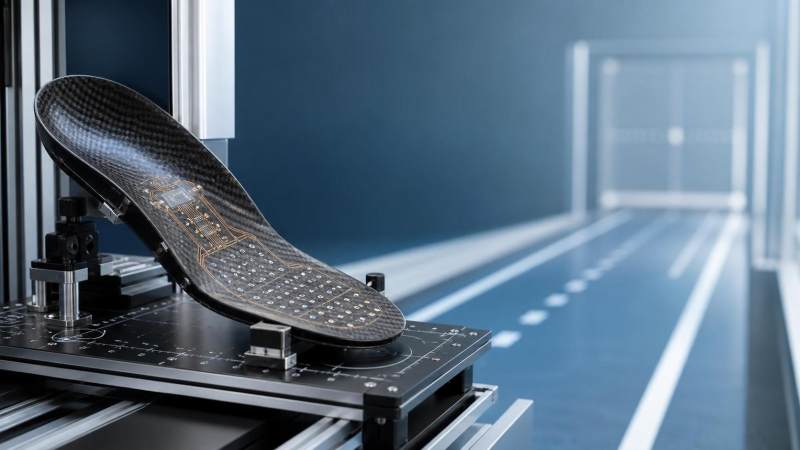
When an orthotic is evaluated only in a static stance, much of the clinically relevant story remains hidden. A foot that appears well supported on a bench may still drift into excessive pronation during late stance, unload a painful metatarsal head too slowly, or create an abrupt pressure transfer at toe-off. These events occur in fractions of a second and under changing loads. For technical evaluators, that is the central reason carbon fiber sensor orthotics deserve closer scrutiny: they turn an orthopedic component into a measurement platform.
Carbon fiber sensor orthotics combine a composite support structure with embedded or integrated sensing elements that capture aspects of gait in motion. Depending on the architecture, the system may measure plantar pressure, local strain, bending response, acceleration, angular motion, or timing across gait phases. The resulting data can inform support tuning more precisely than subjective comfort feedback or a single static pressure map alone.
The promise is not that every sensor-equipped orthotic automatically delivers better outcomes. Precision depends on how well the sensing system survives repeated loading, how signals are calibrated, how data are interpreted, and whether the measured variables actually correspond to the support decision being made. For procurement teams, laboratory architects, and MedTech evaluators, the engineering questions matter as much as the clinical narrative.
Why carbon fiber changes the measurement conversation
Carbon fiber is not simply a premium substitute for conventional orthotic materials. Its value lies in its high stiffness-to-weight ratio, directional mechanical behavior, and capacity to form thin structural elements with controlled flex characteristics. A well-designed laminate can resist deformation in one region while allowing a measured degree of energy return or bending elsewhere.
That mechanical behavior matters because an orthotic sensor does not operate in isolation. Its readings are influenced by the structure carrying it. If the substrate deforms unpredictably, a pressure or strain output may reflect material instability rather than a meaningful change in gait. Carbon fiber’s repeatable structural response can create a more stable platform for sensing, particularly where localized reinforcement, arch support, forefoot lever action, or rearfoot control is required.
There is also a design trade-off. Carbon fiber is anisotropic: its response changes with fiber orientation, layup sequence, resin system, thickness, and geometry. A sensor positioned on a flexing zone may experience very different strain fields after a small modification to the laminate. Technical teams should therefore avoid treating “carbon fiber” as a single material property. The orthotic’s mechanical map—where it bends, where it remains rigid, and how it couples with the shoe—is part of the measurement model.
What carbon fiber sensor orthotics can actually measure
The phrase carbon fiber sensor orthotics covers several distinct architectures. Evaluators should identify the sensing principle before comparing specifications or reviewing performance claims.
- Plantar pressure arrays use distributed sensing cells to estimate how load is applied across the sole. They are useful for identifying peak-loading regions, center-of-pressure progression, contact timing, and left-right asymmetry.
- Strain-based systems place gauges, piezoresistive elements, or fiber-optic sensing paths within or beneath the composite structure. Rather than measuring plantar force directly, they detect structural deformation associated with load transfer.
- Inertial measurement units (IMUs) may be integrated into the orthotic or paired with it. Accelerometers and gyroscopes can support estimation of cadence, stance duration, swing timing, foot orientation, and event detection.
- Hybrid systems combine pressure, strain, and inertial data. Their potential advantage is not merely “more data,” but cross-checking: pressure can indicate contact, while inertial motion can help distinguish a genuine gait event from a transient impact or sensor artifact.
Each modality answers a different question. A pressure map may show that medial forefoot loading is elevated, but it cannot by itself explain whether the driver is altered tibial progression, shoe instability, hallux limitation, or an orthotic edge that changes rollover timing. A strain signal may show that the carbon plate bends more under fatigue or at higher walking speed, yet it does not reveal the exact plantar region receiving the transferred load. Meaningful assessment begins by matching the sensor output to the intended engineering or clinical decision.
From a footfall to an interpretable support adjustment
A typical measurement cycle starts before the user walks. The orthotic must be fitted within a representative shoe, because shoe volume, midsole compliance, heel counter geometry, and lacing tension can materially alter sensor readings. Once the device is seated and the user begins a defined activity, the sensing layer samples load or deformation over successive gait cycles.
Raw signals then require conditioning. This may include baseline correction, filtering of electrical noise, synchronization between channels, detection of stance and swing, and normalization to body mass, walking speed, or both. Without normalization, a higher peak signal may simply reflect faster walking or a heavier test subject rather than a clinically significant support difference.
The most useful output is often a trend rather than a single measurement. Consider a user with discomfort under the second metatarsal head. A technical team may compare repeated walking trials before and after a metatarsal accommodation or change in forefoot stiffness. Relevant observations could include the magnitude and duration of loading in that region, the timing of load migration toward the hallux, and whether compensatory loading rises elsewhere. An apparent reduction in one area is not automatically a success if it introduces a new concentrated load at the lateral forefoot.
This is where dynamic data can make support more precise. Instead of asking only, “Did pressure decrease?” the evaluator can ask, “At what phase did the load shift, how consistently did it shift, and did the new configuration preserve a stable rollover pattern?” The distinction is important when translating measurement into an orthotic modification.
Signal quality is a system property, not a sensor datasheet value
Technical reviews often focus on sensor count, nominal resolution, or sampling rate. These figures are relevant, but they do not independently establish measurement quality. A dense pressure array can still produce weak evidence if its cells drift under temperature changes, if the device wrinkles inside the shoe, or if the algorithm applies aggressive smoothing that obscures short-duration peaks.
For carbon fiber sensor orthotics, signal quality should be examined across the complete assembly:
- Mechanical coupling: Is the sensor positioned so that it receives meaningful loading, or is it partly isolated by cushioning layers, adhesives, top covers, or air gaps?
- Repeatability: Do repeated trials under comparable conditions produce acceptably consistent timing and load patterns?
- Cross-talk: Does force applied in one region incorrectly elevate neighboring channels or distort strain readings elsewhere in the plate?
- Dynamic range: Can the system resolve low-load gait phases while avoiding saturation during heel strike, stair descent, or higher-impact activity?
- Latency and synchronization: If the device is combined with video, force plates, or IMUs, are timestamps aligned well enough for phase-level interpretation?
- Data completeness: How are dropouts, wireless interruptions, battery-related behavior, and invalid trials identified and documented?
Noise should not be confused with clinically meaningful variability. Real gait is variable, especially in pain, neurologic impairment, fatigue, and uneven walking environments. The goal is not to force every stride into a smooth pattern; it is to distinguish natural biological variation from electronic, mechanical, or processing artifacts.
Calibration is where many promising systems become difficult to trust
Calibration links a sensor output to a physical quantity. In a pressure-based device, this usually means relating electrical response to applied force or pressure under specified loading conditions. In strain-based carbon fiber designs, calibration may relate a change in resistance, optical signal, or other output to a known deformation or applied load.
Yet an orthotic rarely experiences loading in the tidy, perpendicular manner used in a bench test. Walking introduces shear, changing contact areas, temperature shifts, bending, torsion, and repeated impacts. A system calibrated only with uniform vertical loads may look accurate in the laboratory but behave differently in footwear during actual gait.
A robust validation plan should therefore include more than a one-time factory calibration. Evaluators should ask whether calibration is device-specific or batch-level; whether zeroing occurs before each session; how temperature and humidity are handled; and whether performance is checked after flexing, trimming, top-cover replacement, or prolonged use. If a carbon composite is modified to fit a patient or shoe, the mechanical relationship between sensor and structure may also change.
Reference comparison is equally important. Depending on the intended use, data may be compared with force platforms, instrumented treadmills, validated in-shoe systems, motion capture, or controlled mechanical fixtures. No reference method is perfect, but the comparison method should be appropriate to the claim. A device intended to identify broad loading trends requires different evidence from one intended to quantify localized peak pressure with narrow tolerances.
Durability: the quiet determinant of longitudinal usefulness
A short walking demonstration can be persuasive. Longitudinal reliability is harder to establish. Carbon fiber structures are often valued for fatigue resistance, but durability in sensor orthotics depends on the entire stack: fibers, resin matrix, sensor encapsulation, conductive traces, bonding layers, connectors, protective top cover, and charging or transmission hardware.
Repeated gait loading can create microcracks in resin-rich regions, delamination around transitions, wear at the forefoot edge, and damage where cables or rigid electronics meet a flexing substrate. Sweat and cleaning agents introduce additional environmental stress. Even modest changes in stiffness can affect both patient experience and sensor interpretation, because the support itself is part of the loading pathway.
Useful durability evidence includes cyclic loading under representative bending and compression, post-cycle calibration checks, inspection for delamination or signal drift, and testing in realistic thermal and moisture conditions. It is also worth examining what happens after ordinary clinical handling: insertion into tight footwear, removal, cleaning, and adjustment. A design that performs well only when untouched on a laboratory fixture has limited practical value.
How to evaluate measurement claims without overreaching
Dynamic orthotic data can support better decisions, but they should not be used to imply diagnostic certainty beyond the device’s validation. A pressure change is not, by itself, a diagnosis. Nor does a symmetrical trace necessarily mean that gait is healthy. People may compensate efficiently for a structural limitation, while others may display asymmetry for reasons unrelated to the orthotic.
Technical evaluators can reduce overinterpretation by defining the intended use in advance. Is the device being assessed for design verification, comparative prototyping, clinician-guided tuning, research data collection, remote monitoring, or routine feedback? The required level of accuracy, traceability, cybersecurity, data governance, and regulatory documentation will differ across those use cases.
For systems entering regulated workflows, requirements should be mapped early to the applicable jurisdiction and intended claims. In European contexts, this may involve considering the relevance of MDR obligations for medical devices, software qualification questions, clinical evaluation expectations, risk management, usability, and post-market processes. A sensor feature should not be assumed to be incidental simply because it is embedded in an orthotic; its role in decision-making may change the compliance discussion.
A practical technical review framework
Before selecting or benchmarking a carbon fiber sensor orthotic platform, ask for a concise evidence package rather than a broad collection of promotional metrics. The package should explain the sensor architecture, sampling method, calibration workflow, test conditions, uncertainty limits, failure modes, expected service life, and data export options. It should also state what the system does not measure.
At VitalSync Metrics, this kind of assessment is approached as an engineering traceability problem. A credible platform should allow reviewers to follow the chain from material layup and sensor integration to raw signal behavior, processing assumptions, and final reported metrics. That chain is what enables procurement and development teams to compare systems on technical integrity rather than visual polish or isolated headline specifications.
The strongest carbon fiber sensor orthotics do not replace clinical judgment, gait laboratories, or careful fitting. They add a missing layer of evidence between the orthotic design and the moving person wearing it. When material behavior, signal quality, calibration, and durability are evaluated together, the result is more than a smarter insole. It is a defensible way to measure whether support is changing gait in the direction it was intended to change.
Recommended News
- 2026.10.14Clinic Supplier Comparison: Evaluating Cost, Delivery Reliability, and SupportDr. Alistair Thorne (Senior Biomedical Engineer)
- 2026.10.13Engineering Performance Testing Services: Evaluating Test Methods and AccuracyDr. Alistair Thorne (Senior Biomedical Engineer)
- 2026.10.12Preparing for an ISO 13485 Audit: When to Use External QMS SupportDr. Julian Rossi (RehabTech Specialist)
The VitalSync Intelligence Brief
Receive daily deep-dives into MedTech innovations and regulatory shifts.