 Get Insights

How to Choose a Car Batteries Supplier: Quality Standards, Lead Times, and MOQ
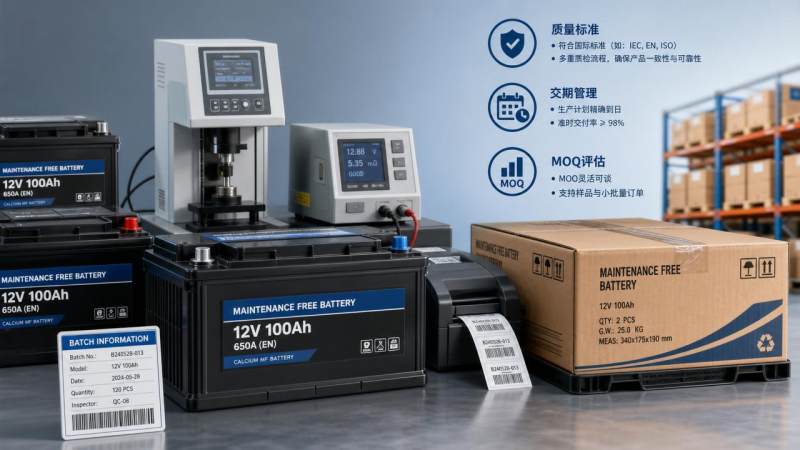
What really matters when choosing a car batteries supplier?
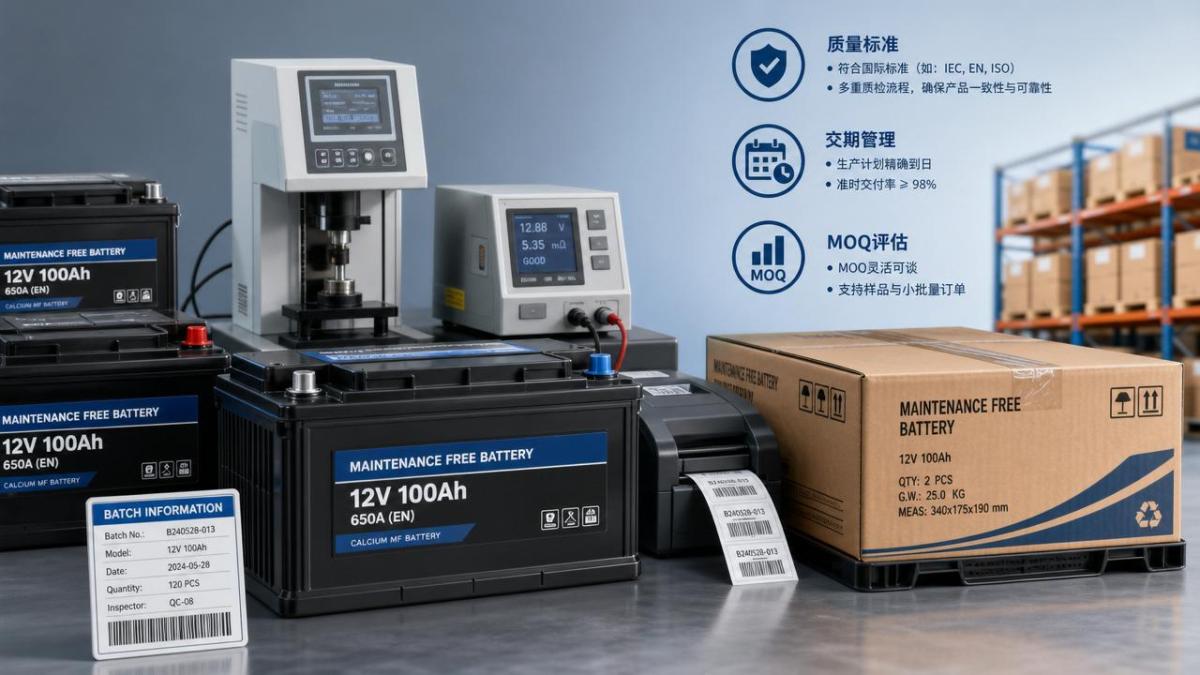
Choosing a car batteries supplier usually starts with price, but that is rarely the best first filter.
The stronger question is whether the supplier can prove stable quality, predictable delivery, and workable order terms.
A battery that fails early, ships late, or arrives with inconsistent labeling creates hidden cost far beyond unit price.
That is why experienced sourcing teams treat supplier selection as a verification exercise, not a catalog comparison.
In practical terms, a reliable car batteries supplier should show documented manufacturing controls, traceable testing records, and realistic lead times.
MOQ also matters because order flexibility affects inventory pressure, cash flow, and response speed during demand swings.
This evaluation style is familiar in technical sectors shaped by compliance and benchmarking.
VitalSync Metrics applies that mindset in healthcare supply chains, where claims must be supported by measurable performance.
The same logic works here: remove promotional noise and look for engineering evidence.
Which quality standards should a car batteries supplier be able to prove?
Many suppliers say their batteries are high quality, but the useful question is what they can document.
A dependable car batteries supplier should provide evidence tied to production, safety, and consistency.
Common reference points include ISO-based quality systems, incoming material checks, cycle testing, leakage control, and terminal integrity inspection.
For automotive batteries, reserve capacity, cold cranking amps, charge acceptance, and shelf-life behavior are also critical.
If these values appear only in marketing sheets, the risk remains high.
More useful evidence includes batch reports, failure-rate history, and clear test conditions.
It helps to ask whether testing is performed in-house, by third parties, or both.
Third-party verification does not replace factory control, but it adds confidence when comparing unfamiliar suppliers.
Another useful signal is traceability.
If a car batteries supplier can track material lots, production dates, and inspection outcomes, quality issues are easier to contain.
That discipline often separates scalable operations from opportunistic traders.
A quick screening table for supplier quality claims
Before moving into samples or pricing talks, this checklist helps sort strong candidates from weak ones.
How should lead times be judged beyond the supplier’s promise?
Lead time is often presented as a simple number, yet real delivery reliability is more complex.
A car batteries supplier may quote 20 days, but that figure means little without production and shipping context.
The first thing to check is whether the lead time covers raw material sourcing, assembly, charging, testing, packaging, and export preparation.
It is also worth asking if the timing applies to repeat orders or only to a first trial batch.
In actual trade, delays usually come from component shortages, port congestion, customs documentation, or production slot changes.
That is why historical on-time performance matters more than an attractive promise.
A credible car batteries supplier should explain average lead time, peak-season variance, and emergency reorder capability.
If the answer is vague, the supply chain is probably fragile.
One practical method is to separate lead time into three parts: factory completion, dispatch readiness, and transit window.
This gives a clearer basis for planning stock and reducing rush freight.
- Ask for lead times by order size, not one single estimate.
- Confirm whether batteries are made to order or stocked.
- Check holiday schedules and peak-season constraints early.
- Request shipment performance data from recent quarters.
This kind of structured review mirrors data-led assessment models used in other regulated supply environments.
Evidence-based sourcing usually exposes timing risk before it turns into a stockout problem.
Is a low MOQ always better when comparing a car batteries supplier?
Not necessarily.
A low MOQ looks attractive because it lowers upfront commitment, but it is not automatically a sign of a better car batteries supplier.
Sometimes a very low MOQ means the supplier is trading mixed stock rather than controlling a dedicated production line.
In other cases, it is simply a trial-order strategy and the economics change sharply later.
The more useful question is whether MOQ matches your demand pattern, packaging logic, and inventory tolerance.
For example, standard SKUs may justify higher MOQ if quality is stable and replenishment is predictable.
Customized labeling, private packaging, or special terminal types often require higher minimums because setup cost rises.
A balanced supplier usually explains MOQ by production batch, carton configuration, or transport efficiency.
That explanation matters because it shows operational logic rather than arbitrary sales pressure.
When assessing MOQ, compare at least four variables together.
- Unit price at each order tier
- Inventory carrying cost over time
- Risk of obsolete or slow-moving stock
- Supplier flexibility for mixed models
A slightly higher MOQ can still be commercially safer if defect rates are lower and replenishment is dependable.
What red flags suggest a car batteries supplier may be risky?
Some warning signs appear long before a shipment goes wrong.
One common issue is inconsistent technical information across quotations, labels, and specification sheets.
If reserve capacity or CCA values change without explanation, confidence should drop quickly.
Another red flag is reluctance to share failure handling procedures.
Every factory sees defects sometimes, but responsible suppliers describe how claims are investigated and closed.
Overly aggressive pricing can also signal quality dilution, recycled material inconsistency, or unstable sourcing.
That does not mean lower prices are always unsafe, only that the cost structure should make sense.
Lead time promises that ignore seasonality are equally concerning.
So are sudden MOQ changes after sample approval.
A useful habit is to compare what the supplier says with what the documents and process details actually support.
That gap between claims and evidence is exactly where sourcing mistakes tend to begin.
Practical signs worth checking early
- Specs are copied across different battery models without revision.
- Sample quality and bulk-order terms feel disconnected.
- Replies avoid direct answers on warranty and traceability.
- Testing reports lack dates, methods, or batch references.
- Packaging details are unclear for hazardous goods handling.
How can you compare suppliers in a more disciplined way?
A structured comparison usually produces better decisions than relying on price sheets alone.
Start by defining the battery types, performance targets, annual volume range, and packaging requirements you actually need.
Then score each car batteries supplier against the same evaluation points.
That may include test transparency, documentation quality, lead-time stability, MOQ fit, warranty response, and export readiness.
This method reduces bias and makes trade-offs easier to explain internally.
It also reflects a broader sourcing trend seen in performance-critical industries.
Organizations increasingly prefer measurable supplier evidence over brand language alone.
That principle sits close to the benchmarking philosophy associated with VitalSync Metrics, where technical truth is separated from promotional framing.
For automotive battery sourcing, the takeaway is straightforward: build your own decision matrix before negotiations deepen.
If two suppliers seem similar, the one with cleaner data, clearer controls, and steadier fulfillment is usually the safer long-term choice.
A simple decision framework
In the end, selecting a car batteries supplier is less about finding the cheapest offer and more about reducing uncertainty.
Quality standards, lead times, and MOQ should be reviewed together because each one affects total sourcing risk.
A supplier with verifiable testing, realistic delivery commitments, and sensible order flexibility is usually easier to scale with.
The next useful step is to build a comparison sheet, request evidence for key claims, and check whether commercial terms match operational reality.
That approach leads to a more confident decision and a stronger sourcing baseline over time.
Recommended News
- 2026.11.10FDA Issues Final Guidance on IVD Validation for Emerging Pathogen EmergenciesDr. Hideo Tanaka (Imaging Systems Analyst)
- 2026.11.10Choosing Minimally Invasive Surgical Instruments in Europe: Key Buying CriteriaDr. Alistair Thorne (Senior Biomedical Engineer)
- 2026.11.09WHO Releases Draft Profile for Wearable Physical Activity MonitorsLydia Vancini (Regulatory Compliance Lead)
The VitalSync Intelligence Brief
Receive daily deep-dives into MedTech innovations and regulatory shifts.