 Get Insights

How to Choose a Hydraulic Press for Automotive Parts by Tonnage and Cycle Time
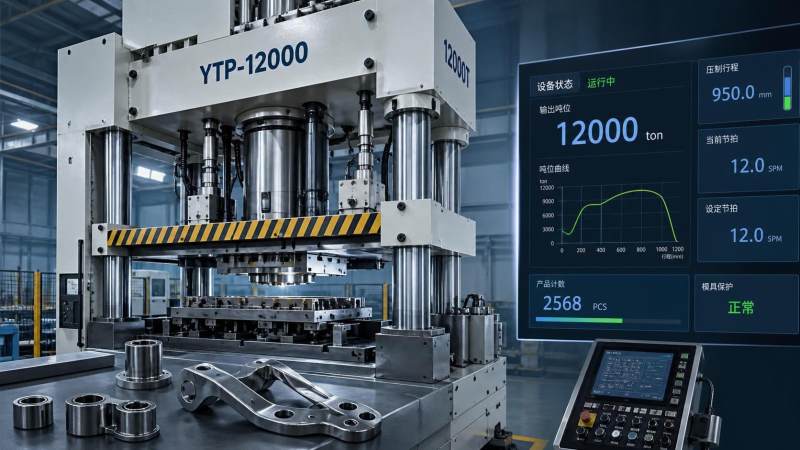
On paper, selecting a hydraulic press for automotive parts can look deceptively simple: identify the required force, compare machine specifications, and shortlist a few models. In real production environments, that approach often leads to underperforming lines, unstable part quality, or expensive oversizing. For technical evaluators, the real question is not just “How much tonnage do we need?” but “How much tonnage is needed at the right point in the stroke, at the right speed, and with a cycle profile that fits the part, tooling, and output target?”
That distinction matters in automotive manufacturing, where components rarely behave like idealized textbook samples. Brackets spring back, bushings demand controlled insertion force, stamped reinforcements need consistent forming depth, and composite or high-strength alloys can punish both tooling and machine frames if press sizing is careless. Tonnage and cycle time sit at the center of this decision because they shape part quality, throughput, energy use, and long-term repeatability.
For evaluators who need a defensible, engineering-based selection process, it helps to treat the press as part of a system rather than a standalone asset. The machine, die set, material, stroke profile, control package, and production takt all interact. A larger press is not automatically safer, and a faster press is not always more productive.
Start with the part, not the machine brochure
The fastest way to make a poor buying decision is to begin with standard press ratings before defining what the automotive part actually requires. A technical review should first map four variables:
- Part geometry: projected area, draw depth, flange features, hole forms, ribs, and any asymmetry that can create off-center loading.
- Material behavior: yield strength, tensile strength, thickness range, lubrication sensitivity, springback tendency, and strain hardening response.
- Process type: deep drawing, coining, embossing, trimming, straightening, press fitting, bonding, or multi-step forming.
- Output requirement: parts per hour, batch change frequency, scrap tolerance, and downstream automation constraints.
Without these inputs, tonnage selection becomes guesswork. Two parts with similar dimensions may require very different press characteristics if one uses mild steel and the other uses high-strength steel or aluminum. Likewise, a simple force estimate tells you little if the process needs a long dwell at bottom dead center, controlled ram speed through a critical forming zone, or precise pressure regulation during insertion.
Tonnage is more than maximum force
Many buyers focus on peak tonnage because it is easy to compare. But when choosing a hydraulic press for automotive parts, the more useful question is how force is delivered across the working stroke. Hydraulic presses are valued precisely because they can provide full tonnage throughout the stroke and support programmable force and speed control. That flexibility can be a major advantage for parts that are sensitive to material flow or final dimensional accuracy.
In selection terms, tonnage should be reviewed through three lenses.
1. Forming force requirement
This is the baseline force needed to shape, trim, coin, or assemble the part under normal conditions. It should be calculated from material properties, contact area, operation type, and tooling design. If possible, validate estimates with trials, FEA, or historical process data from similar parts. Automotive programs often evolve late in development, so relying only on nominal material data can be risky.
2. Force margin for variation
Real lines do not run under perfect conditions. Coil variation, lubrication inconsistency, temperature shifts, die wear, and alignment drift can all increase actual load. A reasonable engineering margin is essential, but excessive oversizing also has consequences. A significantly oversized press may reduce control sensitivity in low-force operations, consume more energy, and increase capital cost without improving part quality.
3. Off-center and dynamic loading
Not every load is evenly distributed. If the tooling creates eccentric force, the press frame, bed, and guiding system must tolerate it without introducing deflection that affects precision or die life. This is especially important for long brackets, structural reinforcements, or transfer tooling where uneven loading is common. In these cases, nominal tonnage alone can hide a structural mismatch.
For evaluators, the practical takeaway is simple: compare the calculated process load with the machine’s usable force profile, frame rigidity, platen size, and allowable eccentric loading—not just the top-line tonnage number.
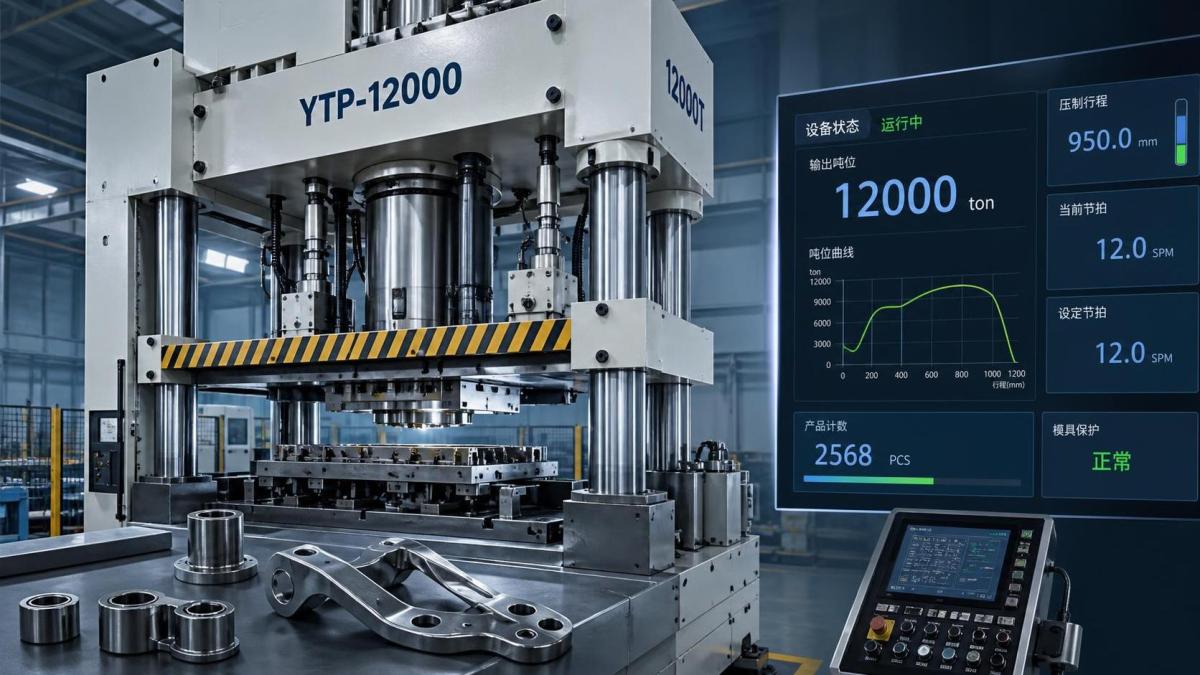
Cycle time should be measured as a process profile, not a headline speed
Cycle time is often misunderstood because machine suppliers may quote rapid approach and return speeds that look impressive but say little about productive output. In automotive manufacturing, the effective cycle includes approach, pressing, dwell if needed, decompression, return, part handling, and control synchronization with the rest of the cell.
A press that moves quickly through non-contact travel but slows substantially in the working zone may still be the right choice if it protects part integrity. On the other hand, a machine with an attractive nominal cycle rate can become a bottleneck if tooling requires longer stabilization or pressure hold than expected.
Technical evaluators should break cycle time into distinct segments:
- Fast approach: travel before material contact
- Working speed: the controlled forming or insertion phase
- Dwell time: required for shaping, bonding, curing initiation, or dimensional settling
- Return speed: retraction after force release
- Auxiliary time: loading, unloading, transfer, sensing, and safety interlocks
This segmented view prevents a common mistake: buying a press based on stroke speed while ignoring the process window where quality is actually created. For example, press-fitting automotive bushings or bearings may require a slower, monitored insertion phase with force-displacement feedback. Deep-drawn parts may need speed control to manage material flow and reduce wrinkling or tearing. In such applications, cycle time optimization depends as much on control architecture as on hydraulic power.
Where tonnage and cycle time trade off
There is a natural temptation to solve throughput concerns by moving to a larger, faster machine. Yet tonnage and cycle time often pull in opposite directions. Higher force capability may mean larger hydraulic systems, heavier moving masses, and a control strategy optimized for demanding loads rather than maximum speed. Conversely, pushing for aggressive cycle times can increase heat, wear, vibration, and part-to-part variability if the process window is narrow.
This is why selection should be linked to the actual automotive application:
- Structural stampings and reinforcements: prioritize stable force delivery, frame rigidity, and programmable motion over headline speed.
- Trim and pierce operations: shorter cycles may be more achievable, but tooling wear and shock management still matter.
- Press-fit assemblies: force accuracy, displacement control, and data capture may outweigh raw cycle speed.
- Multi-stage forming cells: the press must match upstream and downstream takt, not just maximize standalone output.
In other words, the best press is not the fastest machine in isolation. It is the one that sustains the required cycle at acceptable quality and maintenance risk.
Questions that reveal whether a press is really suitable
During supplier evaluation, technical teams often receive polished specification sheets that flatten important differences. Better decisions come from asking more pointed questions.
How much usable tonnage is available throughout the working stroke?
This clarifies whether the machine can apply force exactly where the process needs it.
What is the ram speed under load?
Unloaded speed figures are rarely enough for cycle planning.
How repeatable are position, pressure, and parallelism?
These directly affect part consistency, especially for precision forming and assembly processes.
What control options exist for dwell, decompression, and multi-stage motion?
Automotive parts often require more than a simple down-and-up stroke.
How does the frame handle eccentric loads?
This can separate a press that survives production reality from one that performs only in ideal conditions.
What process data can be captured?
Force, position, and cycle traceability matter more as procurement and quality teams move toward evidence-based equipment validation.
This last point deserves attention. As organizations increasingly demand measurable technical integrity, the evaluation of capital equipment is becoming less about claims and more about verifiable performance. That mindset aligns with how groups such as VitalSync Metrics approach technical benchmarking in healthcare and life sciences: convert operational parameters into comparable evidence so decision-makers can assess reliability, not rhetoric. Although the application here is industrial rather than clinical, the discipline is similar. A press should be selected on demonstrated process behavior, not on marketing language.
Common mistakes in selecting a hydraulic press for automotive parts
Some errors appear again and again in capital equipment reviews, even among experienced teams.
Confusing installed power with forming capability. Hydraulic power unit size does not automatically define usable force control under real process conditions.
Applying a generic safety factor without understanding material variation. Too little margin creates instability; too much can lead to unnecessary machine size and cost.
Ignoring tooling interaction. A well-sized press can still fail the application if die stiffness, cushion behavior, or guiding are mismatched.
Overlooking thermal effects in high-duty cycles. If the line runs continuously, heat generation and hydraulic stability influence repeatability and maintenance intervals.
Evaluating the press outside the production cell. Automation timing, operator access, guarding, and maintenance reach can all affect practical cycle time.
Underestimating data and diagnostics. In modern manufacturing, troubleshooting support and process traceability are no longer optional extras for many programs.
A practical framework for final selection
When the shortlist is down to two or three candidates, a structured comparison helps keep the decision objective. Consider scoring each option against the following categories:
- Calculated tonnage versus required process load
- Force availability at critical stroke positions
- Achievable cycle profile for the actual part
- Ram speed control under load
- Frame rigidity and resistance to off-center loading
- Platen size, daylight, and tooling compatibility
- Control features, sensors, and data logging
- Maintainability, hydraulic stability, and service access
- Integration fit with automation and downstream takt
That kind of matrix is particularly useful when internal stakeholders have different priorities. Manufacturing may push for throughput, tooling engineers may prioritize stiffness and alignment, quality may insist on traceable force-position curves, and procurement may focus on capital cost. A disciplined scoring model makes tradeoffs visible rather than political.
The best choice is usually the most transparent one
For technical evaluators, confidence comes from clarity. If a supplier can explain how the press meets the part’s load curve, speed window, control needs, and durability demands—with evidence to support each claim—the selection process becomes far less risky. If the discussion stays at the level of broad tonnage labels and theoretical strokes per minute, caution is justified.
Choosing a hydraulic press for automotive parts by tonnage and cycle time is ultimately an exercise in matching machine behavior to manufacturing reality. The right press delivers enough force without waste, enough speed without sacrificing control, and enough repeatability to keep quality stable over thousands of cycles, not just during acceptance testing. For organizations making equipment decisions under pressure, that is the difference between buying capacity and buying confidence.
Recommended News
- 2026.10.14Clinic Supplier Comparison: Evaluating Cost, Delivery Reliability, and SupportDr. Alistair Thorne (Senior Biomedical Engineer)
- 2026.10.13Engineering Performance Testing Services: Evaluating Test Methods and AccuracyDr. Alistair Thorne (Senior Biomedical Engineer)
- 2026.10.12Preparing for an ISO 13485 Audit: When to Use External QMS SupportDr. Julian Rossi (RehabTech Specialist)
The VitalSync Intelligence Brief
Receive daily deep-dives into MedTech innovations and regulatory shifts.