 Get Insights

How Should Hospitals Identify IVD Devices Affected by a Supplier Recall?
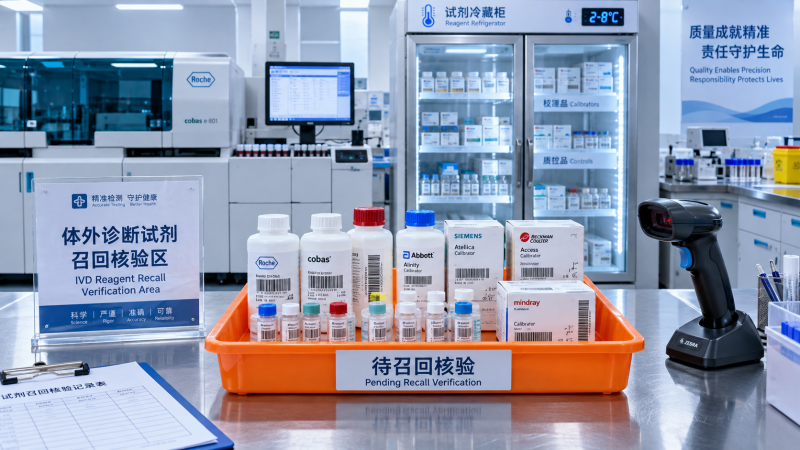
Hospitals should identify IVD devices affected by a supplier recall by matching the notice’s exact product identifiers and scope conditions against both recorded inventory and products physically present. The search must cover instruments, reagents, calibrators, controls, and any specified software or accessories. A matching equipment name alone does not establish whether a device is affected; the decisive details can include a catalog number, lot, serial number, software version, or particular combination of components.
Start containment as soon as a credible match is found, following the recall instructions. Keep unresolved items visibly separate from confirmed unaffected stock while their identity is verified. The result should be a traceable register showing what was found, where it was located, how its status was established, and what happened to it.
Translate the recall notice into precise matching rules
Preserve the original supplier notice, its attachments, and its revision date before extracting the affected identifiers. Confirm that the communication applies to the products supplied to the hospital and obtain missing instructions through a verified supplier contact. A distributor’s abbreviated message can omit exclusions, component details, or conditions contained in the manufacturer’s notice.
Separate product identity from the defect’s operating conditions. A recall might cover every unit within a serial-number range, selected reagent lots, or an assay running on a specified software version. Another notice might describe a problem triggered only by a particular reagent and calibrator combination. Record the complete rule rather than reducing it to a list of product names.
Retain identifiers exactly as printed, including leading zeros, suffixes, and punctuation. Barcode data and purchasing exports sometimes alter these characters. Where a unique device identifier is available, distinguish the product identity from production details such as lot or serial number. A product-level match alone does not resolve a recall limited to specific production units.
If the notice leaves a range boundary or component relationship unclear, record that question explicitly. An undocumented interpretation should not become the basis for releasing stock.
Search beyond the central inventory
Build the initial candidate list from purchasing, receiving, inventory, and asset records. Include supplier catalog numbers, distributor references, local item aliases, and previous names where these map to the affected product. Search canceled and closed purchasing lines when they contain useful delivery history; an inactive item record does not prove that no stock remains.
Then verify the candidates against physical locations. Laboratory refrigerators, freezers, analyzer reagent compartments, satellite laboratories, emergency testing areas, and point-of-care storage can hold material absent from the central stock balance. Include opened containers, reserve stock, consignment supplies, evaluation materials, loan instruments, and items awaiting return or disposal.
Products already loaded into an analyzer require particular attention. An empty outer carton might have been discarded while the reagent remains in use. The analyzer’s reagent-management record can help recover its lot and loading date, but compare that record with the container label wherever accessible. A manually entered lot is weaker evidence than a verified label or a validated barcode capture.
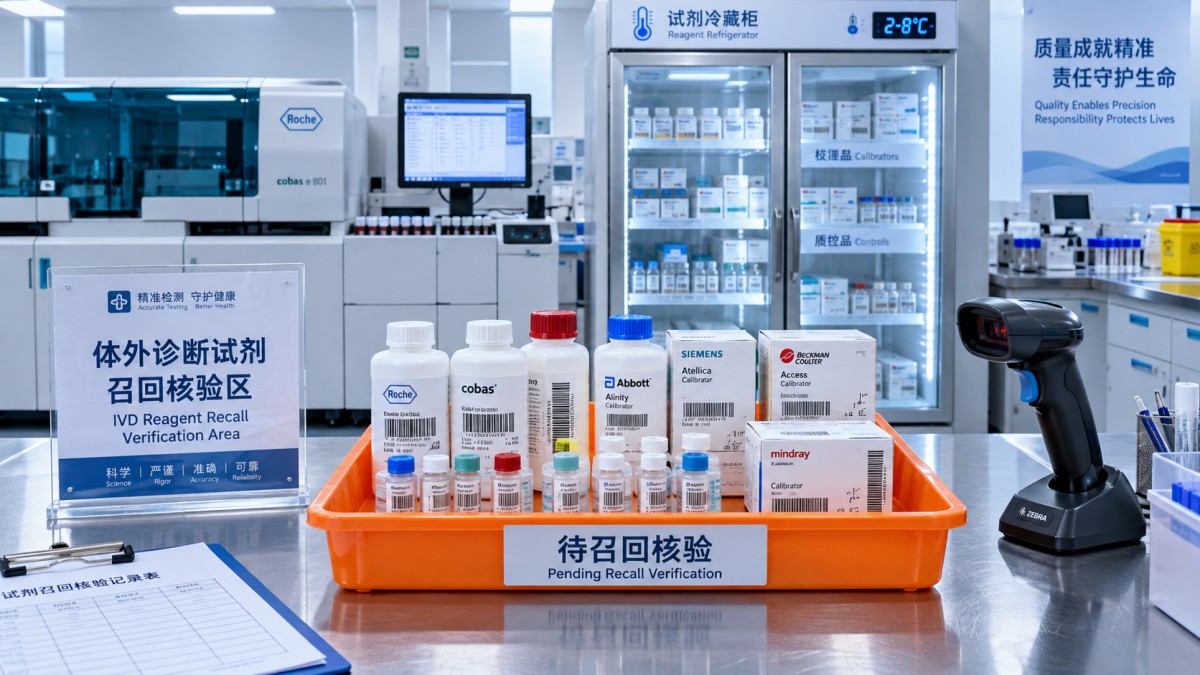
Record each finding at the location where it is discovered. A useful entry links the product identifier, lot or serial number, quantity, unit of measure, expiry date, storage location, and current state. Distinguish unopened packs from opened bottles, installed components, consumed material, and transferred stock. Without these distinctions, the same product can be counted twice or disappear between stock systems.
Where distribution extends outside the main laboratory, use dispatch records to identify the destination and obtain a documented local search result. A message announcing the recall does not establish whether that location held affected material.
Resolve kit components and instrument combinations
IVD kits create a specific identification problem: the saleable kit and its individual components can carry different lot numbers. Read the notice to determine which identifier defines the affected scope. If a calibrator component is recalled, searching only the kit lot can miss affected stock unless the supplier provides a reliable component-to-kit mapping.
When components have been separated from their packaging, preserve any surviving labels and link them to receiving records or preparation logs. Do not assign an assumed component lot based solely on the nearest carton. Mixed storage, partial kits, and replacement components can break that association.
For instruments, distinguish an affected physical unit from an affected testing configuration. A serial-number recall can apply regardless of the assay currently installed. A software-related correction can instead depend on version, configuration, or assay settings. An instrument running an unaffected version today might have operated with the affected version during an earlier period.
A combination-dependent notice needs a combined search. Reagent inventory establishes which lots were present; calibration records establish which calibrator was used; instrument history establishes where and when the combination operated. Separate lists of affected reagents and calibrators are insufficient if the defect occurs only when they are used together.
Normal quality-control results do not establish that a recalled product is unaffected. A defect restricted to certain sample characteristics, concentrations, or operating conditions might not appear in routine controls. Recall status must follow the identifiers and conditions specified in the notice.
Keep uncertain matches visible
Use explicit identification states so that incomplete evidence cannot quietly become a negative result:
- Confirmed affected: the available identifiers and scope conditions match the recall. Record the evidence and apply the specified action.
- Potentially affected: a required identifier is missing, unreadable, or inconsistent. Retain control of the item while the gap is resolved.
- Verified unaffected: documented evidence excludes the item, such as a lot outside the stated range or a clearly excluded configuration.
- Not located: records indicate receipt or transfer, but the search has not established the item’s present location or final disposition.
“Not located” describes an unresolved traceability problem. It does not mean that no affected product remains. Investigate consumption records, internal transfers, returns, and disposal documentation before closing that entry.
For an unreadable label, recover identifiers from package photographs, barcode records, analyzer logs, or supplier shipment details. Record which source supports the decision. If the identifier remains unresolved, maintain the potentially affected status and seek product-specific clarification.
Contain matches without losing the evidence
For affected stock subject to a stop-use instruction, prevent selection at the point of use as well as in the inventory system. Label and segregate it, retain the required storage conditions, and record its location. A purchasing block prevents replenishment but leaves existing bottles available unless physical and operational controls are also applied.
Follow the notice’s specific instructions for installed instruments and loaded reagents. Recall actions can include removal, inspection, software correction, revised operating instructions, or restricted use. Where testing must stop, document the affected instrument or assay and the approved alternative testing route. Do not infer permission to continue from the absence of an obvious malfunction.
Capture label details and relevant configuration evidence before returning, destroying, or modifying the product. A photograph is useful when it connects a readable identifier to the recorded item. Preserve return references, disposal records, service reports, or update confirmations as evidence of the action taken.
Pending deliveries also need attention. Match incoming shipment details to the recall criteria and apply receiving controls so affected material cannot re-enter available stock. Replacement material requires its own identity verification; a replacement shipment is not sufficient evidence that every included item falls outside the recall.
Trace prior use separately from remaining stock
Identifying affected devices includes establishing whether recalled material was already used. Define the relevant period from the notice and local records, then trace reagent consumption, calibration events, instrument operation, and software history. Delivery dates provide a search boundary, but the actual exposure period depends on when the product entered service.
Connect confirmed affected use to assay runs and, where records permit, individual results. Useful links include reagent lot, instrument identity, run time, calibration event, and the result record in the laboratory information system. If the system does not retain a direct lot-to-result link, document the reconstructed interval and the evidence used to define it.
Keep exposure identification separate from the decision to repeat testing, amend reports, or communicate with clinical services. Those decisions depend on the defect described, the assays involved, the potential effect on results, and the recall’s instructions. Flagging every result from an entire analyzer can create an inaccurate review population when only one assay or configuration is affected.
Conversely, an empty shelf does not end the investigation if affected material has been consumed. The inventory search and the historical-use review answer different questions and need separate completion records.
Close the search with a reconciled record
Reconcile receipts and transfers against stock found, consumption, returns, disposal, and onward distribution. Use consistent units: a purchasing record expressed in kits cannot be directly compared with an analyzer record expressed in tests. Where consumption cannot be converted reliably, document that limitation instead of forcing a false quantity balance.
The recall register should retain the notice revision, search scope, locations examined, matching criteria, evidence sources, identification status, and disposition for each affected or unresolved entry. Record who verified the finding and when. Any release from temporary hold needs a documented basis for exclusion.
Closure requires more than a signed supplier acknowledgment. Every searched location should have a recorded outcome, affected items should have a completed or controlled disposition, and historical-use findings should have reached the appropriate review process. Outstanding supplier corrections or missing stock remain open actions with an assigned owner.
If the supplier expands the lot range or revises the conditions, preserve the earlier assessment and rerun the matching rules against the updated scope. That makes it possible to distinguish newly affected items from those already contained and to explain exactly why an earlier identification decision changed.
Recommended News
- 2026.10.25UK University Trial Suggests Ear-Stimulation Device May Lower Resistant HypertensionDr. Alistair Thorne (Senior Biomedical Engineer)
- 2026.10.25FDA Medical Device Testing: When Is Biocompatibility Testing Needed for a 510(k)?Dr. Julian Rossi (RehabTech Specialist)
- 2026.10.24Berg Insight Forecasts 160 Million Connected Home Medical Devices by 2030Lydia Vancini (Regulatory Compliance Lead)
The VitalSync Intelligence Brief
Receive daily deep-dives into MedTech innovations and regulatory shifts.