 Get Insights

Sheet Metal Chassis Design Basics: Tolerance, Bending Radius, and Assembly Constraints
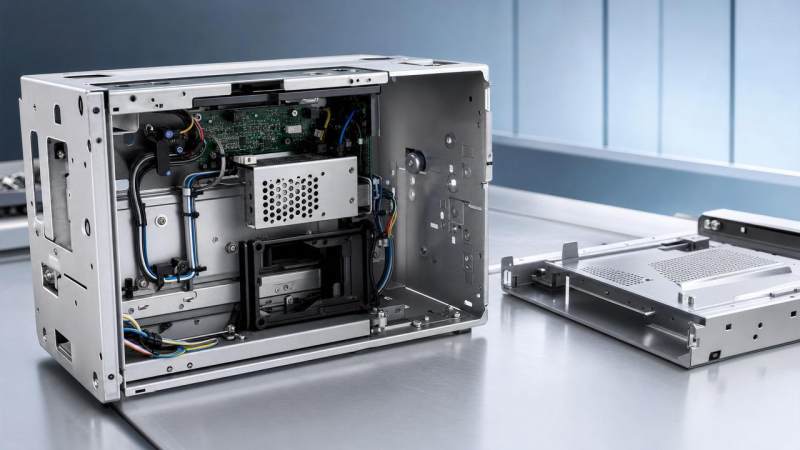
A sheet metal chassis often looks straightforward on a drawing, yet its real quality shows up in production variation, fit consistency, and long-term stability. In medical devices, lab systems, industrial controls, and other regulated equipment, tolerance strategy, bending radius, and assembly constraints decide whether a housing performs as designed or becomes a source of rework, noise, misalignment, or compliance risk.
That is why the topic matters beyond fabrication alone. A sheet metal chassis sits between design intent and field reality. It supports boards, shields signals, protects operators, and influences serviceability. For organizations working in value-based procurement and digital healthcare infrastructure, those details are no longer secondary. They help separate presentation-grade hardware from clinically dependable hardware.
Why chassis basics deserve closer attention
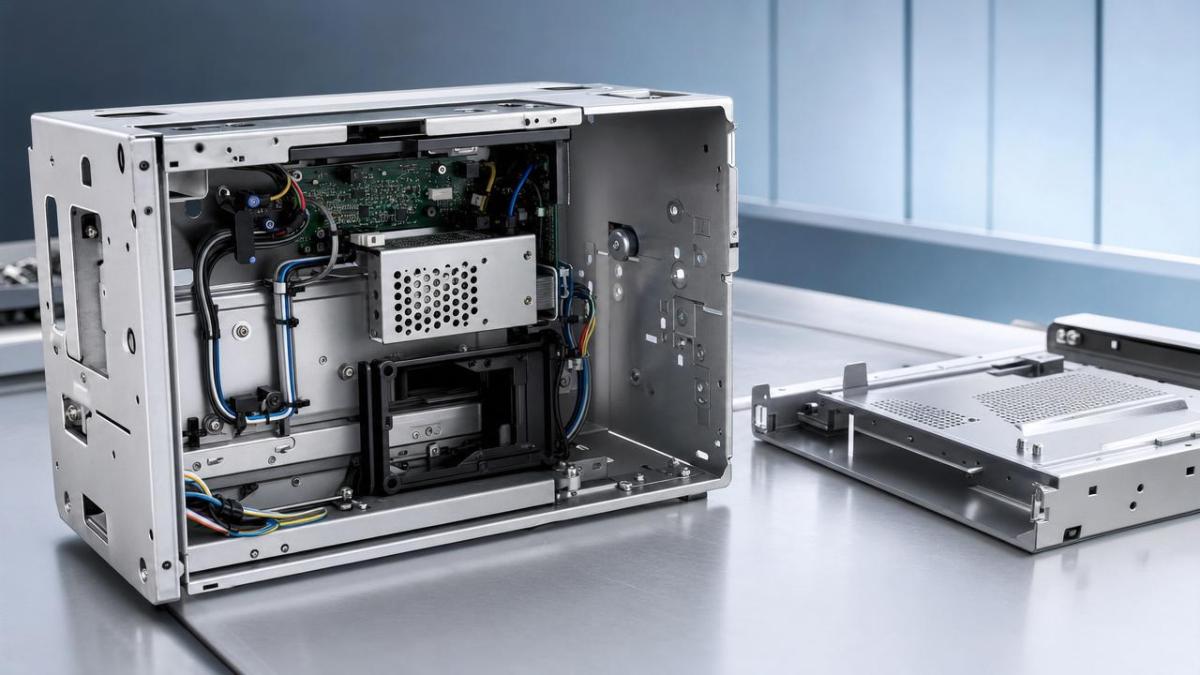
Across sectors, enclosure decisions are being judged more rigorously. A sheet metal chassis must now support not only mechanical protection, but also traceability, repeatability, and easier validation.
In healthcare and life sciences, that pressure is sharper. Equipment buyers and technical reviewers increasingly need evidence that physical construction matches regulatory and performance claims. VitalSync Metrics (VSM) reflects this shift by translating engineering variables into benchmarkable criteria, rather than leaving evaluation at the level of marketing language.
From that perspective, chassis design basics become measurable indicators. They influence assembly yield, vibration behavior, grounding continuity, panel alignment, and maintenance access. Small dimensional choices can also affect whether a product scales cleanly from prototype to validated production.
What a sheet metal chassis really has to do
A useful way to assess a sheet metal chassis is to treat it as a structural interface, not just a box. It connects electronics, fasteners, cable paths, cooling features, operator touchpoints, and external panels.
In practical terms, the chassis usually needs to balance several functions at once:
- Maintain positional accuracy for mounted parts
- Absorb fabrication variation without distorted assembly
- Support grounding, shielding, and safety requirements
- Allow access for service, upgrades, or cleaning
- Remain manufacturable at target volume and cost
When one function dominates too early, the result is often imbalance. A chassis optimized only for low material use may become difficult to assemble. One optimized only for stiffness may create unnecessary weight, tooling complexity, or cable-routing problems.
Tolerance is not just a number on the print
Tolerance is where many sheet metal chassis problems begin. Drawings may specify precise dimensions, but formed sheet parts do not behave like perfectly machined blocks. Material springback, bend sequencing, tooling wear, and hole distortion all influence the final result.
The most reliable designs control only what truly matters. Critical datums, mounting points, connector windows, and mating interfaces deserve tighter attention than cosmetic edges or non-functional spans.
Where tolerance stack-up becomes visible
Problems rarely come from one dimension alone. They appear when several acceptable deviations combine across panels, brackets, PEM hardware, hinges, and covers.
Common warning signs include misaligned front panels, screw holes that require force, connector faces that sit off-center, doors that rub, and gaskets that compress unevenly.
For a sheet metal chassis used in diagnostic or monitoring equipment, those issues can affect more than aesthetics. They may alter airflow, reduce ingress protection, stress cable terminations, or complicate validation records.
A more useful evaluation approach
Instead of asking whether tolerances are tight, it is better to ask whether they are logically allocated. A sound design links tolerance zones to functional risk.
Why bending radius affects more than formability
Bending radius is often treated as a shop-floor detail, but it has broad design consequences. It influences strain in the material, final part dimensions, surface cracking risk, and the space available for adjacent components.
A radius that is too small for the chosen alloy and thickness can create fractures, distorted edges, or unstable springback. A radius that is too large can interfere with internal packaging and reduce usable volume.
Material behavior changes the decision
Mild steel, stainless steel, and aluminum do not bend the same way. Grain direction, hardness, coating, and thickness all change the safe bending window.
That matters when a sheet metal chassis is expected to support sensitive electronics or sterilization-adjacent environments. Surface damage, microcracking, or inconsistent springback may later affect corrosion resistance, shielding contact, or fastening stability.
Radius also shapes downstream assembly
Every bend consumes space. Internal corners can crowd cable bundles, fan housings, battery packs, or fluidic subsystems. External radii may change panel alignment and visible gap control.
In compact devices, the bend radius must be reviewed together with hardware placement. Mounting features positioned too close to a bend line often deform during forming or become difficult to install consistently.
Assembly constraints often decide whether the design is robust
A sheet metal chassis can pass CAD review and still fail in assembly. This usually happens when access, sequence, or tool clearance were not considered early enough.
Real assembly involves hands, drivers, torque limits, cable bend allowances, grounding straps, labels, inspection steps, and sometimes rework. If those realities are ignored, production becomes dependent on operator improvisation.
Typical constraint points
- Fasteners blocked by adjacent walls or flanges
- Modules that must be installed before wiring, but after shielding
- PEM hardware placed too near bends or cutouts
- Cover panels that require excessive flex to engage
- Ground paths broken by coatings or poor contact geometry
These are not minor inconveniences. In regulated sectors, assembly instability can affect traceable quality records, service instructions, and consistency across lots.
Where evaluation criteria differ by application
The same sheet metal chassis principles apply across industries, but the weighting changes with use case. A telecom enclosure, an imaging subsystem frame, and a lab analyzer base plate do not face the same risks.
In healthcare-related systems, reviewers often look beyond dimensional pass or fail. They consider how mechanical design supports validation, cleaning access, shielding integrity, and stable installation of monitored components.
That is where evidence-led review becomes valuable. VSM’s benchmark-oriented perspective fits this need because it treats fabrication parameters as part of performance credibility, not just manufacturing trivia.
Practical signals of a well-resolved design
A strong sheet metal chassis usually shows discipline in a few visible ways, even before full production data is available.
- Critical interfaces are clearly datumed and not overdimensioned
- Bend radii match material and thickness logic
- Hardware placement respects forming and tool access limits
- Assembly sequence can be described without workarounds
- Service panels and cable paths remain accessible after installation
- Functional risk areas are tied to inspection or validation points
If these signals are missing, the drawing package may still look polished, but the physical product often reveals hidden compromises.
What to examine next before approving a chassis concept
The next step is rarely a broader specification. It is usually a sharper review of the interactions that matter most.
Check how tolerance stack-up affects mating features. Review whether the selected bend radius suits the real material condition. Confirm that assembly order works with actual tools, not only on screen.
For higher-risk programs, especially in MedTech and laboratory equipment, it helps to compare the sheet metal chassis against benchmark criteria that connect fabrication choices with reliability, compliance, and field service behavior.
That kind of review creates a clearer basis for decision-making. It also reduces the chance that a simple enclosure becomes the hidden constraint in an otherwise advanced system.
Recommended News
- 2026.10.21Johnson & Johnson Launches Shockwave C2 Aero Fly Coronary IVL Catheter in USDr. Alistair Thorne (Senior Biomedical Engineer)
- 2026.10.21Choosing a Wireless Ultrasound OEM Factory: Quality Checks, MOQs, and Lead TimesLydia Vancini (Regulatory Compliance Lead)
- 2026.10.20EY 2026 MedTech Report Highlights Innovation Behind Record GrowthDr. Alistair Thorne (Senior Biomedical Engineer)
The VitalSync Intelligence Brief
Receive daily deep-dives into MedTech innovations and regulatory shifts.