
Why Sheet Metal Thickness Can Raise Forming Costs Fast
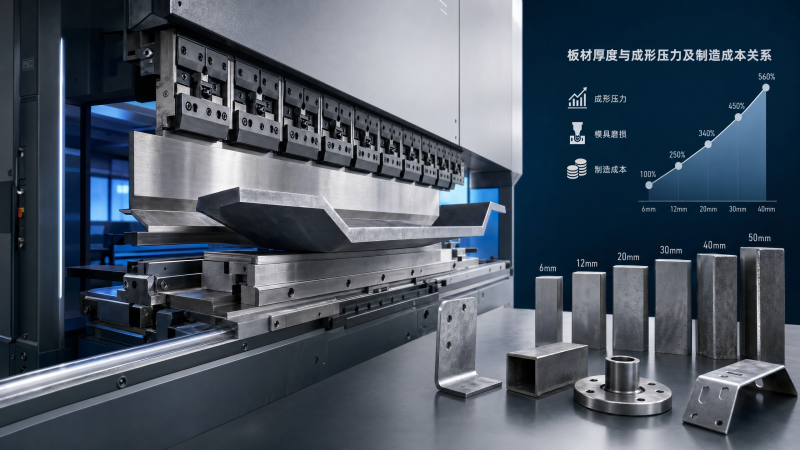
In metal fabrication, sheet metal thickness can drive forming costs up faster than many buyers expect. A small increase in gauge does not create a small, linear increase in cost. It often triggers a chain reaction: higher press tonnage, slower cycle times, more demanding tooling, tighter process windows, and a greater risk of scrap or secondary correction work. For procurement teams, engineers, and operations leaders, that is why thickness decisions deserve closer scrutiny long before a quote is approved.
The core issue is practical, not theoretical. Thicker material resists deformation more strongly, which means the forming process needs more force and more robust tooling to shape it consistently. As loads rise, wear rises too. Setups become less forgiving. Springback behavior changes. Dimensional variation becomes harder to control. What looks like a minor design or sourcing adjustment can quickly alter the total economics of production.
For organizations working across regulated, performance-sensitive sectors such as MedTech and life sciences, the consequences can extend beyond shop-floor efficiency. Higher forming costs can affect sourcing strategy, lead times, design validation, quality consistency, and supplier selection. If a part must meet strict mechanical, dimensional, or surface requirements, understanding the cost behavior of sheet metal thickness becomes essential to making better engineering and procurement decisions.
What buyers and engineers really need to know before thickness increases
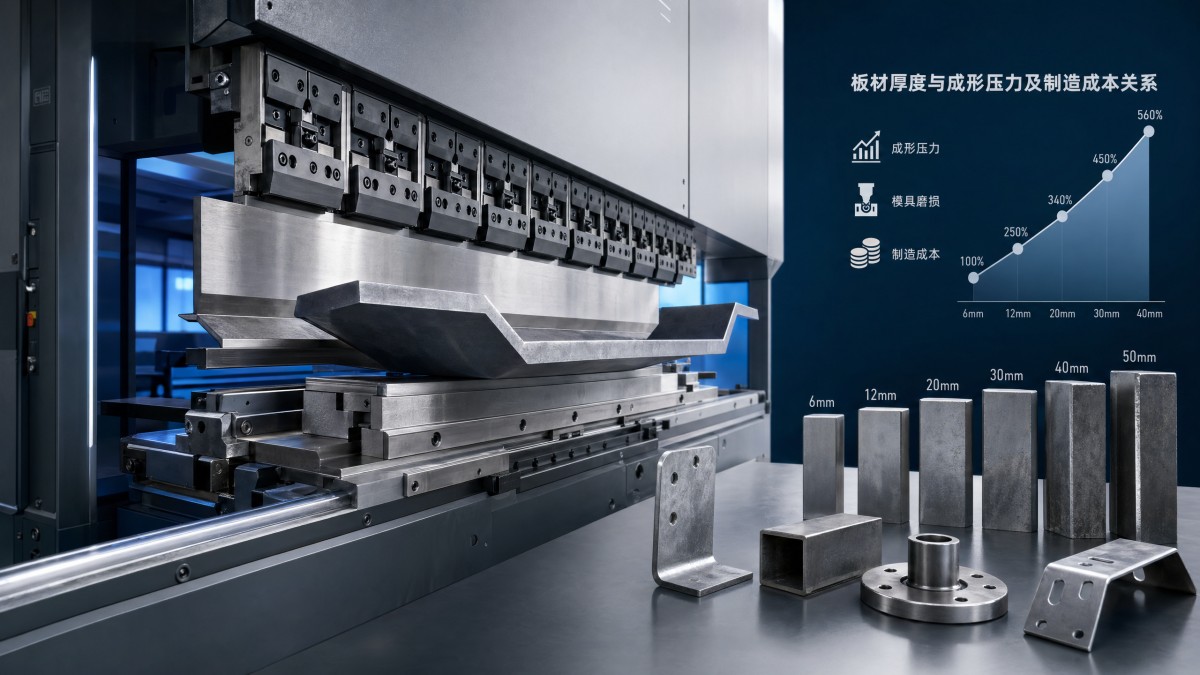
The most important takeaway is simple: sheet metal thickness raises forming costs fast because it amplifies multiple cost drivers at the same time. Material itself costs more, but that is rarely the full story. The larger impact often comes from the production system having to work much harder to form the part without defects, excessive wear, or dimensional instability.
Searchers looking up this topic are usually trying to answer a very practical question: “If I increase thickness for strength, safety, or durability, how much more expensive will the part become to form?” They are also asking a second question that matters even more in sourcing: “Is the cost increase justified, or is there another way to achieve the performance target?”
That is why the best evaluation does not stop at price per kilogram or a simple quote comparison. Decision-makers should examine whether the thickness increase changes required press capacity, die design, bend radii, cycle time, scrap rate, secondary operations, or quality risk. In many cases, these hidden factors explain why a seemingly modest thickness change causes a surprisingly large jump in forming cost.
Why thickness changes are rarely cost-neutral in forming operations
When sheet metal gets thicker, the forming load rises significantly. The press must apply more force to bend, draw, stamp, or shape the material. Depending on the process, that can mean moving to a larger machine, reducing production speed, or limiting the number of parts that can be produced per stroke. If the existing equipment is near its limit, capacity constraints can become a direct cost issue.
Tooling also becomes more expensive and more vulnerable to stress. Dies, punches, and support components must withstand higher loads, and that usually requires stronger materials, more robust design, and more careful maintenance. Over time, higher forces accelerate wear, increase sharpening frequency, and shorten tool life. These are not one-time costs; they accumulate across the life of the program.
Another reason thickness drives costs quickly is that process flexibility narrows. Thin materials can often be formed across a wider operating window before problems appear. Thicker materials may require more exact control of lubrication, bend sequence, press settings, and tooling condition. That makes repeatable production harder, especially for complex geometries or tight tolerances.
How sheet metal thickness affects tonnage, energy use, and machine selection
One of the fastest ways thickness raises cost is through tonnage requirements. Forming force does not simply rise in a gentle, proportional way in every application. In bending and stamping, even a relatively small thickness increase can push the process into a different equipment category. Once that happens, the cost structure changes: larger presses are more expensive to run, schedule, and maintain.
Higher tonnage often means higher energy consumption per part as well. While energy may not be the largest line item in every quote, it becomes more relevant in high-volume programs or where the process already operates near machine limits. Increased force demand can also reduce operational efficiency, especially if production has to shift to less available equipment or run in smaller batches due to scheduling constraints.
Machine selection affects lead time in addition to direct cost. Not every supplier has open capacity on high-tonnage equipment, and not every plant is optimized for thick-gauge forming. Buyers comparing suppliers should ask whether the quoted process fits existing production assets comfortably or depends on scarce machine time. A low initial quote may be less attractive if it carries hidden capacity risk or delivery instability.
Why tooling wear and maintenance escalate with thicker material
Tooling wear is one of the most underestimated consequences of thicker sheet metal. Higher contact pressure between the workpiece and the tool increases abrasion, stress concentration, and the chance of micro-damage at cutting and forming edges. Over a long production run, this leads to more frequent maintenance, more downtime, and a higher probability of quality drift between service intervals.
In parts with demanding geometry, thicker material may also require more sophisticated die features to control material flow. That raises initial tooling cost and extends development time. If the part is redesigned later, tooling modifications can become more expensive than expected because the tool set is already more complex and heavily engineered around high-force conditions.
For procurement teams, this matters because a competitive piece-price quote may not reflect lifecycle tooling realities. The better question is not only “What is the tool cost today?” but also “How often will this tool need intervention, and what does that mean for uptime, consistency, and replacement budgeting?” In regulated industries, tooling stability has downstream implications for validation and quality documentation as well.
Thickness also changes part quality, springback, and tolerance control
Many teams increase thickness to improve strength or stiffness, but that can complicate dimensional control. As thickness rises, the material’s response to bending and forming changes. Springback may become more difficult to predict and compensate for, especially in high-strength alloys or complex shapes. That can create repeatability issues even when the nominal process seems robust.
Thicker material can also increase the likelihood of surface marking, edge stress, cracking at tight radii, or geometric inconsistency in deeper forms. These problems are especially relevant where parts must interface with assemblies, enclosures, brackets, or medical devices that require precise fit. A design that appears manufacturable on paper may prove sensitive in production if the bend radii, tolerances, and material properties are not aligned.
From a cost perspective, quality instability is expensive because it rarely shows up as a single line item. It appears as first-article delays, increased inspection, process adjustments, extra sorting, rework, and scrap. In critical applications, it may also trigger additional validation effort or supplier corrective action cycles. This is one reason thicker sheet metal can raise total forming cost faster than material pricing alone would suggest.
When a thicker sheet is justified—and when it may be the wrong fix
There are many legitimate reasons to specify greater thickness. The part may need higher load-bearing capacity, better dent resistance, reduced vibration, improved durability, or a stronger safety margin. In some products, thickness is the most straightforward path to achieving functional performance. The mistake is not choosing thicker material; the mistake is choosing it without checking whether it is the most cost-effective solution.
Sometimes the same performance target can be achieved through geometry rather than gauge. Adding ribs, changing bend profiles, adjusting flange design, or selecting a different alloy can improve stiffness or strength without imposing the full forming penalty of a thicker sheet. In other cases, local reinforcement or hybrid assembly methods may deliver better economics than increasing thickness across the entire part.
This is particularly important for buyers and product teams managing cost-sensitive programs. If the only design change considered is “make it thicker,” the organization may miss lower-cost alternatives. A more disciplined approach is to compare functional requirements against several manufacturable design paths, then evaluate not just raw material cost but total forming cost, quality risk, and supply chain resilience.
Questions procurement teams should ask suppliers before approving thicker-gauge parts
Procurement teams should push beyond the headline quote and ask whether the thickness change affects required press tonnage, tooling complexity, setup time, cycle time, and tool maintenance frequency. These questions help reveal whether the cost increase is driven by real process demands or by conservative quoting assumptions. They also expose whether the supplier has stable capability for the proposed part.
It is also worth asking how the supplier plans to manage tolerance control and springback at the specified thickness. If the answer is vague, the risk of later quality issues is higher. Buyers should look for evidence of process knowledge: simulation, trial data, part history in similar materials, and clear discussion of bend radii, lubrication, die design, and inspection strategy.
For critical applications, teams should request visibility into process capability, not just price. A supplier who can explain how thickness influences wear, repeatability, and production rate is more likely to deliver predictable long-term performance. In a market where technical claims can exceed actual manufacturing discipline, this level of transparency is valuable for de-risking sourcing decisions.
How operations and engineering teams can control cost before it escalates
The best time to control forming cost is before the drawing is frozen and the RFQ is released. Engineering teams should review whether the selected thickness is tied to a validated functional requirement or simply inherited from an earlier concept. If the requirement is real, they should confirm that bend radii, hole placement, flange lengths, and tolerances are appropriate for the chosen gauge and process.
Operations teams can reduce cost exposure by involving manufacturing early. A quick manufacturability review can identify whether the part is nearing machine capacity limits, whether tooling life will be problematic, or whether the geometry encourages springback and variation. These discussions are often more valuable than late-stage quote negotiations because they address root causes instead of symptoms.
Cross-functional evaluation is especially useful when comparing domestic and global suppliers. The lowest quote may come from a supplier that treats thickness-related risk lightly, while a slightly higher quote may include better tooling strategy, more realistic cycle planning, and stronger process control. The right choice depends on total cost of ownership, not just unit price.
A practical framework for evaluating sheet metal thickness versus forming cost
Start with function. What exactly is the thickness increase supposed to solve: structural strength, impact resistance, flatness, shielding, longevity, or compliance? If the answer is unclear, the specification may be overbuilt. Next, test alternatives such as material substitution, geometry optimization, reinforcement, or localized gauge changes. These options should be considered before assuming thicker sheet is the best answer.
Then assess process impact. Ask how the new thickness changes tonnage, machine eligibility, tooling design, cycle time, and defect risk. If any of those factors shift materially, the quote should be understood as a process change, not a simple material change. That distinction matters because process changes often bring new operational constraints and quality variables.
Finally, evaluate supplier evidence. The most reliable suppliers can explain why cost changes, not just state that it does. They can show how the part will be formed, what the risk points are, and what controls are in place. For organizations that prioritize technical integrity and long-term reliability, this level of detail supports better sourcing decisions than price comparison alone.
Conclusion: thickness decisions should be engineering decisions, not assumptions
Sheet metal thickness can raise forming costs fast because it affects far more than raw material usage. It increases force requirements, accelerates tooling wear, tightens process windows, and makes dimensional control more difficult. Once those effects combine, the total manufacturing impact can be much larger than many teams expect from a modest gauge increase.
For buyers, engineers, operators, and business leaders, the key is to treat thickness as a strategic manufacturing variable. The right question is not simply whether a thicker sheet is stronger, but whether it is the best way to achieve the required performance at an acceptable cost and risk level. That requires looking at tooling, equipment, quality, throughput, and supplier capability together.
When organizations evaluate sheet metal thickness with this broader lens, they make better sourcing choices, avoid preventable cost escalation, and improve confidence in long-term production outcomes. In complex supply chains, that is where real value lies: not in buying thicker material, but in understanding when thickness truly pays for itself.
Recommended News
- 2026.04.28How to Spot Premium Car Accessories That Are Mostly MarkupDr. Julian Rossi (RehabTech Specialist)
- 2026.04.28What Shortens the Life of Aftermarket Truck Parts FastDr. Hideo Tanaka (Imaging Systems Analyst)
- 2026.04.28Aftermarket Auto Parts for Trucks That Cut Repeat RepairsDr. Hideo Tanaka (Imaging Systems Analyst)
The VitalSync Intelligence Brief
Receive daily deep-dives into MedTech innovations and regulatory shifts.