
Hydraulic Press for Composite Materials and Cure Time Tradeoffs
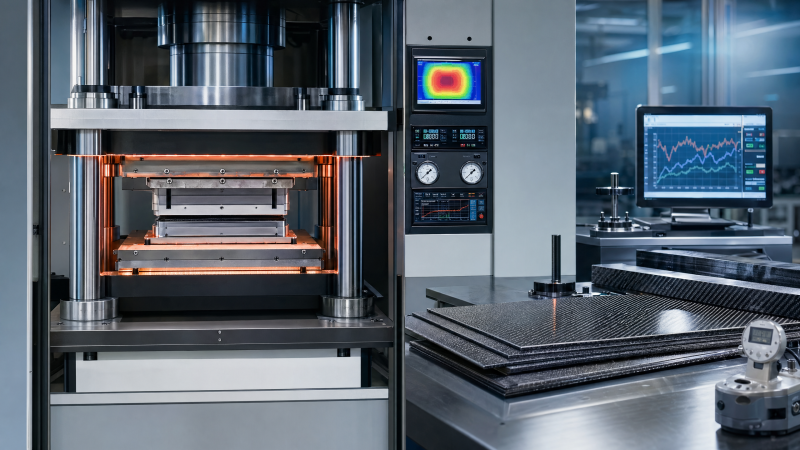
Selecting a hydraulic press for composite materials is rarely about tonnage alone. In most real production settings, the central question is how the press influences cure time, part quality, and overall throughput at the same time. Faster cycles can improve equipment utilization and reduce cost per part, but pushing cure too aggressively can create incomplete crosslinking, voids, spring-back, uneven thickness, or long-term durability issues. Slower cycles may improve process stability, yet they also tie up capacity and increase energy and labor costs.
For engineers, operators, procurement teams, and business decision-makers, the practical answer is this: the best hydraulic press is the one that can deliver stable pressure, controllable platen temperature, repeatable dwell profiles, and data visibility that matches the curing behavior of the specific composite system being processed. Cure time tradeoffs are not just a materials question. They are an equipment-control question, a quality-risk question, and a cost-of-ownership question.
This guide explains how to evaluate hydraulic press performance for composite materials through the lens of cure time tradeoffs. Rather than treating press selection as a catalog comparison, it focuses on what matters in production and technical benchmarking: process consistency, pressure and thermal uniformity, defect risk, traceability, maintenance implications, and the operational economics of faster or slower cure cycles.
What decision-makers really need to know before choosing a hydraulic press
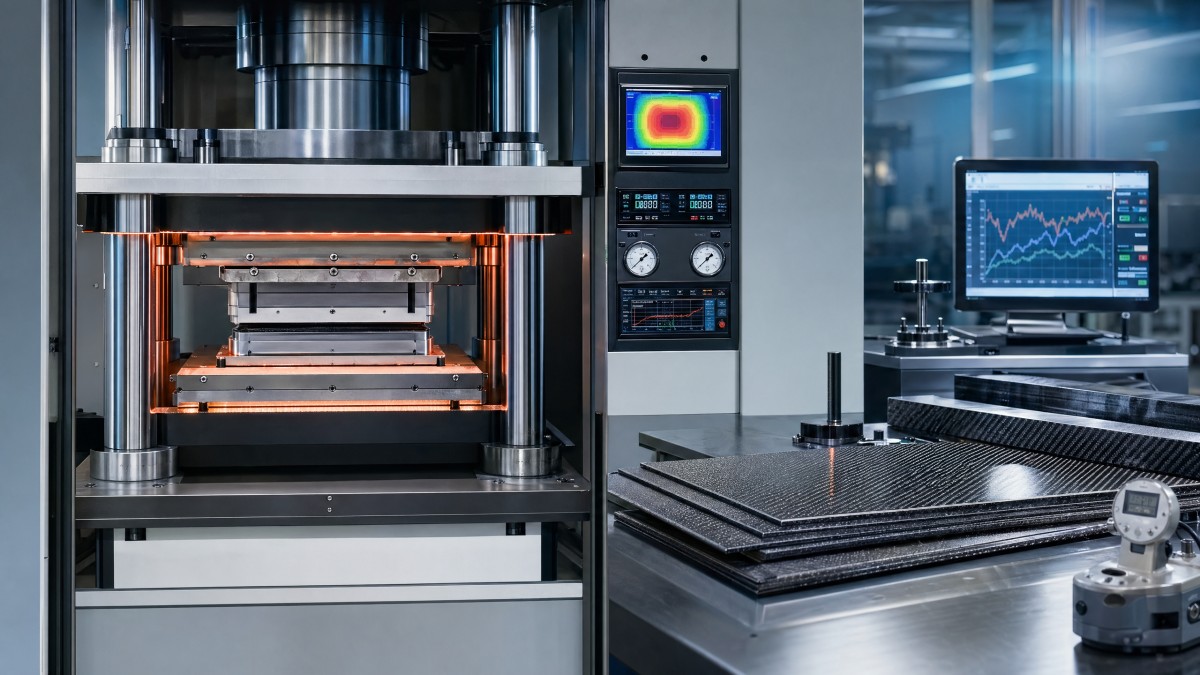
When users search for information on a hydraulic press for composite materials and cure time tradeoffs, they are usually trying to answer one of four practical questions. First, can a given press shorten cure time without compromising laminate performance? Second, what equipment features most directly affect cure consistency? Third, how do cure cycle choices impact throughput, scrap, and total manufacturing cost? Fourth, how can buyers compare suppliers using technical evidence instead of marketing claims?
These questions matter across several roles. Process engineers want to understand whether the press can maintain the pressure and temperature profile required by thermoset prepregs, SMC, BMC, or other composite formulations. Operators care about recipe stability, setup ease, and how sensitive the process is to material variation. Procurement teams want to know which specifications are truly performance-critical and which are just sales language. Executives care about production risk, ROI, and whether cycle-time gains are real or theoretical.
That means a useful evaluation framework must connect machine capability to part outcomes. A press may advertise high tonnage, but if platen temperature deviates significantly across the working area, cure behavior may vary from one region of the part to another. A system may claim fast heat-up, but if control lag causes overshoot, resin flow and crosslinking can become unstable. In composite processing, the value of a press is measured less by headline specifications and more by how predictably it supports the material’s cure kinetics.
Why cure time is never just a speed issue
Cure time in composite molding is tied to the chemistry of the resin system, the geometry of the part, and the thermal and mechanical behavior of the press. In thermoset composites, curing is a reaction process that changes viscosity, flow behavior, and final network structure. If the cycle is too short, the part may leave the mold with incomplete cure or internal stress. If it is too long, manufacturers lose productivity and may even overexpose certain systems to thermal degradation or unnecessary energy consumption.
The pressure profile also matters during curing. In many composite applications, pressure is not simply used to shape the part. It influences fiber wet-out, consolidation, void reduction, resin distribution, and surface finish. If pressure ramps too quickly before the material reaches the right flow state, defects can be locked in. If pressure is too low or unstable during critical parts of the cure, porosity and dimensional variation can increase. The hydraulic press therefore becomes an active part of the cure strategy, not a passive forming tool.
This is why cure time tradeoffs should be analyzed as a process window rather than as a single target number. A shorter cycle may be safe only if thermal uniformity, pressure control, tooling design, and venting are all good enough to support it. Without that foundation, trying to reduce cure time often shifts cost from cycle time to scrap, rework, customer complaints, or field reliability risk. For technical buyers, the right question is not “How fast can this press run?” but “How tightly can this press hold a validated curing window at production scale?”
Which hydraulic press characteristics matter most for composite curing performance
The first critical factor is pressure accuracy and repeatability. Composite materials often respond poorly to pressure variation, especially in parts where thickness tolerance, fiber volume fraction, and surface integrity are important. A press should be evaluated for closed-loop control quality, pressure ramp precision, dwell stability, and platen parallelism under load. If force distribution is inconsistent, cure results can differ between batches even when the nominal recipe stays the same.
The second major factor is thermal uniformity. In composite molding, the difference between an acceptable part and a rejected one can come from a relatively small temperature variation across the platen or tooling surface. Buyers should ask for mapped temperature uniformity data under operating conditions, not just empty-system specifications. Heating rate, recovery time after loading, zoned temperature control, and sensor placement all affect whether the material sees the intended cure cycle.
The third factor is recipe programmability and process data capture. Modern composite production increasingly requires documented traceability, especially in regulated or quality-sensitive sectors. A hydraulic press that records actual pressure, temperature, dwell time, alarms, and batch data provides much stronger process evidence than one that only executes a basic timed cycle. For organizations that benchmark suppliers or validate production quality, this data layer is not a luxury. It is a core capability for proving repeatability and supporting continuous improvement.
How faster cure cycles can create hidden quality and cost risks
On paper, reducing cure time improves output per shift and lowers cost per part. In reality, the gain depends on whether the material system and press can support the change without increasing variability. One common risk is incomplete cure at thick sections or thermally lagging areas of the part. Another is nonuniform resin flow caused by aggressive heating or pressure ramping. These problems may not always appear immediately in visual inspection, but they can reduce mechanical performance, dimensional stability, or fatigue life.
Fast cycles can also magnify sensitivity to incoming material variation. A process that works well with one resin batch, one storage condition, or one ambient environment may become unstable when those variables shift. This matters for production operations because a narrow cure window creates hidden dependence on operator skill and material handling discipline. A press that appears productive in trials may be difficult to run robustly at volume if its controls are not sophisticated enough to compensate for normal shop-floor variability.
There is also a financial tradeoff that is often missed in capital purchasing. If a faster cycle raises scrap rates by even a small percentage, the apparent throughput benefit may disappear once labor, tooling occupancy, inspection burden, and rework are included. In high-value parts, one failed cure can cost far more than the savings from several shortened cycles. This is why procurement and plant leadership should evaluate cure-time reduction as a controlled productivity strategy, not as an isolated machine-speed metric.
How slower, more conservative cure cycles can also become a strategic problem
While many buyers focus on the dangers of pushing cure too fast, excessively conservative cycles create their own business risks. Longer dwell times reduce available capacity, especially in batch-based press operations where each mold ties up expensive equipment. If demand increases, the manufacturer may need additional presses, more floor space, and more labor simply because the process window has not been optimized. In that case, “safe” curing may be hiding a large capacity penalty.
Long cycles also increase utility and thermal management costs. Heated platens, hydraulic systems, and ancillary equipment consume energy throughout the dwell period, and the economic impact becomes significant in multi-shift production. Over time, this can affect cost competitiveness, especially in sectors where composite parts are transitioning from specialty production to higher-volume manufacturing. For purchasing teams comparing equipment options, a press that enables reliable cycle optimization may have higher upfront cost but lower total cost of ownership.
Another issue is process rigidity. If the press lacks responsive control or recipe flexibility, manufacturers may keep cure times longer than necessary to protect quality. That is not always a materials limitation; it can be an equipment limitation. Better thermal mapping, more precise closed-loop pressure control, and stronger process monitoring can sometimes reduce the need for excessive time buffers. In this sense, advanced press capability creates value not only by running faster, but by enabling validated confidence in shorter cycles.
What to ask suppliers when benchmarking hydraulic presses for composite materials
Meaningful supplier comparison starts with application-specific questions. Buyers should ask what composite systems the press has been used for, what part sizes and thicknesses are typical, and whether the supplier can provide process data from similar curing applications. Generic statements about “suitability for composites” are not enough. The goal is to understand proven operating conditions, not just theoretical compatibility.
Technical questions should include platen temperature uniformity under load, pressure control tolerance across the cure cycle, parallelism at working tonnage, control-system sampling rate, alarm architecture, and data export capability. It is also important to ask how the press behaves during transient phases such as heat-up, loading, decompression, and unloading, because many cure defects originate during transitions rather than during steady-state dwell. Serviceability should be part of the same discussion: calibration intervals, sensor replacement, hydraulic maintenance demands, and spare-parts lead times all affect long-term reliability.
For organizations that prioritize evidence-based procurement, supplier evaluation should include witness testing or review of standardized performance documentation. A strong benchmark package might include thermal maps, pressure repeatability studies, cycle trace logs, acceptance criteria, and maintenance records from comparable installations. This is particularly valuable in sectors where quality integrity and traceability matter more than the lowest purchase price. In those cases, the press should be assessed as a process-validation asset, not just a forming machine.
How different stakeholders should judge value
Engineers should focus on process window stability. They need to know whether the press can reliably hit the required cure profile and maintain it despite normal variation in material, tooling, and ambient conditions. Useful indicators include repeatability over multiple cycles, sensitivity analysis, and correlation between machine data and part quality results such as thickness consistency, void content, or mechanical test performance.
Operators should judge how manageable the system is in real production. A technically advanced press still creates risk if setup is confusing, alarms are poorly designed, or recipe changes are cumbersome. Human-machine interface quality, recipe lockout, guided startup, and clear fault diagnostics directly affect whether the curing process stays under control on the shop floor. Ease of cleaning, loading access, and safety interlocks also matter because practical friction often becomes a hidden source of downtime and inconsistency.
Procurement leaders and executives should connect all of this to business outcomes. The best press is not automatically the cheapest or the fastest. It is the one that offers the strongest combination of validated quality, predictable output, manageable maintenance, and traceable performance over time. In sectors influenced by compliance expectations, supplier accountability, and long product life cycles, investing in process stability often delivers better value than chasing a headline cycle-time reduction that cannot be sustained in routine production.
A practical framework for balancing cure time, quality, and throughput
A useful decision framework begins with the material and part, not the machine catalog. Define the actual cure requirements of the composite system, the acceptable quality metrics, and the production volume target. Then identify which press capabilities are essential for achieving that combination. For example, thick or complex parts may place more importance on thermal uniformity and controlled ramps, while higher-volume simpler parts may place more emphasis on repeatable cycle execution and quick recovery between runs.
Next, model the economics of three scenarios: conservative cure, optimized cure, and aggressive cure. Include not only nominal throughput, but also expected scrap, inspection load, energy use, labor burden, maintenance implications, and the cost of process instability. This makes the cure-time tradeoff visible in operational rather than purely technical terms. It also prevents teams from overvaluing a short cycle that only works under ideal trial conditions.
Finally, validate supplier claims with evidence. Request trial data, benchmark documentation, or structured factory acceptance testing tied to your actual application criteria. If possible, link machine parameters to part-level outcomes instead of stopping at equipment readings. That approach aligns with a more rigorous, engineering-based procurement philosophy: decisions should be made on measurable process integrity, not on optimistic assumptions about speed.
Conclusion
Choosing a hydraulic press for composite materials is fundamentally a decision about controlled curing, not simply forming force. Cure time tradeoffs sit at the center of that decision because they shape quality, throughput, cost, and long-term reliability all at once. A press that supports faster cycles without stable pressure control, thermal uniformity, and data traceability may reduce apparent cycle time while increasing real production risk.
The strongest equipment choice is usually the one that gives manufacturers a wider, more controllable process window. That means reliable pressure delivery, well-mapped heating performance, programmable recipes, and enough visibility to verify that the material is being cured as intended. For buyers and technical teams alike, the most useful question is not whether a press can run quickly, but whether it can run predictably, validate performance, and support confident decisions over the life of the production program.
In composite manufacturing, speed matters. But verified process integrity matters more. When hydraulic press selection is approached through that lens, cure time becomes a manageable engineering variable instead of a hidden source of quality and procurement risk.
Recommended News
- 2026.04.28How to Spot Premium Car Accessories That Are Mostly MarkupDr. Julian Rossi (RehabTech Specialist)
- 2026.04.28What Shortens the Life of Aftermarket Truck Parts FastDr. Hideo Tanaka (Imaging Systems Analyst)
- 2026.04.28Aftermarket Auto Parts for Trucks That Cut Repeat RepairsDr. Hideo Tanaka (Imaging Systems Analyst)
The VitalSync Intelligence Brief
Receive daily deep-dives into MedTech innovations and regulatory shifts.