 Get Insights

Does an Implant Material Change Require a New Supplier Review?
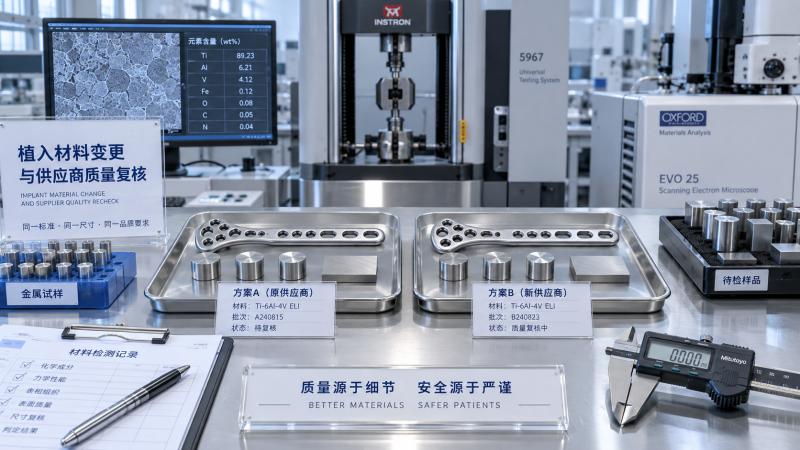
A supplier emails your engineering team: the implant material is changing, but the part number, dimensions, and delivery schedule will remain the same. The purchasing system sees no disruption. Your quality team sees a question that cannot be answered from a certificate of analysis alone.
Does a change in implant material require a new supplier review? It requires a documented assessment of the change and its implications for supplier approval. It does not automatically require a complete supplier requalification. The appropriate response depends on whether the revised alloy, polymer, coating, or material source affects biological safety, mechanical performance, manufacturing controls, or regulatory obligations.
For MedTech manufacturers and healthcare procurement teams, the practical challenge is deciding how much evidence is enough before accepting the change. VitalSync Metrics’ engineering-focused approach starts with a simple principle: approval should follow demonstrated technical suitability, not supplier familiarity.
The supplier may be unchanged. The basis for approval may not be.
Supplier approval is usually tied to a defined scope: a material specification, manufacturing site, process capability, inspection method, and intended application. A supplier qualified to deliver one titanium alloy is not automatically qualified to deliver every titanium alloy. Likewise, a polymer producer with a strong delivery record may lack evidence supporting a new implant-grade formulation.
That distinction matters because “material change” can describe very different events:
- A correction to documentation with no physical material change.
- A new raw-material source supplying the same nominal grade.
- A revised alloy composition, polymer formulation, or additive package.
- A new coating, surface treatment, or cleaning process.
- A manufacturing route change that alters material structure or surface condition.
Not all of these justify the same review depth. However, none should be classified solely by the supplier’s description of the change as “minor” or “equivalent.” The receiving organization needs its own assessment against the approved device requirements.
Keep supplier review and device change assessment connected, but separate. Supplier review asks whether the source can consistently provide conforming material. Device change assessment asks whether the resulting implant remains safe, performs as intended, and satisfies applicable regulatory requirements. Passing one does not resolve the other.
How to decide whether the material change requires supplier requalification
Begin with the approved baseline, not the new sample. Retrieve the current material specification, supplier approval scope, relevant validation records, biological evaluation, risk management documentation, and purchasing agreement. Without that baseline, “equivalence” becomes an opinion rather than a comparison.
These are decision pathways, not universal regulatory classifications. Review depth should reflect the implant’s application, exposure duration, failure consequences, and the uncertainty introduced by the change.
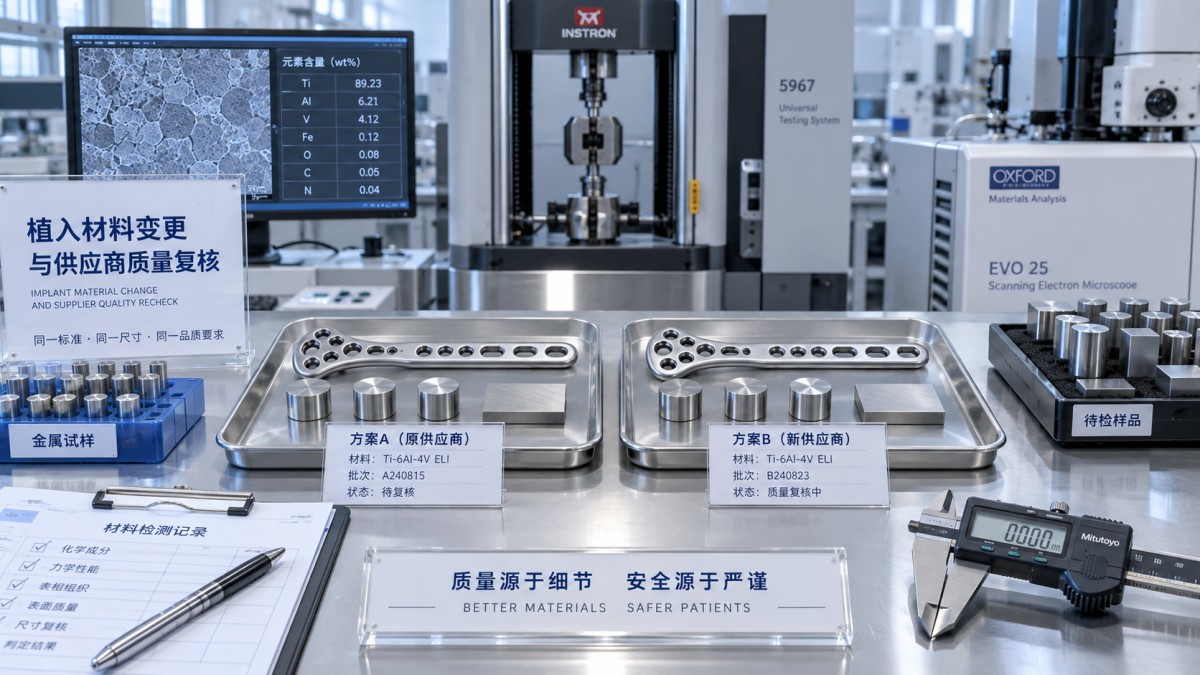
1. Define exactly what changed
Ask the supplier for a controlled change notification identifying the old and new specifications, affected sites, implementation date, affected lots, and reason for the change. Request a side-by-side comparison rather than a general assurance that performance is unaffected.
For metals, relevant differences may include composition limits, interstitial content, heat treatment, microstructure, inclusions, or product form. For polymers, investigate resin grade, molecular characteristics, additives, processing aids, and residual substances. For coatings, examine composition, thickness, adhesion, deposition conditions, and surface preparation.
A trade name is not a complete specification. Nor does compliance with the same material standard necessarily establish equivalence for a particular implant design.
2. Identify the device characteristics that could move
Map the change to the implant’s critical requirements. A load-bearing component may be sensitive to fatigue behavior, fracture resistance, and corrosion. A polymer bearing may require attention to wear, oxidation, creep, and sterilization effects. A coated implant may depend on coating adhesion, particulate generation, and surface characteristics.
Consider interactions as well. A revised material may behave differently during machining, welding, cleaning, or sterilization even when its incoming inspection results meet specification. The risk assessment should follow the material through the actual production route and intended use.
3. Check whether the supplier’s approved scope still fits
Review the supplier’s capability to control the revised requirements. Existing quality-system certification is useful context, but it does not establish competence for every implant material or process.
Look for validated processes where applicable, suitable analytical methods, calibrated equipment, trained personnel, and effective control of upstream suppliers. If critical operations are outsourced, determine whether the supplier has assessed those subcontractors and can maintain traceability through them.
A targeted remote review may be sufficient for a well-characterized change with strong supporting records. An on-site audit becomes more compelling when a new facility, special process, or significant control gap is involved. The audit scope should follow the risks rather than repeat every item from the original qualification.
Build an evidence package that answers the real risks
The strongest change package connects each identified risk to evidence and an acceptance criterion. A large folder of certificates is not necessarily more persuasive than a focused set of relevant results.
Material identity and lot consistency
Obtain controlled specifications, certificates linked to actual lots, test methods, and traceability records. Where risk warrants it, independently verify identity or composition rather than relying exclusively on supplier declarations.
Evaluate evidence across representative lots when variability is important. A single acceptable sample can demonstrate that the supplier produced one conforming sample; it cannot, by itself, establish stable production capability. The sampling rationale should reflect process knowledge and the consequences of variation.
Biological safety of the finished implant
A material change should trigger review of the biological evaluation within the applicable ISO 10993 framework. That does not mean every change requires repeating every biological test. It means the existing evidence must be assessed for continued relevance.
Consider new constituents, impurities, processing residues, degradation products, and changes in patient-contact surfaces. Chemical characterization and toxicological assessment may help address questions that nominal composition data cannot resolve.
Importantly, material-level evidence may not represent the finished device. Machining, cleaning, coating, packaging, and sterilization can alter the exposure profile. Select test articles and supporting evidence that meaningfully represent the final implant, with a documented rationale.
Mechanical performance under relevant conditions
Choose testing around plausible failure modes. Depending on the implant, this may include fatigue, corrosion, fretting, wear, coating adhesion, or degradation behavior. Where appropriate, assess sterilized or aged samples rather than only newly manufactured material.
Use applicable standards and validated methods, but avoid treating a standard test as a substitute for device-specific reasoning. A material can meet a tensile requirement while performing differently at a stress concentration or mating interface.
VitalSync Metrics’ benchmarking perspective is valuable here: compare the changed material against defined engineering requirements and the approved baseline, using conditions that reveal meaningful differences. The objective is not to generate an impressive test list; it is to resolve uncertainty.
Regulatory review is a parallel decision, not an afterthought
Supplier approval alone does not authorize a changed implant for every market. The legal manufacturer must assess the material change under its quality system and the requirements applicable to the device.
For devices marketed under the EU Medical Device Regulation, a material change may affect technical documentation, biological evaluation, risk management, clinical evaluation, and notified-body involvement. Whether notification or further assessment is required depends on the device, conformity assessment route, certification arrangements, and nature of the change.
For US-marketed devices, assess whether the change requires a new submission or supplement under the relevant FDA pathway. The answer differs between, for example, a device cleared through 510(k) and one approved through PMA. A supplier’s equivalence statement does not replace the manufacturer’s regulatory assessment.
ISO 13485 purchasing controls provide a framework for supplier evaluation, monitoring, and re-evaluation proportionate to risk. ISO 14971 supports assessment of changed device risks. Neither should be reduced to a blanket rule that every material change requires a full audit—or that an existing supplier needs no further review.
Make the release decision traceable
Before production acceptance, assemble a decision record that another qualified reviewer could understand without reconstructing months of email correspondence. It should contain:
- The change description and affected materials, devices, sites, and lots.
- The comparison with the approved specification and qualification scope.
- The risk assessment and rationale for review depth.
- Required testing, acceptance criteria, results, and unresolved issues.
- The supplier review outcome and any conditions of approval.
- The regulatory assessment and necessary documentation updates.
- Authorized approvals, implementation timing, and monitoring arrangements.
Quality, engineering, regulatory affairs, and procurement should each understand their responsibilities. Commercial urgency should not silently become technical approval.
Define the transition between old and new material. Identify remaining inventory, segregate lots where necessary, and preserve traceability to finished devices. Additional incoming verification or enhanced monitoring may be appropriate during introduction, but it should not substitute for resolving essential safety or performance questions before release.
What hospital procurement teams should ask
Hospitals generally do not perform the legal manufacturer’s device validation or supplier qualification. They can, however, request enough information to make an informed purchasing decision.
Ask whether the implant specification or patient-contact material has changed, whether relevant regulatory requirements have been addressed, and whether labeling, compatibility, handling, or clinical use is affected. Request a clear manufacturer statement identifying affected product codes and transition dates.
If procurement receives only “same product, improved material,” the next question should be what that claim means technically. Depending on the change, clinical engineering, infection prevention, or the relevant surgical team may need to review its implications.
The practical answer: reassess first, requalify to the necessary depth
Does a change in implant material require a new supplier review? It requires a documented reassessment; the findings determine whether a limited update, targeted review, or broader requalification is necessary.
The most defensible decision connects the changed material, the supplier’s actual capabilities, and the finished implant’s requirements. Familiarity with a supplier can make communication easier, but it cannot establish material equivalence. When evidence is incomplete, pausing acceptance is not needless bureaucracy—it protects patients and prevents an uncertain change from becoming an expensive downstream problem.
Recommended News
- 2026.10.23bioMérieux Announces FDA Clearance and CLIA Waiver for SPOTFIRE Vaginitis PanelDr. Hideo Tanaka (Imaging Systems Analyst)
- 2026.10.23Southeast Asia’s Medical Supply Chain: Sourcing Shifts and Import RisksDr. Alistair Thorne (Senior Biomedical Engineer)
- 2026.10.2294th CMEF Opens in Beijing as Two Venues Showcase the Broader Healthcare IndustryDr. Hideo Tanaka (Imaging Systems Analyst)
The VitalSync Intelligence Brief
Receive daily deep-dives into MedTech innovations and regulatory shifts.