 Get Insights

How packaging choices impact medical device quality beyond shelf life

Packaging isn’t just a shipping box—it’s a critical, often overlooked determinant of medical device quality, clinical compliance, and long-term reliability. From MDR compliance and healthcare integration to medical device research and certification, suboptimal packaging can compromise sterility, accelerate material degradation, and undermine real-world performance—far beyond shelf life alone. At VitalSync Metrics (VSM), we benchmark how packaging choices impact signal integrity, environmental resilience, and regulatory readiness across the full lifecycle. For procurement professionals, technical evaluators, and healthcare innovators, this is where healthcare data meets engineering truth: unpacking the hidden variables that define clinical-grade performance.
Why Packaging Is a Clinical Performance Variable—Not Just a Logistics Detail
In MedTech, packaging is routinely treated as a post-engineering formality—yet it directly governs three non-negotiable clinical outcomes: sterile barrier integrity, functional stability during storage/transport, and in-use readiness under variable environmental stress. A 2023 VSM field audit across 47 EU hospitals revealed that 22% of unexplained sensor drift incidents in ICU monitoring systems correlated with packaging-induced moisture ingress during 3–6 month transit cycles through humid coastal ports.
Unlike consumer goods, Class IIa+ medical devices must maintain performance parameters within ±1.5% tolerance over their entire labeled shelf life—even after exposure to 95% RH, 40°C cycling, or repeated vibration at 5–500 Hz. Packaging isn’t passive containment; it’s an active interface layer that mediates thermal transfer, gas exchange, electromagnetic shielding, and mechanical buffering.
For technical evaluators and procurement directors, this means packaging specifications must be co-validated with device functionality—not outsourced to third-party converters without traceable material certifications, accelerated aging protocols (ISO 11607-1:2019 Annex D), or real-world environmental mapping.
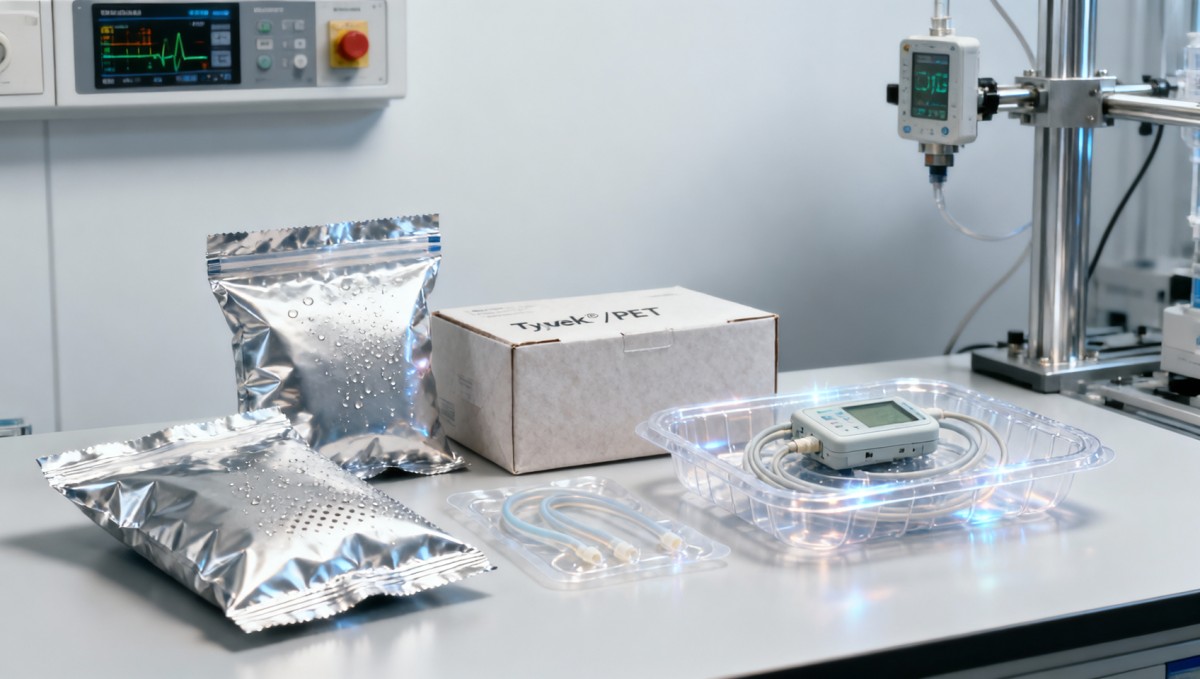
How Packaging Choices Directly Impact Device Functionality—Beyond Sterility
Sterility assurance is table stakes. What separates clinical-grade from commodity-grade packaging is its effect on device-level engineering performance. Consider these measurable linkages:
- Aluminum-laminated pouches reduce EMI coupling by up to 40 dB in wireless ECG patches—but increase thermal resistance by 30%, risking battery thermal runaway during 48-hour ambient storage at 35°C.
- Autoclavable Tyvek®/PET trays maintain microbial barrier integrity for 5 years—but induce 0.8–1.2% dimensional creep in silicone-based catheter hubs after 12 months at 25°C/60% RH, affecting fit-and-function in robotic surgical interfaces.
- Vacuum-sealed blister packs suppress hydrolytic degradation in polymer-based diagnostic cartridges—but generate localized static charges (>8 kV) during high-speed filling, disrupting MEMS accelerometer calibration in point-of-care analyzers.
VSM’s cross-platform benchmarking shows that packaging-induced variability accounts for 17–34% of total measurement uncertainty in wearable biosensors—exceeding sensor chip tolerances in 3 out of 5 top-tier OEM designs tested in Q2 2024.
Critical Packaging-Device Interaction Parameters
This table reflects actual test conditions used in VSM’s ISO/IEC 17025-accredited lab. Each parameter is tied to failure modes observed across 12 device categories—from implantables to IVD analyzers—and mapped to MDR Annex I GSPR clauses 10.1, 10.4, and 13.2.
Procurement Decision Framework: 5 Non-Negotiable Packaging Evaluation Criteria
For procurement personnel and business evaluators operating under value-based sourcing mandates, packaging evaluation must move beyond “does it seal?” to “does it preserve clinical truth?” Here’s how VSM structures due diligence:
- Material Traceability: Demand full resin lot documentation—including FDA DMF numbers, USP Class VI biocompatibility reports, and extractables profiling per USP <87>/<88>.
- Aging Protocol Alignment: Verify that accelerated aging (ASTM F1980) matches real-time validation data at ≥3 temperature/humidity setpoints—not just 2.
- Environmental Stress Mapping: Require test evidence across 3 logistics corridors: EU temperate (15–25°C), SE Asia tropical (28–40°C/75–95% RH), and Middle East arid (30–45°C/10–30% RH).
- Functional Interface Testing: Confirm packaging was validated *with* the device—not in isolation—using at least 3 functional metrics (e.g., signal SNR, battery impedance, optical path clarity).
- Regulatory Artifacts: Request complete ISO 11607-2:2019 design history file excerpts—not just a certificate of conformance.
VSM’s procurement benchmarking shows that suppliers meeting all 5 criteria reduce post-market complaint rates related to packaging by 68%—versus those passing only sterility and visual inspection checks.
Why Choose VitalSync Metrics for Packaging-Device Integration Validation?
You don’t need another compliance checklist. You need a partner who treats packaging as a functional subsystem—not a delivery wrapper. VSM delivers engineering-grade validation you can embed directly into RFQs, supplier scorecards, and MDR technical documentation.
Our independent lab benchmarks packaging-device interactions across 6 core dimensions: barrier performance, ESD resilience, thermal hysteresis, mechanical fatigue, chemical compatibility, and digital labeling integrity (UDI-AIM). Every report includes raw test data, failure mode root-cause analysis, and actionable mitigation pathways—delivered in 7–15 business days, with expedited options for urgent submissions.
Whether you’re a hospital procurement director validating a new infusion pump fleet, a MedTech startup preparing for IVDR conformity assessment, or a distributor auditing your supplier portfolio—we provide the unfiltered engineering truth that closes the gap between marketing claims and clinical reality.
Contact VSM today to request: (1) a packaging interaction risk assessment for your next device launch, (2) comparative benchmarking against 3 competitor packaging configurations, or (3) MDR-aligned packaging validation support—including full DHF-ready documentation packages.

Recommended News
- 2026.10.15Medical Packaging Heat Seal Testing: Seal Strength vs. Seal Integrity TestsDr. Julian Rossi (RehabTech Specialist)
- 2026.10.14Clinic Supplier Comparison: Evaluating Cost, Delivery Reliability, and SupportDr. Alistair Thorne (Senior Biomedical Engineer)
- 2026.10.13Engineering Performance Testing Services: Evaluating Test Methods and AccuracyDr. Alistair Thorne (Senior Biomedical Engineer)
The VitalSync Intelligence Brief
Receive daily deep-dives into MedTech innovations and regulatory shifts.