 Get Insights

How to verify a machinery parts exporter before buying
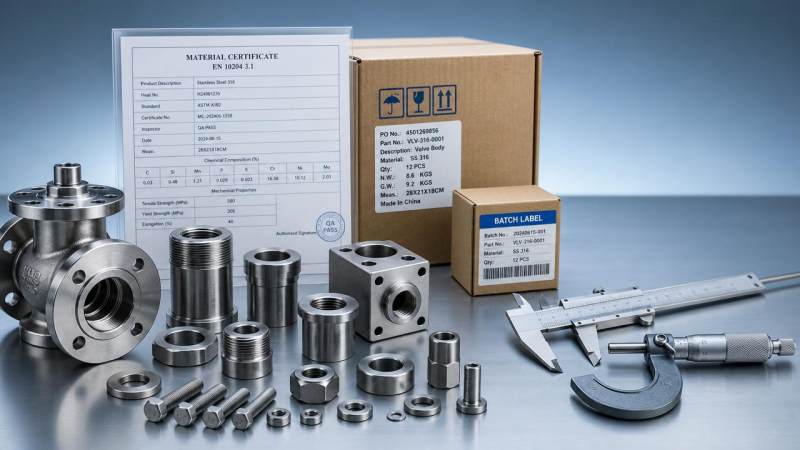
Choosing an Industrial & Manufacturing machinery parts exporter is not just a sourcing task—it is a quality and safety decision. For QA teams and safety managers, verifying supplier capability means looking beyond brochures to assess production controls, compliance records, traceability, and long-term reliability. This guide explains how to validate an exporter before purchase, reduce operational risk, and protect performance in demanding industrial environments.
For quality control and safety leaders, the real risk often appears after installation: premature wear, undocumented material substitutions, missing batch data, or inconsistent tolerances that trigger downtime. In regulated and high-consequence sectors, including healthcare manufacturing, laboratory infrastructure, and precision industrial environments, a weak exporter can introduce both operational and compliance exposure within 30 to 90 days of deployment.
That is why verification should be handled as a structured technical review, not a price comparison exercise. When evaluating an Industrial & Manufacturing machinery parts exporter, buyers should examine process discipline, inspection evidence, document control, and service responsiveness across the full lifecycle, from pre-shipment checks to corrective action support.
Why exporter verification matters before the first order
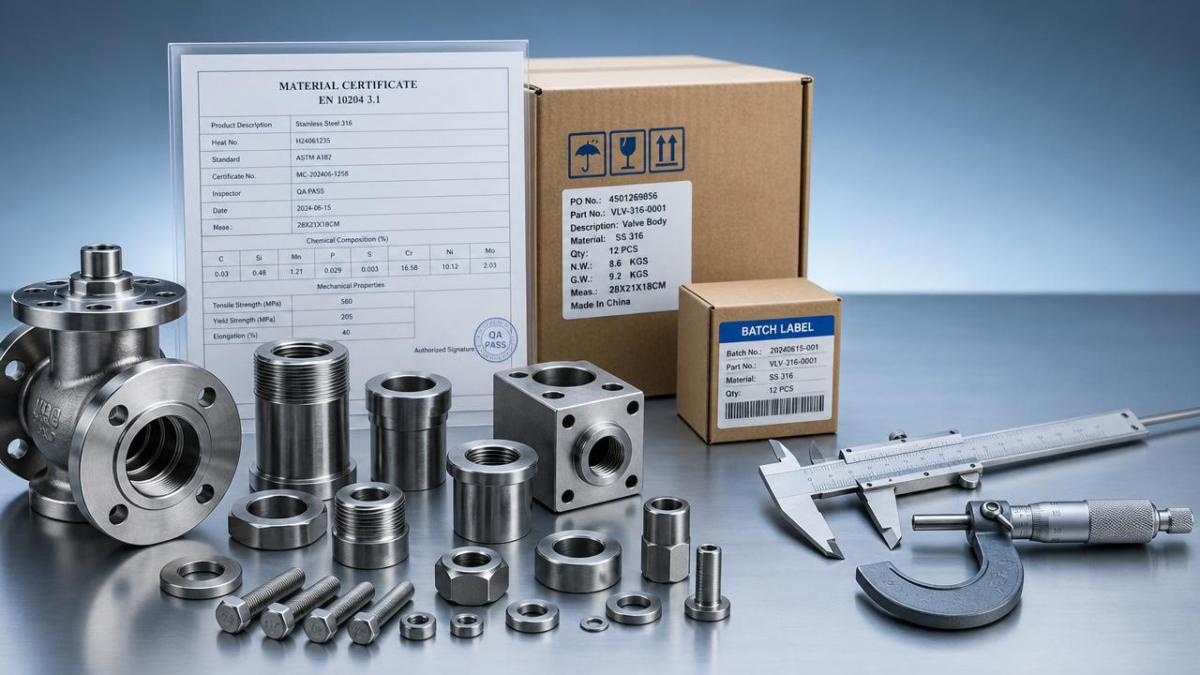
A capable exporter does more than move parts across borders. It preserves specification integrity from raw material intake to packaging, export documentation, and after-sales issue handling. For rotating equipment, fabricated assemblies, machined shafts, housings, valves, or fastener systems, even a deviation of ±0.1 mm to ±0.3 mm can affect fit, vibration, or sealing performance.
In safety-sensitive operations, the cost of an unverified supplier is rarely limited to replacement parts. It can include line stoppage, emergency maintenance, delayed validation, additional incoming inspection hours, and incident investigation. A single nonconforming batch can add 2 to 4 weeks to a project schedule if root cause evidence is incomplete.
Common failure points seen by QA and safety teams
- Material grade on the certificate does not match the actual alloy or polymer received.
- Dimensional reports cover only first articles, while production lots show wider variation.
- Heat treatment, surface finish, or coating thickness data is missing or inconsistent.
- Traceability stops at the carton level rather than the lot, batch, or serial level.
- Corrective actions are verbal, with no 8D, CAPA, or documented containment plan.
What a reliable exporter should be able to prove
A credible Industrial & Manufacturing machinery parts exporter should be able to provide evidence in 5 core areas: manufacturing capability, quality management, traceability, regulatory or standards alignment, and post-shipment support. Buyers should request documents dated within the last 12 months wherever possible, rather than relying on old qualification files.
The table below shows a practical verification framework that helps QA teams rank supplier maturity before placing even a pilot order.
If the exporter cannot provide consistent evidence across these four areas within 5 to 7 business days, that is an early warning sign. Delayed, incomplete, or contradictory documentation often predicts future issues in shipment accuracy, change control, and complaint response.
How to verify manufacturing and quality capability
The fastest way to assess an Industrial & Manufacturing machinery parts exporter is to move from claims to measurable controls. Ask how parts are made, checked, identified, packaged, and released. A supplier with mature systems should explain this in a clear sequence of 6 to 8 steps, not vague marketing language.
1. Review process stability, not only final inspection
Final inspection catches defects; it does not prevent them. QA teams should ask for process control plans showing critical dimensions, torque values, hardness ranges, coating thickness, or leak-test thresholds. For example, if a bushing diameter tolerance is ±0.02 mm, the exporter should show how that feature is monitored during production, not only at the end.
Look for evidence of in-process checks at defined frequencies such as every 30 pieces, every 2 hours, or at each machine setup change. Stable suppliers usually define reaction plans as well, including line stop criteria, segregation method, and re-inspection scope.
2. Confirm measurement capability and calibration discipline
Measurement error can hide nonconforming parts. Ask which tools are used for critical characteristics: micrometers, CMMs, thread gauges, roughness meters, pressure rigs, or hardness testers. Calibration intervals are commonly 6 or 12 months, but what matters is whether instruments used on your parts are clearly identified and current.
If the exporter provides dimensional reports, check whether the sample size matches the lot risk. A 3-piece sample for a 5,000-piece order may be too limited for high-risk features. For first orders, a stronger approach is first article inspection plus random sampling from at least 2 or 3 different production time points.
Useful questions to ask during technical review
- Which dimensions or performance characteristics are classified as critical?
- How often are those features measured during production?
- What is the containment method if one reading falls outside the limit?
- Which records are retained for 12, 24, or 36 months?
- Are special processes handled in-house or outsourced?
3. Verify traceability to batch, operator, and process date
For safety managers, traceability is not optional. When a field issue occurs, you need to identify the affected lots within hours, not days. Ask whether the exporter can trace parts back to raw material heat number, machine route, operator, inspection record, and packing date. Strong traceability reduces the scope of quarantine and speeds root cause analysis.
This matters even more where machinery parts support medical device production, clean utility systems, laboratory automation, or precision assembly cells. In these settings, contamination risk, material integrity, and maintenance history can all become part of a broader compliance file.
Documents, audits, and sample orders that reveal the truth
Documents alone are not enough, but they are the starting point. The next step is to compare paperwork against behavior. A robust exporter should demonstrate alignment between certificates, inspection reports, production photos, shipping labels, and actual sample performance. Any mismatch across these items deserves follow-up before commercial approval.
A practical 3-stage validation path
Many QA departments use a phased approach that starts small and increases confidence through evidence. This reduces exposure while still allowing procurement to move forward on schedule.
This 3-stage model usually takes 2 to 6 weeks, depending on part complexity and document readiness. It is often faster and less costly than recovering from one failed production lot after full approval.
How to use a pilot order effectively
A pilot order should not be treated as routine purchasing. It is a controlled test. Define 4 to 6 acceptance criteria in advance, such as dimensional pass rate, packaging integrity, document completeness, on-time delivery window, and response time for technical questions. This turns the pilot into a real qualification event.
For higher-risk components, include destructive or functional checks where appropriate, such as torque retention, fatigue screening, pressure holding, or corrosion exposure. Even basic checks over 24 to 72 hours can reveal whether the exporter’s process is stable enough for scaled orders.
Risk indicators that should delay or stop approval
Not every warning sign requires immediate rejection, but some should pause the buying decision. A quality issue is manageable when it is transparent and controlled. It becomes dangerous when the exporter hides process changes, avoids data requests, or cannot explain how nonconforming parts are contained.
Red flags in communication and quality records
- Inspection reports are edited PDFs with no inspector name, date, or revision reference.
- Material certificates are generic and not tied to actual lot codes on the shipment.
- Lead time changes from 3 weeks to 8 weeks without capacity explanation.
- Dimensions repeatedly pass on paper but fail during your incoming verification.
- Corrective action closes in 24 hours without containment, root cause, or verification data.
Commercial terms that affect quality risk
Quality verification also includes commercial clarity. Confirm who owns tooling, what revision level is frozen, how engineering changes are approved, and what happens if a lot is rejected. If the exporter offers unusually low pricing, ask whether material grade, finishing scope, or inspection depth has been reduced.
For long-term supply, define service expectations early: complaint response within 24 to 48 hours, containment within 72 hours, and formal corrective action within 5 to 10 business days. These timelines are often more valuable than small unit-price savings when equipment uptime matters.
A simple approval threshold for internal use
Many organizations use a weighted scorecard. For example, process capability may count for 30%, traceability 20%, documentation quality 20%, pilot order performance 20%, and communication responsiveness 10%. Suppliers below a defined threshold, such as 75 out of 100, can be held for corrective action before full approval.
Building a stronger sourcing decision in high-consequence sectors
In environments linked to healthcare infrastructure, lab systems, and advanced manufacturing, part quality is not an isolated issue. It affects validation, equipment reliability, maintenance scheduling, and documentation readiness. That is why verification should connect engineering evidence with procurement decisions rather than sit in separate silos.
This is also where independent benchmarking adds value. A data-driven review of tolerances, material consistency, fatigue behavior, sealing performance, or sensor interface compatibility can help buyers compare suppliers on engineering truth instead of sales language. For organizations navigating technical sourcing risk, that extra layer of scrutiny supports better decisions over the next 12 to 36 months.
Final buyer checklist before release of a production PO
- Approve the latest drawing, revision, and inspection criteria.
- Confirm lot-level traceability and document retention rules.
- Review pilot order results against pre-agreed acceptance targets.
- Lock packaging, labeling, and shipping protection requirements.
- Define escalation contacts for quality, logistics, and engineering issues.
- Record response-time expectations for complaint handling and CAPA.
Selecting an Industrial & Manufacturing machinery parts exporter should be based on documented control, repeatable output, and transparent problem solving. For QA teams and safety managers, the best supplier is not simply the one that ships fastest or quotes lowest, but the one that can prove consistency from raw material to final delivery.
VitalSync Metrics supports technical decision-makers who need deeper validation in complex supply chains, especially where performance claims must be tested against engineering evidence. If you need help benchmarking supplier data, reviewing verification files, or building a stronger qualification framework, contact us today to discuss your sourcing scenario, request a tailored assessment, or learn more solutions for risk-based supplier evaluation.
Recommended News
- 2026.10.15Medical Packaging Heat Seal Testing: Seal Strength vs. Seal Integrity TestsDr. Julian Rossi (RehabTech Specialist)
- 2026.10.14Clinic Supplier Comparison: Evaluating Cost, Delivery Reliability, and SupportDr. Alistair Thorne (Senior Biomedical Engineer)
- 2026.10.13Engineering Performance Testing Services: Evaluating Test Methods and AccuracyDr. Alistair Thorne (Senior Biomedical Engineer)
The VitalSync Intelligence Brief
Receive daily deep-dives into MedTech innovations and regulatory shifts.