 Get Insights

How to vet an industrial equipment supplier in Germany

Choosing an Industrial & Manufacturing equipment supplier in Germany is not just about price or delivery speed—it is about proving engineering quality, regulatory discipline, and long-term supply reliability. For complex sourcing programs, a structured vetting process reduces risk, tests technical claims, and confirms whether a supplier can support real operating conditions after installation, validation, and scale-up.
Why a checklist matters when evaluating an Industrial & Manufacturing equipment supplier in Germany
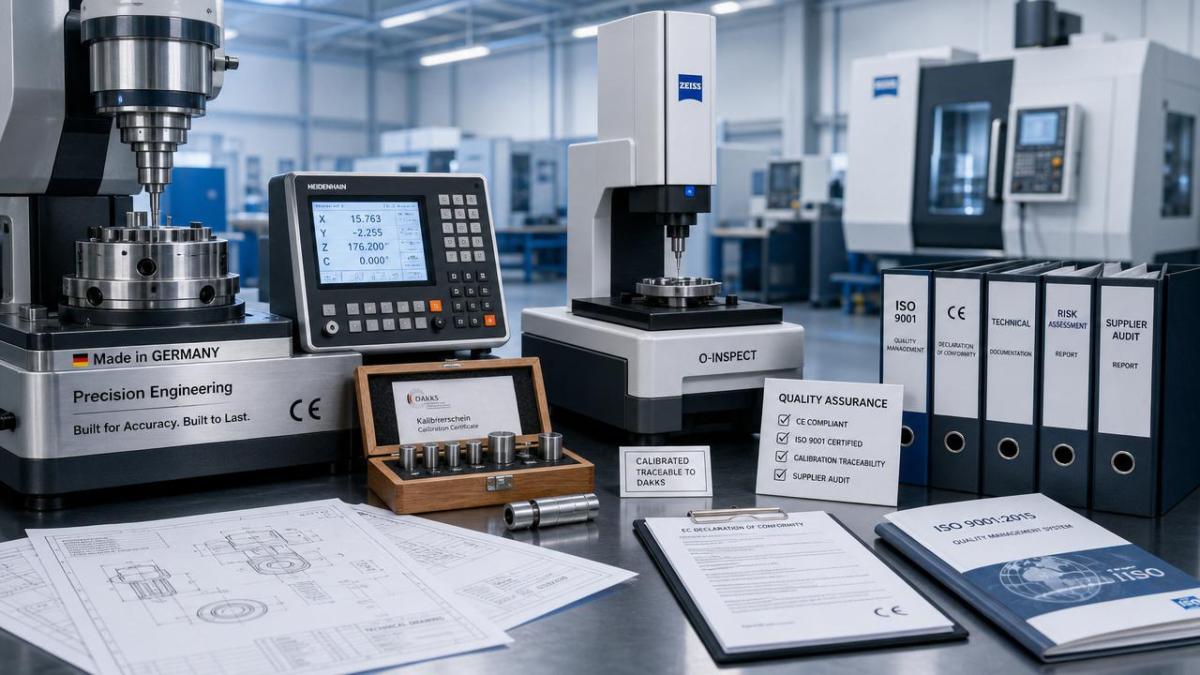
Germany is associated with precision engineering, but supplier quality still varies by niche, ownership model, subcontracting depth, and export experience. A checklist prevents brand reputation from replacing evidence.
This matters even more in healthcare, life sciences, and regulated production. Equipment may affect sterility, traceability, calibration integrity, data capture, and validation readiness.
VitalSync Metrics (VSM) approaches supplier screening through measurable proof. Marketing language is secondary. What matters is engineering documentation, process capability, compliance history, and field performance under stress.
Core vetting checklist for an Industrial & Manufacturing equipment supplier in Germany
- Verify legal identity, beneficial ownership, export scope, and manufacturing footprint before discussing technical fit or price competitiveness.
- Request equipment datasheets, tolerance tables, validation protocols, and revision-controlled manuals rather than brochure-level claims.
- Check ISO certifications, CE documentation, and sector-specific compliance records relevant to machinery, electrical safety, and regulated production environments.
- Map critical components and ask which parts are made in-house versus outsourced to sub-tier vendors.
- Audit quality control methods, including incoming inspection, process checks, final acceptance testing, and nonconformance handling.
- Review calibration traceability, metrology practices, and maintenance intervals for machines with measurement or process-control functions.
- Assess software architecture, cybersecurity controls, data export formats, and integration options for MES, ERP, LIMS, or SCADA systems.
- Confirm spare parts strategy, service response times, technician availability, and warranty exclusions across your operating regions.
- Test lead-time realism by comparing quoted schedules with component sourcing risk and prior delivery performance.
- Inspect FAT and SAT procedures to ensure the supplier can prove performance before shipment and after commissioning.
- Request reference projects with comparable duty cycles, materials, throughput targets, and regulatory expectations.
- Score total cost of ownership, including validation effort, downtime exposure, consumables, software licensing, and operator training.
What to ask for in the document room
- General arrangement drawings, P&IDs, electrical schematics, and bill of materials for critical assemblies.
- Factory acceptance test templates, deviation logs, CAPA records, and sample maintenance schedules.
- Material certificates, weld qualifications, surface finish data, and cleaning or sterilization compatibility evidence where applicable.
- Software validation notes, user access control logic, audit trail capability, and backup or recovery procedures.
A strong Industrial & Manufacturing equipment supplier in Germany will provide this material quickly, clearly, and with revision control. Delays, redactions without reason, or inconsistent file versions usually signal internal process weakness.
How to judge technical credibility beyond the sales presentation
Start with performance claims. If a supplier states higher throughput, lower vibration, or tighter repeatability, ask which test method produced the result and under what load conditions.
Then review failure behavior. Mature engineering teams discuss wear points, preventive replacement cycles, and process limits without hesitation. Vague answers often mean insufficient field learning.
For regulated sectors, technical credibility also includes documentation discipline. If change control is weak, equipment consistency over time may be impossible to guarantee.
Useful indicators during a site visit
- Observe whether workstations show current instructions, traceable batch records, and visible quality checkpoints.
- Inspect how finished assemblies are protected, labeled, and segregated from rework or nonconforming material.
- Ask operators to explain process controls rather than relying only on management presentations.
Scenario-based checks for different applications
For automated production lines
Focus on uptime architecture. Redundancy, spare sensor availability, PLC compatibility, and remote diagnostics often matter more than headline speed.
An Industrial & Manufacturing equipment supplier in Germany serving automation should also prove safe commissioning practices, line balancing support, and documented changeover procedures.
For laboratory or life sciences environments
Check surface materials, cleanability, data integrity, calibration logic, and environmental stability. These details directly affect validation and audit readiness.
Where equipment influences sample integrity, sterility, or measurable output quality, ask for documented drift performance and alarm handling logic.
For heavy industrial equipment
Prioritize structural fatigue data, maintenance access, parts interchangeability, and performance under variable duty cycles. Heavy assets fail expensively and rarely on a convenient schedule.
Here, a capable Industrial & Manufacturing equipment supplier in Germany should provide service planning, wear-part forecasts, and realistic lifecycle cost models.
Commonly overlooked risks during supplier selection
Sub-tier dependency
Some suppliers present as manufacturers but assemble around outsourced critical modules. This increases variability, lead-time exposure, and root-cause complexity during failure investigations.
Weak after-sales infrastructure
A strong machine with weak field support becomes a fragile investment. Verify regional service coverage, remote support language, and spare parts stocking strategy.
Incomplete digital interoperability
Many systems claim Industry 4.0 readiness but export data in limited or proprietary formats. Integration cost can exceed the hardware discount.
Compliance by assumption
Do not assume German origin automatically guarantees every applicable standard. Compliance must be demonstrated for the exact model, configuration, and destination market.
A practical execution method
- Create a weighted scorecard covering engineering proof, compliance, service capacity, delivery reliability, and lifecycle economics.
- Shortlist three to five candidates and use the same evidence request package for each one.
- Run a technical review meeting before any commercial negotiation to separate engineering fit from price pressure.
- Perform a site audit or remote process audit focused on quality records, assembly controls, and traceability discipline.
- Request a pilot, FAT witness, sample run, or benchmark test for critical performance claims.
- Negotiate service-level terms, spare parts commitments, software access, and change-notification obligations into the contract.
This method helps compare every Industrial & Manufacturing equipment supplier in Germany using evidence instead of impression. It also creates an audit trail for future supplier reviews.
Conclusion and next step
The right Industrial & Manufacturing equipment supplier in Germany should prove capability through documents, tests, traceability, and service readiness—not branding alone.
A disciplined checklist reduces technical uncertainty, supports compliance decisions, and protects long-term operating performance in manufacturing, laboratory, and healthcare-linked environments.
Use a structured evidence request, score suppliers consistently, and validate critical claims before contract signature. That is the fastest way to source with confidence and avoid expensive surprises later.
Recommended News
- 2026.10.15Medical Packaging Heat Seal Testing: Seal Strength vs. Seal Integrity TestsDr. Julian Rossi (RehabTech Specialist)
- 2026.10.14Clinic Supplier Comparison: Evaluating Cost, Delivery Reliability, and SupportDr. Alistair Thorne (Senior Biomedical Engineer)
- 2026.10.13Engineering Performance Testing Services: Evaluating Test Methods and AccuracyDr. Alistair Thorne (Senior Biomedical Engineer)
The VitalSync Intelligence Brief
Receive daily deep-dives into MedTech innovations and regulatory shifts.