
Hospital furniture wholesale: which specs matter most?

In hospital furniture wholesale, the most important specs go far beyond dimensions and price. Procurement teams now compare load capacity, infection-control materials, ergonomic safety, digital integration, and supply chain verification to reduce risk across healthcare equipment sourcing. For buyers evaluating everything from an ICU monitor supplier to a smart wheelchair manufacturer, understanding which technical standards truly affect performance is essential to making compliant, durable, and cost-effective decisions.
What should buyers evaluate first in hospital furniture wholesale?
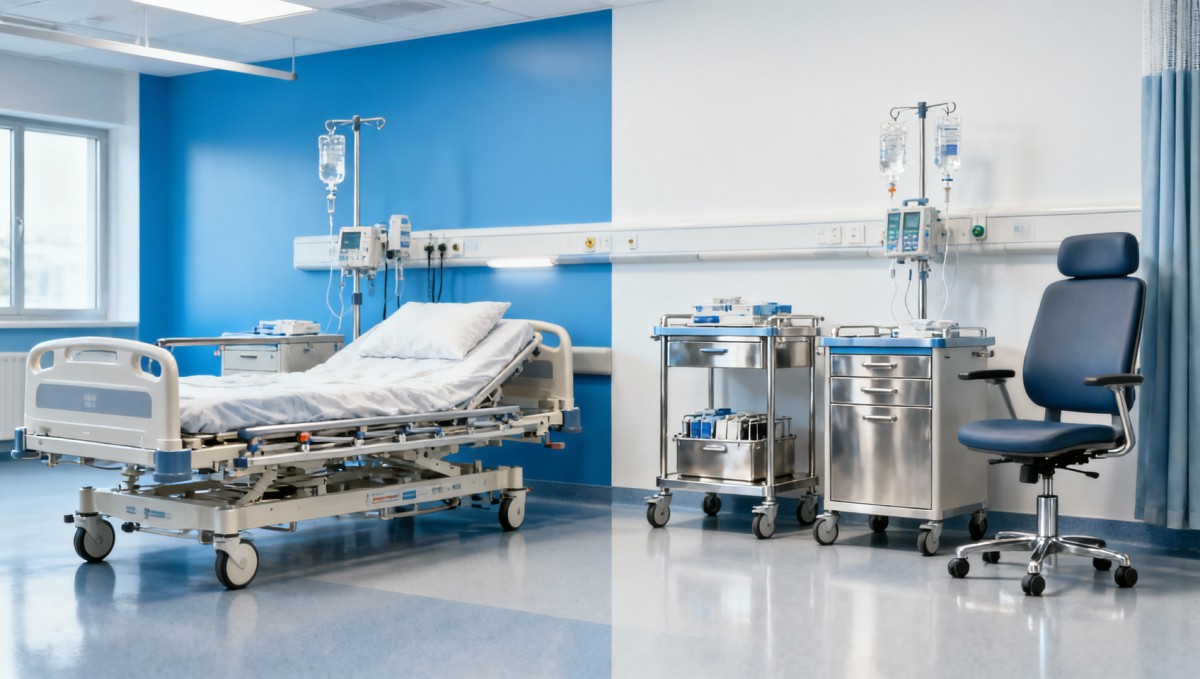
Hospital furniture wholesale decisions often fail when teams start with unit price, color options, or catalog appearance. In real healthcare environments, the first screening step should focus on 5 core dimensions: structural safety, infection control, ergonomic usability, compatibility with clinical workflow, and documentation quality. These points matter across wards, outpatient clinics, operating support zones, emergency departments, and laboratory-adjacent spaces.
For procurement personnel, the challenge is not simply choosing between beds, trolleys, overbed tables, treatment chairs, or storage units. The challenge is confirming whether a product can perform reliably over 3–7 years of repetitive use, frequent cleaning cycles, and mixed operator handling. A low-cost frame that deforms after repeated transfers can create hidden lifecycle costs that exceed the initial savings within 12–24 months.
For users and operators, the key question is practical: does the furniture support safe movement, quick cleaning, and efficient patient interaction during every shift? For enterprise decision-makers, the concern is broader: can the specification package stand up to tender review, internal risk assessment, and cross-border compliance checks, especially when multiple suppliers are involved in one project phase?
This is where VitalSync Metrics (VSM) adds value. Instead of relying on promotional language, VSM approaches hospital furniture wholesale as a technical verification exercise. That means comparing material declarations, load claims, moving-part tolerances, cleaning compatibility, and long-term durability indicators in a structured way, helping procurement teams filter marketing claims from engineering reality before issuing purchase commitments.
The 5 screening questions that reduce procurement risk
- What is the verified safe working load, and does it cover real patient transfer conditions rather than only static showroom loads?
- Which contact surfaces are designed for frequent disinfection, and are the material finishes compatible with common hospital cleaning agents?
- How many adjustment points, lock points, or moving joints are included, and what maintenance burden will these create over each quarter?
- Can the furniture integrate with surrounding equipment, such as monitors, accessories, storage modules, cable routing, or mobility pathways?
- Does the supplier provide traceable technical files, test references, cleaning guidance, and spare-parts support for a realistic service window?
Which technical specs matter most beyond dimensions and price?
In hospital furniture wholesale, the most important specifications vary by product category, but several technical indicators repeatedly shape performance. Safe working load, dynamic stability, caster performance, joint fatigue resistance, edge sealing, coating durability, and disinfection tolerance are usually more decisive than nominal size. A bed frame, treatment chair, or instrument trolley may fit the room perfectly and still fail under routine use if these deeper specs are weak.
Safe working load should be reviewed carefully because suppliers may state static capacity without clarifying movement conditions. In many care settings, repeated patient repositioning, transport vibration, and operator-assisted transfer produce dynamic stress. For practical comparison, buyers should request both static and operational load context, plus whether the claim covers accessories, mattress systems, attached devices, or side-rail use. Typical review ranges may span 150–250 kg depending on product type and clinical use.
Material selection also has direct implications for infection control and service life. Powder-coated steel, stainless steel, aluminum structures, compact laminates, molded polymers, and antimicrobial surface treatments each involve trade-offs. Buyers should not assume that a smooth-looking finish is automatically suitable for aggressive cleaning. The key issue is whether the material can tolerate repeated exposure over monthly and quarterly sanitation cycles without cracking, swelling, delaminating, or exposing joints where contaminants accumulate.
Mobility-related specs are often underestimated. Caster diameter, brake reliability, rolling resistance, directional lock options, and floor compatibility influence staff effort and patient safety every day. In high-use departments, poor caster design can turn a clinically acceptable trolley into an operational bottleneck within weeks. The same applies to height adjustment range, hand-control durability, and cable management if the furniture supports connected healthcare equipment.
Technical parameters buyers should request before comparing quotes
The table below gives a practical hospital furniture wholesale checklist for technical comparison. It helps information researchers and procurement teams separate appearance-based selection from operational performance evaluation.
When procurement teams align supplier quotations against these parameters, price comparisons become much more meaningful. A quote that looks 8%–15% lower can become less attractive once repair intervals, cleaning compatibility, or replacement frequency are included in the evaluation.
Three specs that are often ignored until failure happens
First, weld quality and joint reinforcement. These are rarely visible in brochures, yet they strongly influence fatigue life. Second, edge geometry and seam closure. Poor sealing creates sanitation blind spots that matter in patient-care areas. Third, replacement component availability. If wheels, rails, actuators, or pads are unavailable after 18 months, a technically repairable unit can become operational waste.
How do specifications change by clinical setting?
Not all hospital furniture wholesale projects should be evaluated with the same specification priorities. An ICU bed, a day-treatment recliner, a ward bedside cabinet, and a laboratory support workstation do not face the same stress profile. Clinical setting determines not only dimensions and accessories, but also cleaning frequency, mobility requirements, patient dependency level, and device integration needs.
In ICU and high-acuity areas, stability, side access, cable routing, accessory rail strength, and compatibility with monitoring equipment become higher priorities. Furniture in these settings often supports continuous operation for 24 hours a day and requires rapid cleaning between interventions. Procurement teams should check whether frames and surfaces remain reliable under frequent adjustment, attached equipment weight, and repeated staff interaction during every shift.
In outpatient and infusion settings, comfort and operator ergonomics can be just as important as structural capacity. Reclining mechanisms, transfer height, arm support stability, and upholstery cleanability affect patient turnover and staff workflow. Here, a narrow focus on frame load alone may miss the operational impact of poor reset speed, difficult-to-clean seams, or limited access around the chair footprint.
For laboratories and technical support zones, furniture may need chemical resistance, vibration control, modular storage, and long work-surface durability rather than patient-transfer features. VSM’s benchmarking perspective is valuable because it treats each environment as a performance system. Instead of buying by category name alone, buyers can match furniture specifications to actual use conditions, maintenance cycles, and compliance expectations.
Scenario-based specification priorities
The next table compares how hospital furniture wholesale priorities shift across common healthcare environments. This can help procurement teams avoid applying one generic tender matrix to every department.
This comparison shows why a single “best” specification rarely exists. A better approach is to define 3–5 weighted criteria per department, then compare suppliers against those criteria rather than using broad marketing labels such as premium, heavy-duty, or advanced.
A simple weighting method for mixed projects
In multi-department hospital furniture wholesale projects, many teams use a weighted matrix across safety, cleanability, operator ergonomics, maintainability, and commercial terms. Even a basic 4-step process can improve selection quality: define use cases, set weighted specs, shortlist suppliers, and validate documents before award. This reduces mismatch between tender language and real clinical use.
What compliance and documentation should procurement teams request?
Compliance in hospital furniture wholesale does not always mean the same thing for every item, especially when the project includes both general furniture and clinically adjacent equipment. Buyers should distinguish between products that are primarily furnishing items and those that may fall under stricter healthcare-related technical controls due to intended use, patient support functions, or integration with other medical systems.
Even where formal medical device classification does not apply, documentation still matters. Procurement teams should request technical datasheets, material declarations, cleaning and disinfection guidance, warranty terms, spare-parts availability, preventive maintenance instructions where relevant, and manufacturing traceability details. In cross-border projects, it is also prudent to ask how the supplier aligns product claims with applicable regulatory frameworks, including MDR or IVDR context when bundled solutions are involved.
For decision-makers, the practical objective is to reduce ambiguity. If a supplier cannot explain how load claims were established, which surfaces were tested for chemical compatibility, or how replacement components will be managed over 24–60 months, the procurement risk increases. Missing documentation can delay internal approvals, import processing, installation planning, and final acceptance.
VSM’s role is especially relevant at this stage because verification is not the same as brand comparison. VSM helps buyers analyze technical integrity across documents, not just sales presentations. That includes checking whether specification sheets are internally consistent, whether compliance language is used appropriately, and whether the operational evidence supports the purchasing claim.
Minimum document set for a disciplined review
- A current technical specification sheet with load data, dimensions, material descriptions, and accessory compatibility.
- Cleaning and disinfection instructions that identify compatible agents, exposure considerations, and surface limitations.
- Installation, handover, and maintenance guidance for movable or adjustable products, including routine inspection points every 3–6 months where applicable.
- Warranty and spare-parts policy covering realistic support periods, not only shipment acceptance.
- Traceability or production-batch information sufficient for quality review and post-delivery issue handling.
Common compliance misconception
A frequent mistake is assuming that the presence of one certificate or one conformity statement resolves all procurement questions. In reality, compliance review should connect intended use, technical design, cleaning conditions, and support documentation. The most useful procurement file is not the largest file. It is the one that clearly explains what the product is designed to do, under which conditions, and with what limitations.
How can buyers balance cost, lifecycle value, and supplier reliability?
Cost control in hospital furniture wholesale should extend beyond purchase price to include maintenance, downtime, replacement parts, operator efficiency, and expected service life. A cheaper product may still be the right choice for low-intensity use zones, short deployment cycles, or temporary facilities. But in high-frequency clinical settings, lower acquisition cost can quickly be offset by higher cleaning damage, wheel failures, upholstery replacement, or reduced usability.
Procurement teams usually achieve better results when they compare total cost in 3 layers: upfront acquisition, operating burden, and replacement risk. For example, if one trolley line requires caster replacement every 9–12 months while another typically operates longer under the same floor conditions, the apparent savings at the quotation stage may not survive the first annual review. The same principle applies to adjustable mechanisms, side rails, upholstery seams, and laminate edge failures.
Supplier reliability should also be tested operationally, not only commercially. Can the supplier confirm realistic lead times such as 4–8 weeks for standard orders? Can they support phased delivery for multi-site projects? Do they maintain consistency across batches when a hospital expands after the initial fit-out? These questions directly affect project execution, especially where the furniture package must align with equipment installation, infection-control validation, or department opening schedules.
For organizations sourcing internationally, independent benchmarking can reduce risk before contract signature. VSM helps evaluate whether quoted specifications, lifecycle assumptions, and compliance files support the business case. That is particularly useful when decision-makers must compare established suppliers with emerging manufacturers, or when a mixed package includes hospital furniture together with digital-care or monitoring-adjacent components.
A practical 6-point procurement checklist
- Define the use intensity: low, medium, or high frequency, and link it to expected duty cycles.
- Separate mandatory specifications from preferred features before requesting quotations.
- Ask for documentation on load, materials, cleaning compatibility, and service support at the same time.
- Score at least 4 dimensions: technical fit, compliance clarity, delivery reliability, and lifecycle cost.
- Review spare-parts access and post-installation support for a 24–36 month horizon.
- Use independent technical benchmarking when supplier claims are difficult to compare directly.
FAQ: common hospital furniture wholesale questions from buyers and operators
Search intent around hospital furniture wholesale is usually practical. Buyers want clearer selection criteria, users want safer and easier operation, and decision-makers want fewer surprises after purchase. The questions below address frequent concerns that appear during sourcing and technical review.
How do I compare two suppliers if both claim the same load capacity?
Ask whether the number refers to static load, working load, or a dynamic condition. Then check if the figure includes accessories, movement, and repeated use. Two products may both claim 200 kg, but one may be designed for low-frequency support while the other is engineered for continuous clinical use. Without that context, the number has limited procurement value.
What is the most overlooked specification in hospital furniture wholesale?
Cleaning compatibility is one of the most overlooked issues. Many buyers review structure and price but do not test how coatings, plastics, upholstery, or laminate edges tolerate repeated disinfection. In hospitals, this can affect appearance, hygiene, and service life within the first 6–18 months. Always request cleaning guidance and material compatibility details.
How long is a typical delivery cycle?
Delivery depends on product complexity, quantity, and customization. Standard hospital furniture wholesale orders may move in roughly 4–8 weeks, while customized configurations, multi-site shipments, or mixed packages can take longer. The better question is whether the supplier can provide a phased delivery plan, packaging logic, and acceptance schedule that matches the facility opening sequence.
When should buyers request independent technical review?
Independent review is useful when quotations are close in price but differ in technical language, when documentation quality is inconsistent, when a project involves cross-border compliance concerns, or when the furniture package interfaces with broader MedTech infrastructure. It is also valuable when a procurement team must justify a decision internally to finance, engineering, infection-control, and operations stakeholders.
Why work with VSM when specifications are hard to verify?
Hospital furniture wholesale is no longer a simple catalog transaction. Buyers increasingly need to verify technical integrity, clarify compliance language, compare supplier claims, and protect lifecycle value under real operating conditions. That is especially true when furniture procurement overlaps with digital-health infrastructure, laboratory planning, or broader healthcare equipment sourcing.
VitalSync Metrics (VSM) supports this process by translating engineering parameters into clear procurement intelligence. Instead of asking buyers to rely on sales positioning, VSM helps evaluate measurable factors such as material durability, maintenance logic, specification consistency, and evidence quality. This approach is useful for procurement directors, MedTech startups, facility planners, and technical teams that need more than surface-level supplier comparison.
If you are reviewing hospital furniture wholesale options, VSM can help you examine 4 critical areas before commitment: parameter confirmation, product selection logic, delivery and support assumptions, and compliance-related documentation gaps. This is particularly valuable when tenders involve multiple departments, mixed-use environments, or supplier proposals that look similar on paper but differ in technical credibility.
Contact VSM to discuss specification review, supplier benchmarking, delivery planning, custom sourcing criteria, documentation checks, sample evaluation support, or quotation comparison. A disciplined technical review at the start can prevent delays, mismatched purchases, and avoidable replacement costs later in the project lifecycle.
- surface treatment
- EMS
- ESS
- hospital furniture
- PPE
- EdTech
- procurement
- AR
- supply chain
- Cement
- benchmarking
- technical integrity
- technical benchmarking
- digital integration
- supply chain
- technical verification
- healthcare equipment
- supply chain verification
- Packaging
- icu monitor supplier
- smart wheelchair manufacturer
- hospital furniture wholesale
Recommended News
- 2026.04.17Hospital equipment standards shaping modern rehab devicesSarah Jenkins (Laboratory Infrastructure Consultant)
- 2026.04.17Laboratory equipment validation errors in sample storageDr. Hideo Tanaka (Imaging Systems Analyst)
- 2026.04.17Medical equipment certification delays in remote monitoringLydia Vancini (Regulatory Compliance Lead)
The VitalSync Intelligence Brief
Receive daily deep-dives into MedTech innovations and regulatory shifts.