 Get Insights

FDA Tightens Cybersecurity Filing Needs for Connected IVD Hardware
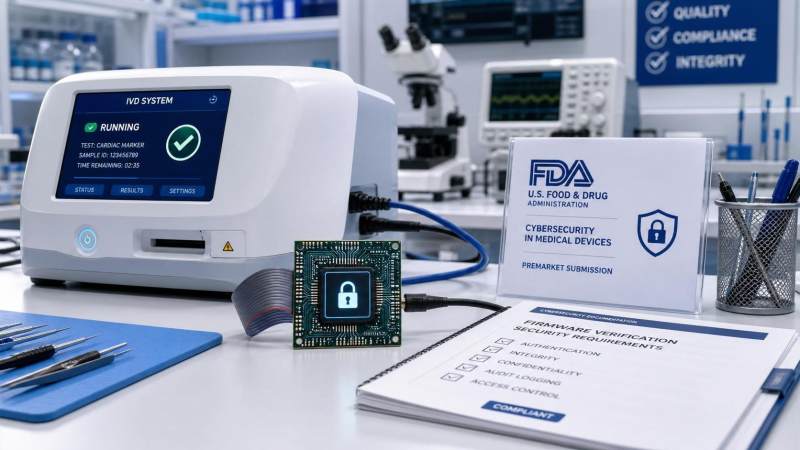
On July 18, 2026, the FDA released new guidance on cybersecurity for remote monitoring devices, making network security documentation a more explicit part of market entry for connected products, including IVD hardware. For exporters, manufacturers, registration teams, distributors, and compliance service providers tied to the U.S. market, this is worth close attention because the change reaches beyond product design and into submission preparation, testing timelines, customs flow, and downstream acceptance.
What the new FDA guidance now requires
The FDA issued Cybersecurity in Remote Monitoring Devices: Guidance for Industry on July 18, 2026. According to the provided event summary, the guidance requires all remote monitoring devices with connectivity features, including IVD hardware, to provide firmware signature verification, secure boot, and OTA update audit logs in 510(k) or De Novo submissions.
The same summary states that this guidance directly affects the registration path and type-testing cycle of Chinese IVD hardware exporters to the United States. It also states that products not adapted to the new requirements may face customs clearance delays and refusal by terminal distributors.
Where the pressure is likely to appear first
Submission and market-entry work will become more document-driven
From an industry perspective, exporters and registration-facing manufacturers are likely to feel the first impact in submission planning. The reason is straightforward: firmware signature verification, secure boot, and OTA update audit logs are no longer peripheral technical topics if they must be included in 510(k) or De Novo materials. In practice, this means compliance teams will need to pay closer attention to whether technical files, validation records, and device-level cybersecurity descriptions are complete enough for filing.
Testing and delivery schedules may become less flexible
Manufacturing and testing-related parties may see pressure on scheduling because the event summary explicitly points to an effect on type-testing cycles. Analysis shows that when a rule change adds new verification expectations, it can alter the order in which firmware, validation, and submission materials are prepared. For companies already working against shipment deadlines, the main concern is whether compliance readiness now becomes a gating factor for delivery timing.
Distributors and channel partners may tighten acceptance checks
Channel participants and terminal distributors may also need to reassess intake standards. The confirmed information already notes a risk of distributor refusal for products that have not been adapted. What deserves closer attention is that commercial acceptance may begin to depend more heavily on whether a supplier can demonstrate aligned cybersecurity documentation and traceable update controls, rather than relying only on legacy product qualification habits.
Supply-chain and service partners may be drawn into the compliance process
Supply-chain service providers, testing support organizations, and after-sales teams may be affected because firmware control, boot integrity, and OTA log retention are not isolated to one department. Observably, any handoff involving configuration, installation status, post-shipment updates, or traceability could become more sensitive if customers or channel partners request clearer supporting records before accepting delivery or moving goods through customs procedures.
What companies should watch in current operations
Check whether existing technical files match the new filing expectation
Analysis shows that companies shipping connected IVD hardware to the U.S. should first review whether their current submission packages and supporting technical documents can clearly cover firmware signature verification, secure boot, and OTA update audit logs. If those elements exist in engineering practice but are weakly documented, the filing risk may still remain.
Reassess validation sequencing around firmware updates
What deserves closer attention is the validation path around firmware changes. Because the guidance ties cybersecurity elements to 510(k) or De Novo submissions, companies should watch whether their current firmware verification flow, release records, and audit-log retention process are organized in a way that supports regulatory review. The provided information does not define detailed execution criteria, so this remains an area for ongoing monitoring rather than fixed interpretation.
Review customs and distribution handoff risk before shipment
The event summary specifically mentions customs clearance delays and terminal distributor rejection for products that are not aligned with the new guidance. From an operational perspective, exporters and channel-facing teams should therefore pay attention to shipment documentation, product readiness claims, and the consistency between regulatory files and delivery-stage technical evidence.
Watch for changes in procurement and customer-side documentation requests
Observably, procurement teams, distributors, and downstream buyers may begin asking for more explicit proof tied to cybersecurity functions in connected hardware. It is more appropriate to understand this as a developing documentation and acceptance issue: even where formal execution details are still being watched, customer-side review standards may move faster than internal preparation cycles.
Why this looks more like an execution signal than a distant policy note
Analysis shows that this update should not be read as a general cybersecurity statement alone. The key point is that the guidance links specific technical controls to recognized U.S. submission routes for connected remote monitoring devices, including IVD hardware. That makes it relevant to real filing paths and real shipment planning.
At the same time, it would be premature to treat every downstream effect as fully uniform or already settled. The provided information confirms the new required submission elements and identifies risks around registration, testing cycles, customs delay, and distributor refusal. Beyond that, the market still needs to watch how review expectations, document requests, and business acceptance standards are applied in practice.
How this update is best understood now
At this stage, the development is best understood as a live compliance and execution signal for connected IVD hardware entering the U.S. market, rather than as a background policy headline. The immediate significance lies in the fact that firmware verification and update traceability now sit closer to registration readiness and shipment viability. A measured reading is still necessary: the confirmed change is clear, while the pace and consistency of implementation across filing, testing, customs, and distribution remain areas to monitor.
Basis of this article and what still needs verification
This article is based on the user-provided news title, event date, and event summary. For events of this kind, relevant source categories typically include official regulatory announcements, notices issued by supervisory authorities, customs or trade administration information, industry association updates, standard-setting documents, and reporting by authoritative trade media.
No specific official source link was provided in the input, so the exact official publication link still needs to be verified on an ongoing basis. Observably, the areas that warrant continued follow-up include detailed enforcement language, certification and submission interpretation, changes in tender or procurement documents, market feedback from channel partners, and how affected companies implement the required cybersecurity documentation in practice.
Recommended News
- 2026.10.18Choosing a Mobility Aid Manufacturer: Safety Testing, Lead Times, and Spare PartsSarah Jenkins (Laboratory Infrastructure Consultant)
- 2026.10.17Choosing a Laboratory Centrifuge Manufacturer: Safety, Warranty, and ServiceDr. Hideo Tanaka (Imaging Systems Analyst)
- 2026.10.16Wearable Medical Sensors: When Is FDA Clearance or Approval Required?Lydia Vancini (Regulatory Compliance Lead)
The VitalSync Intelligence Brief
Receive daily deep-dives into MedTech innovations and regulatory shifts.