 Get Insights

Medical Package Seal Failure Testing: Methods, Acceptance Criteria, and Root Causes

Medical Package Seal Failure Testing: Methods, Acceptance Criteria, and Root Causes
Medical packaging seal failure testing is not a final-box exercise. A package may leave the sealing station looking clean, pass a quick visual check, and still lose sterile barrier integrity after distribution, aging, vibration, temperature exposure, or routine handling in a hospital. For sterile medical devices, the seal is part of the product’s safety system. If it opens too easily, channels microorganisms, or tears unpredictably during aseptic presentation, the consequences extend beyond scrap and complaints.
That is why quality teams need more than a pass/fail test report. They need a testing strategy that distinguishes seal strength from package integrity, assigns acceptance criteria that reflect actual package risks, and identifies where a weak seal was created. The practical challenge is that no single method can answer every question. A strong peel test does not prove the absence of a microchannel. A bubble-emission test can identify leaks but does not explain whether the seal will open cleanly in the operating room.
In a regulated environment, package validation is generally expected to align with the applicable requirements of ISO 11607-1 for materials and sterile barrier systems, and ISO 11607-2 for forming, sealing, and assembly processes. The standards establish the framework; they do not provide one universal sealing temperature, dwell time, or minimum peel-force value for every pouch, tray, lid, or device. Those decisions belong to the manufacturer’s documented risk assessment, material combination, intended use, and validated process.
Start by Separating the Questions a Test Must Answer
Confusion often starts when “seal testing” is treated as one broad activity. In reality, the test method should be selected according to the failure mode under investigation. A medical pouch with a porous Tyvek®-type lid and a rigid thermoformed tray does not behave like a nonporous foil pouch. Likewise, an intentionally peelable seal should not be judged by the same expectations as a seal designed to remain permanently bonded.
A useful working distinction is between seal quality and package integrity. Seal quality asks whether the bonded area has adequate and consistent mechanical performance. Package integrity asks whether the complete package has a leak path that could compromise the sterile barrier. Both matter, but they are not interchangeable.
Test Methods and Their Practical Limits
Visual inspection is necessary, but it is a screen
Visual inspection is usually the first control because it is fast and can be performed in-process. It can reveal crushed seals, folds crossing the seal path, visible particulate, misalignment, seal skips, and film damage. ASTM F1886 provides a recognized visual inspection approach for medical packaging seals, particularly where transparent materials permit examination of the seal area.
Its weakness is obvious: many meaningful defects are too small to see reliably, especially when the seal is opaque, printed, textured, or covered by a label. Inspection lighting, magnification, inspector training, and clear defect photographs matter. A vague instruction such as “inspect for good seal appearance” creates variable decisions on the production floor. Quality personnel should define what a wrinkle, void, contamination event, or unacceptable seal discontinuity actually looks like for that package configuration.
Peel-strength testing shows more than a force value
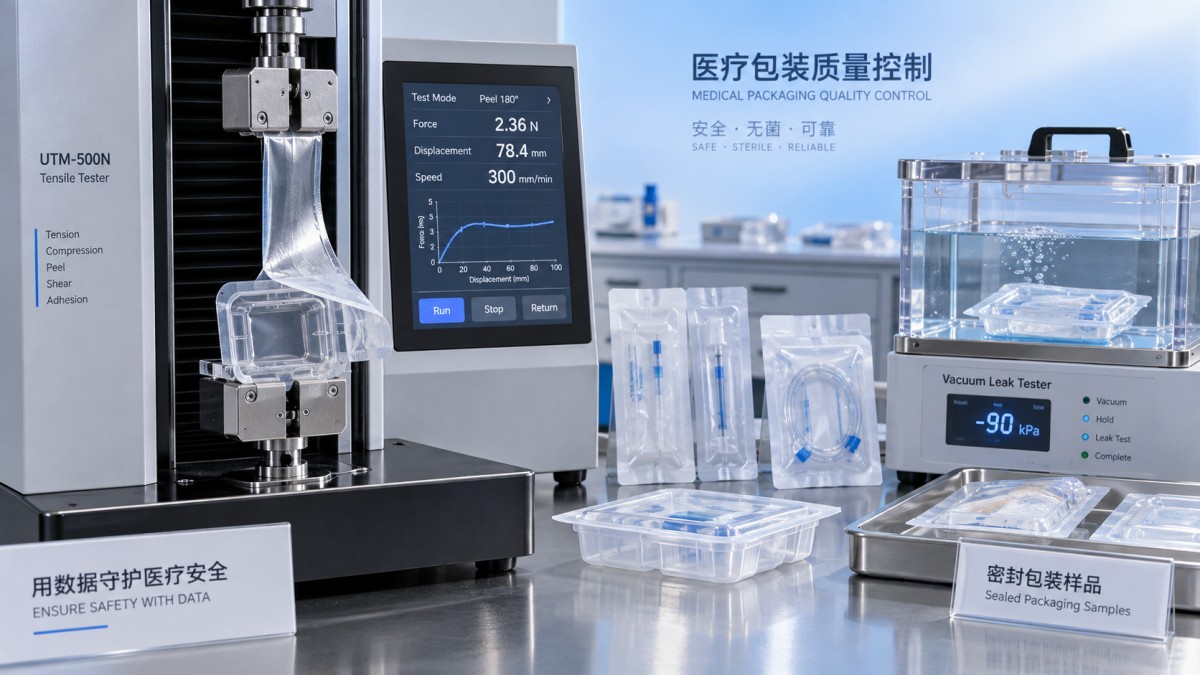
ASTM F88/F88M is widely used to measure the strength of flexible barrier material seals. Test strips are peeled in a tensile tester, producing a force-versus-displacement curve. The average force is useful, but it is rarely the full story. A seal can meet an average requirement while containing local low-strength regions that would be missed if only a small number of strips are tested.
The failure mode deserves equal attention. For a peelable lid, a stable adhesive or cohesive peel may be expected. Fiber tear, film tear, delamination, or abrupt spikes in the curve may indicate an overly aggressive process window, material variation, or a package that could be difficult to open aseptically. Conversely, a very low and smooth force result may look attractive from a usability perspective while leaving insufficient margin after aging and distribution.
This is where teams sometimes make a costly shortcut: they establish one lower specification limit and stop there. In practice, upper limits and failure-mode expectations can be just as relevant, particularly for clinical users wearing gloves or opening a pouch in a sterile field.
Leak detection must match the package material
Dye penetration methods are commonly used for channel detection, but their applicability depends on the package construction. ASTM F1929 is intended for detecting channels in porous medical packaging. The method can be highly informative for porous lidding systems because dye can reveal a continuous channel along the seal. It should not be casually applied to every package type, and test fluid selection, dwell conditions, and interpretation must follow the applicable procedure.
For nonporous packages, ASTM F3039 is often considered for dye penetration testing. Bubble emission testing under ASTM F2096 can be useful for identifying gross leaks in flexible packages submerged in water under vacuum. However, an operator must be able to distinguish true bubble streams from trapped air released from folds, rough surfaces, or package geometry. That sounds basic, but it is a common source of false calls during routine testing.
Burst and creep tests, including methods described in ASTM F1140/F1140M and ASTM F2054, provide another perspective. They are destructive tests that pressurize the package until it ruptures or holds a specified pressure for a defined period. These methods are useful for understanding the package’s weak point, whether that is the seal, a film puncture, a tray corner, or another feature. A package that consistently bursts outside the seal area may demonstrate a robust seal, but that does not eliminate the need for separate leak testing where microchannels are a concern.
Acceptance Criteria: Defensible, Specific, and Linked to Risk
Acceptance criteria should not be copied from a material supplier’s brochure or borrowed from a different package family without evidence. The right criterion is tied to the actual sterile barrier system: materials, seal width, device mass and geometry, intended sterilization process, distribution route, aging condition, and opening requirements.
For seal strength, a defensible specification typically addresses the test configuration, sample location, peel speed where relevant, average or minimum performance measures, and allowable failure modes. For integrity testing, the criterion may be no observed dye channel, no continuous stream of bubbles under validated conditions, or no loss of pressure before the designated endpoint. The wording needs to be precise enough that two trained analysts reach the same conclusion.
The acceptance criteria should also reflect the package lifecycle. Testing only freshly sealed samples can be misleading. Sterilization may alter polymers, adhesives, or coatings. Accelerated and real-time aging studies may reveal changes in peel behavior. Distribution simulation can expose edge damage, flex cracking, or seal stress that is absent in a static laboratory sample. ISO 11607 validation work is therefore not simply about proving that a sealer can create one acceptable batch; it is about demonstrating that the process and package system remain suitable through the claimed shelf life and expected handling conditions.
Where Seal Failures Usually Begin
Most failures can be traced to a short list of interacting causes, though the evidence is rarely as clean as “temperature too low” or “operator error.” Sealing is a material-and-process interaction. A change that improves one material pair may damage another.
Insufficient temperature, pressure, or dwell time can create weak bonds and intermittent channels. Excessive heat or dwell can produce melt-through, brittle interfaces, distortion, or a seal that tears the substrate during opening. Uneven jaw pressure is particularly troublesome because it can create acceptable peel-force results in one sampled area while leaving weak sections near a corner or across a wrinkle.
Contamination is another recurring source of failure. Powder, fibers, lubricants, moisture, device debris, and even packaging dust can interrupt the bond line. A product that sits too close to the seal area may cause mechanical interference after sealing, even if the seal initially passes inspection. This is why investigating a defect requires looking at package loading, not only the sealing machine.
Material variation should not be overlooked. Coating weight, film thickness, storage humidity, roll winding tension, and lot-to-lot variation can shift sealing behavior. When a process is validated with one material lot and later becomes unstable, the answer is not automatically to widen the sealing window. First confirm incoming material controls, approved specifications, and whether the observed failure mode has changed.
A Better Root-Cause Workflow Than “Retest and Release”
When seal failures appear, retesting may confirm the problem, but it rarely explains it. Begin by preserving failed samples and documenting exactly where failure occurred: along the seal, at a corner, near a device feature, in the lidding material, or in the tray wall. Photograph the package before destructive testing. Once the package has been pulled apart, valuable evidence is gone.
Then compare the failure pattern with process data: sealer temperature records, pressure settings, dwell time, alarm history, maintenance status, tooling condition, line speed, operator changes, and material lot traceability. A localized defect often points toward jaw damage, contamination, platen misalignment, or package placement. A broad shift across many samples may suggest a process parameter drift or material change.
Sampling location matters. Testing strips only from the center of a seal may hide weak corners, while testing only the weakest-looking area can overstate routine performance. A planned sampling map is more credible than opportunistic cuts. For unusual failures, cross-sectional examination or closer assessment of seal morphology may be warranted, provided the method and interpretation are appropriate for the material system.
Independent benchmarking can help when supplier claims, internal test results, and field performance do not align. Organizations such as VitalSync Metrics approach these questions by translating manufacturing parameters and test evidence into comparable technical documentation rather than relying on promotional claims. For procurement teams, laboratory architects, and device manufacturers, that kind of review is most valuable when it asks uncomfortable but necessary questions: Was the method suitable for the package? Were the samples representative? Did the reported result demonstrate integrity, usability, or only a narrow mechanical outcome?
What a Reliable Control Plan Looks Like
A reliable medical packaging seal failure testing program combines controls rather than depending on one impressive test. Incoming material verification, in-process seal monitoring, visual inspection, periodic destructive testing, integrity testing, equipment maintenance, and change control all have a place. The exact mix depends on package design and process risk.
The strongest programs also treat packaging changes with caution. A new tray supplier, revised artwork, different sterilization load, adjusted line speed, or replacement sealing jaw may seem minor. Any of these can alter seal performance. The appropriate response is not always full revalidation, but the change should be assessed against the validated state and documented before it becomes a production surprise.
In the end, acceptable seals are not defined by a single number on a tensile tester. They are demonstrated by consistent evidence that the sterile barrier remains intact, the package survives its expected lifecycle, and the user can open it safely when it matters. If a test result cannot answer which of those conditions it supports, it is probably being asked to do more than the method was designed to prove.
Recommended News
- 2026.10.15Medical Packaging Heat Seal Testing: Seal Strength vs. Seal Integrity TestsDr. Julian Rossi (RehabTech Specialist)
- 2026.10.14Clinic Supplier Comparison: Evaluating Cost, Delivery Reliability, and SupportDr. Alistair Thorne (Senior Biomedical Engineer)
- 2026.10.13Engineering Performance Testing Services: Evaluating Test Methods and AccuracyDr. Alistair Thorne (Senior Biomedical Engineer)
The VitalSync Intelligence Brief
Receive daily deep-dives into MedTech innovations and regulatory shifts.