 Get Insights

Medical Packaging Heat Seal Testing: Seal Strength vs. Seal Integrity Tests

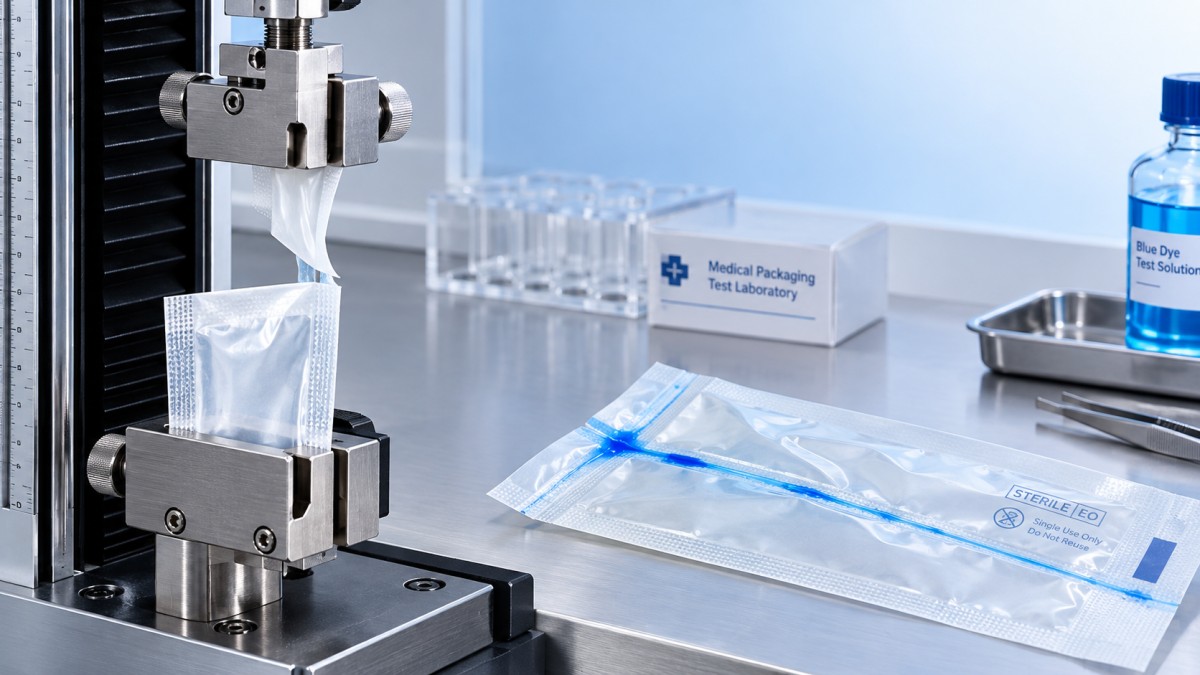
A medical pouch can meet its peel-strength specification and still contain a channel through the heat seal. During supplier qualification or packaging validation, that discrepancy matters: an acceptable force reading may conceal a pathway that compromises the sterile barrier. Seal strength measures resistance to separation; seal integrity testing looks for defects or leakage pathways. Neither result substitutes for the other.
Medical packaging heat seal testing therefore needs complementary evidence. ASTM F88/F88M supports mechanical seal-strength evaluation, while methods such as dye penetration and bubble emission address particular integrity questions. The practical task is to select methods suited to the package materials, establish their detection capability, and evaluate packages after relevant sterilization, aging, and distribution exposures—not simply collect passing test reports.
Two properties, two different failure questions
A strength test asks whether a seal can withstand the mechanical demands placed on it and, for peel-open designs, whether opening remains controlled. It measures force while a specimen is separated under defined conditions. Results depend on specimen width, test configuration, material behavior, and the way the seal fails.
An integrity test asks whether the tested package or seal contains a detectable pathway. A narrow channel caused by a wrinkle or trapped contamination may occupy very little of the bonded area. Most of a peel specimen can therefore resist separation normally even though the channel crosses the seal.
Neither test alone directly proves microbial exclusion throughout shelf life. Integrity results support sterile-barrier assessment, but that assessment also depends on material barrier properties, package design, validated sealing, and performance through the intended lifecycle.
Reading ASTM F88 results beyond the average
ASTM F88/F88M measures the strength of seals in flexible barrier materials. A strip containing the seal is pulled apart in a tensile tester, and the force is recorded. The test is valuable for process development, comparing sealing conditions, and monitoring changes, provided the specimen preparation and test configuration remain consistent.
Before comparing two suppliers’ results, check specimen width, units, grip separation rate, conditioning, and support technique. Unsupported and supported configurations can change the contribution of bending and material deformation to the measured force. Values reported in newtons are not directly comparable with values normalized by width unless the specimen dimensions and calculation basis are known.
Failure mode changes the meaning of the number
A high force does not necessarily indicate a better package. For a peel-open pouch, excessive bonding may cause substrate tearing, delamination, or an opening behavior that interferes with aseptic presentation. Material rupture can also prevent the test from measuring the intended peel response across the full seal.
Record the failure mode alongside the force result. Where supported by the procedure, inspect the force trace rather than relying only on a reported average. A brief weak region may disappear within an acceptable average, while an isolated peak may reflect local tearing rather than uniform bond strength.
- Low force with seal separation: investigate insufficient bonding, contamination, or incompatible sealing conditions.
- High force with material tearing: assess whether the result represents the intended seal behavior and whether opening remains acceptable.
- Large variation between locations: check local temperature, pressure contact, wrinkles, and differences in package construction.
Acceptance limits should reflect package performance and opening requirements. There is no universal peel-strength threshold suitable for every medical pouch, tray lid, laminate, or sealing process.
Selecting an integrity method for the actual materials
The first distinction is whether the package includes a porous barrier, such as medical-grade paper or spunbonded polyolefin, or uses nonporous materials. Porosity affects liquid migration, gas escape, and the interpretation of a test signal. A method selected only because equipment is available may produce misleading evidence.
Dye penetration: locating a seal pathway
ASTM F1929 addresses dye penetration for detecting seal leaks in porous medical packaging. ASTM F3039 addresses dye penetration for nonporous packaging or flexible barrier materials. These are not interchangeable labels for a generic dye test; select the applicable procedure and verify that the materials and package geometry fall within its scope.
Dye penetration can help locate a channel across a seal. However, a valid result depends on the prescribed solution, application technique, contact time, and observation conditions. With porous materials, extended exposure can allow wicking into the substrate and complicate interpretation. Dye movement through the material must be distinguished from movement through a seal defect.
Visibility also matters. Printing, opaque layers, folds, or difficult access can obscure the observation area. Representative defect controls and intact controls help establish whether the procedure can detect the intended defect without producing misleading indications. A negative result means no defect was detected under those conditions, not that every possible leak has been excluded.
Bubble emission: finding gross leaks under pressure
ASTM F2096 uses internal pressurization and immersion to detect gross leaks through bubble emission. Depending on the package and procedure, it can reveal seal channels or defects in the package body. It is particularly useful when the evaluation must extend beyond the seal region.
Pressure must be controlled. Too little pressure may fail to expose a leak; excessive pressure can deform the package or create a failure that was not present beforehand. Porous materials require the conditioning and test provisions specified by the applicable method. Trapped surface air and diffuse release must also be distinguished from a persistent localized leak signal.
Bubble emission should not be described as a universal microleak test. Its detection capability depends on the package, defect characteristics, pressure, and observation conditions. Where smaller defects require assessment, a different qualified method may be necessary. Instrumented methods are not automatically suitable either: package porosity, compliance, and fixture sealing can affect their response.
When passing results disagree
Consider a routine evaluation in which peel specimens pass, but dye reveals a channel near a pouch corner. The integrity failure should not be dismissed because the average force is acceptable. The next step is to identify the pathway and determine whether the strength sampling included that location.
Corner transitions, gussets, changes in material thickness, and areas near the product can behave differently from straight, unobstructed seal sections. A specimen cut from the middle of a long seal may miss a local pressure-contact problem. Conversely, an integrity test may pass on an undamaged package even though its seal is mechanically weak and vulnerable during handling.
Keep suspect packages, photographs, force traces, and defect maps where practical. Repeated testing without preserving this evidence can destroy the information needed to distinguish a process defect from a preparation or measurement artifact.
Build the protocol around the seal’s lifecycle
ISO 11607-1 addresses materials, sterile barrier systems, and packaging systems for terminally sterilized medical devices. ISO 11607-2 addresses validation requirements for forming, sealing, and assembly processes. These standards frame the validation work; they do not make one strength or integrity method sufficient for every package.
- Define the package and its intended use. Document materials, seal geometry, product loading, sterilization exposure, shelf-life claim, and opening requirements. Identify where a defect would threaten the sterile barrier.
- Select complementary measurements. Pair mechanical testing with an applicable integrity method. Define whether integrity testing covers only seals or also the package body, and establish method suitability for the actual construction.
- Challenge the sealing process. Evaluate the justified operating window for temperature, pressure, and dwell time, including relevant equipment and material variability. Nominal setpoints alone do not describe conditions at every seal location.
- Evaluate lifecycle exposures. Test at justified stages following sterilization, distribution simulation, and aging. Define exposure sequencing according to the intended lifecycle and risk rationale; do not assume accelerated aging reproduces every degradation mechanism.
- Set acceptance and sampling rules in advance. Specify strength criteria, acceptable failure modes, integrity endpoints, specimen locations, sample-size rationale, and handling of invalid or failed tests.
Use separate, traceable specimens when one destructive method would affect another. Pulling a seal apart before dye testing changes the object being evaluated. Similarly, immersion, pressurization, or dye exposure may alter subsequent mechanical behavior. Any combined sequence needs a demonstrated rationale.
Sampling must address spatial and temporal variation. Packages from one position or one short production interval may miss differences across sealing jaws, machine lanes, startups, or material lots. Destructive sample testing provides evidence about a process or population; it does not certify every untested package.
Turn supplier reports into usable engineering evidence
A statement such as “tested to ASTM F88” is incomplete without the applicable edition, configuration, specimen dimensions, conditioning, calculation method, and failure observations. An integrity report should likewise identify the method, package construction, test settings, endpoint, and evidence of suitability. Confirm applicable standard editions and regulatory expectations for the product and market rather than assuming every citation carries the same status.
Request results linked to the package configuration, sealing equipment, material lots, and lifecycle exposure. Without that traceability, a strong result may belong to a different laminate, seal geometry, or sterilization condition. Raw data and documented deviations are more useful than a certificate showing only “pass.”
When approving a material or process change, first ask which failure mechanisms it could alter. A different coating may change both peel behavior and dye interaction; a thicker web may change heat transfer and jaw contact. Requalification should address those effects explicitly. The acceptance decision should rest on compatible evidence of mechanical performance and integrity at the relevant lifecycle stages—not on whichever test gives the more favorable result.
Recommended News
- 2026.10.15Medical Packaging Heat Seal Testing: Seal Strength vs. Seal Integrity TestsDr. Julian Rossi (RehabTech Specialist)
- 2026.10.14Clinic Supplier Comparison: Evaluating Cost, Delivery Reliability, and SupportDr. Alistair Thorne (Senior Biomedical Engineer)
- 2026.10.13Engineering Performance Testing Services: Evaluating Test Methods and AccuracyDr. Alistair Thorne (Senior Biomedical Engineer)
The VitalSync Intelligence Brief
Receive daily deep-dives into MedTech innovations and regulatory shifts.