 Get Insights

Does smartortho gait data remain reliable outside the clinic?
Does smartortho Gait Data Remain Reliable Outside the Clinic?
A gait signal that looks clean during a supervised clinic visit may behave very differently during a week of ordinary life. In the clinic, the walking surface is predictable, the device is usually fitted correctly, the patient is observed, and the activity is deliberately structured. At home, a patient may walk on carpet, stairs, wet pavement, uneven ground, or crowded corridors. They may wear the sensor inconsistently, charge it late, carry shopping bags, compensate for pain, or leave a phone in another room.
That does not make remote gait monitoring unreliable by definition. It does mean that the question is more demanding than “Does the smartortho device collect gait data?” Technical evaluators should ask whether the system can preserve measurement integrity when the conditions that made the original algorithm work are no longer controlled. Accuracy, repeatability, missing-data behavior, artifact handling, and interpretation boundaries all matter.
For orthopedic use, the practical issue is clinical relevance. A small variation in cadence may be unimportant for one postoperative pathway, while an unexplained change in stance asymmetry could be relevant if it persists across comparable activity periods. Reliable smartortho data outside the clinic is therefore not simply “high-volume data.” It is data with a traceable relationship to patient movement, device state, and the conditions under which it was collected.
The Clinic-to-Home Gap Is Mostly an Engineering Problem
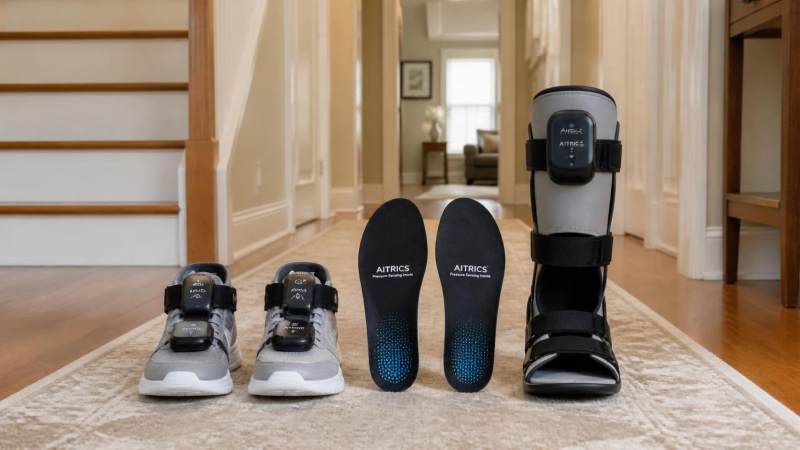
Many gait-monitoring systems rely on inertial measurement units, pressure-sensitive components, connected braces, instrumented insoles, or combinations of these technologies. Each approach has a different failure profile. A foot-worn sensor may capture step timing well when placement is stable, but may become sensitive to footwear changes. A wearable placed near the pelvis can be useful for broader movement patterns, yet it may be affected by attachment angle, garment movement, or the patient’s habit of repositioning it.
The home environment compounds those hardware limitations. A sensor does not know whether a sudden acceleration comes from a stride transition, a stumble, entering a vehicle, or dropping the device onto a table. The algorithm has to infer context from imperfect signals. This is where product demonstrations can become misleading: a device may perform convincingly on level walking at a prescribed pace but provide less stable outputs during slow shuffling, turning, stair negotiation, assistive-device use, or intermittent weight-bearing.
Technical teams should resist treating “free-living validation” as a single checkbox. A system can be valid for recognizing walking bouts yet insufficiently validated for estimating joint loading, limb symmetry, or recovery progression. Those are different analytical claims. The more specific the clinical output, the stronger the evidence needed to show that the output remains meaningful across real-world movement conditions.
Calibration is not a one-time event
Sensor calibration is often discussed as if it occurs only during manufacturing. Factory calibration is necessary, but it does not resolve all sources of drift in use. Device orientation, attachment tension, mechanical wear, temperature exposure, battery condition, and firmware changes can all affect field performance. For systems that estimate gait variables from accelerometer and gyroscope data, orientation error can become especially consequential when the wearer puts the device back on at a slightly different angle each day.
A credible smartortho workflow should make clear which controls are automatic, which require user action, and which are not monitored at all. If a device depends on a guided fitting procedure, the evaluator should determine whether the system can detect an incorrect fit later. If it relies on baseline normalization, the timing of baseline collection matters. A baseline taken immediately after surgery, during acute pain or swelling, may not be interchangeable with a baseline taken after initial rehabilitation.
This is not a minor usability detail. When a trend line is used to inform a clinical conversation, it should be possible to distinguish a change in patient performance from a change in device placement or system configuration.
Motion Artifacts Are Often the Real Limitation
In orthopedic monitoring, not every non-walking movement is noise. Sit-to-stand transitions, transfers, stair climbing, and protective movement after pain can all carry useful information. The difficulty is that they can also contaminate gait-specific metrics if the system classifies them incorrectly. A patient using a cane, for example, may produce movement patterns that differ substantially from the population used to train an activity-classification model. The same applies to severe antalgic gait, neurological comorbidities, or recovery protocols that restrict normal loading.
This is why aggregate daily scores deserve careful scrutiny. They are convenient, but they can hide the quality of the underlying segmentation. If a system reports a single mobility or gait-quality value, evaluators should ask what activities are included, what recordings are excluded, and whether a low-confidence segment is visibly flagged. A polished dashboard is not evidence that the underlying signal is robust.
In practice, signal quality indicators are more useful than many procurement documents suggest. They can reveal poor sensor contact, improbable step patterns, insufficient data duration, or a loss of synchronization between components. The best systems do not merely suppress poor-quality data; they preserve an auditable indication that the data was filtered, rejected, or estimated. That distinction matters when a clinician is reviewing a change that could influence rehabilitation planning.
Reliability Depends on the Metric Being Claimed
The phrase “gait data” is too broad for technical evaluation. Step count, cadence, walking-bout duration, stride-time variability, symmetry estimates, range-of-motion proxies, and load-related inferences should not be assessed as though they carry the same measurement burden. Basic activity detection may remain reasonably resilient in ordinary settings. More complex biomechanical interpretation usually requires stronger assumptions about sensor position, body model, walking context, and algorithm validity.
A useful assessment separates three questions:
- Can the system detect that walking occurred?
- Can it measure the selected gait variable consistently under expected home-use conditions?
- Can that variable support the clinical or operational decision being proposed?
These questions often produce different answers. A platform may be suitable for confirming adherence to a prescribed walking program but not for diagnosing an implant-related problem. It may help identify a sustained decline in mobility that warrants follow-up, while remaining unsuitable as a standalone basis for changing treatment. The distinction should be documented early, especially when a MedTech startup is moving from a wellness-style product concept toward a clinical workflow.
Repeatability should also be examined in context. Repeating a standardized corridor walk is not the same as repeating a normal day. For home monitoring, a more meaningful question is whether comparable activity windows produce stable results when the patient’s condition has not materially changed. That usually requires a predefined method for selecting valid walking bouts, handling days with little usable data, and interpreting natural day-to-day variation.
Connectivity Problems Can Become Data-Integrity Problems
Wireless connectivity is frequently treated as an operational concern rather than a measurement concern. In reality, it can affect both. If data are stored locally and synchronized later, the evaluator needs to understand storage limits, timestamp behavior, encryption controls, retransmission logic, and what occurs when a synchronization attempt fails. If data are streamed continuously through a phone, phone operating-system restrictions, Bluetooth interruptions, permissions, and background-process behavior can influence completeness.
A missing block of data is not automatically harmless. Its significance depends on why it is missing. A brief transmission gap during a quiet afternoon may have little practical impact. Recurrent loss during active periods, low battery states, or certain types of movement may introduce systematic bias. The device may then appear to show lower activity or fewer gait events simply because the relevant data did not reach the analysis layer.
Technical documentation should identify whether the system distinguishes among “no activity,” “device not worn,” “sensor fault,” “data not synchronized,” and “data rejected by quality rules.” When these states are collapsed into one blank field, retrospective interpretation becomes much weaker. This is particularly important in multi-site programs, where support teams may otherwise make inconsistent assumptions about incomplete records.
What a Defensible Validation Package Should Show
A technical evaluator does not need a marketing claim that a smartortho platform is “clinically proven.” They need to see whether the evidence matches the intended use. The reference method, participant population, walking scenarios, exclusion criteria, device configuration, algorithm version, and outcome definitions should all be visible enough to evaluate. Validation involving healthy adults on a treadmill may be useful, but it cannot by itself settle performance for postoperative orthopedic patients walking freely at home.
For a remote orthopedic application, evidence is stronger when it addresses the actual sources of field variation: different gait speeds, turning, non-level surfaces where relevant, use of braces or assistive devices, variable wear duration, and repeated measurements over time. It should also clarify whether the reported performance refers to raw sensor measurements, derived gait parameters, or a composite algorithmic score. These layers are too often blended together.
Where medical-device regulatory obligations apply, the intended purpose and associated claims should be reviewed alongside the evidence. MDR or IVDR discussions are sometimes raised broadly in procurement conversations, but applicability depends on the device, its function, and the claims being made. A general statement that a digital platform is “compliant” is not enough. The relevant regulatory status, quality documentation, and clinical evaluation materials must be reviewed for the specific market and use case.
Benchmarking Should Include Failure Behavior, Not Just Best-Case Performance
At VitalSync Metrics, the useful benchmark is not limited to whether a wearable sensor can generate an attractive mobility chart under ideal conditions. The more revealing work is examining how the system behaves when conditions deteriorate: partial wear, variable attachment, intermittent connectivity, low activity levels, atypical gait, and software updates. A clinical team can work with a known limitation. It is much harder to work with a limitation that is invisible in the output.
That approach reflects a broader shift in healthcare procurement. As hospitals, laboratory architects, and digital-health teams seek technical integrity rather than promotional assurances, they need comparable evidence about signal quality, data traceability, long-term device behavior, and the boundaries of intended use. The engineering question is not whether a system ever produces useful data. It is whether its useful-data conditions are explicit, monitored, and reproducible.
Smartortho gait data can remain reliable outside the clinic, but only within a clearly defined measurement framework. The strongest implementations treat remote data as a structured evidence stream: calibrated where needed, quality-checked before interpretation, linked to device and connectivity status, and reviewed against a validation plan that resembles real use rather than an idealized walking test. Before relying on a gait trend, ask the simple but decisive question: could this change be explained by the patient, the sensor, or the data pipeline? If the system cannot help answer that, it is not yet ready to carry much clinical weight.
Recommended News
- 2026.10.15Medical Packaging Heat Seal Testing: Seal Strength vs. Seal Integrity TestsDr. Julian Rossi (RehabTech Specialist)
- 2026.10.14Clinic Supplier Comparison: Evaluating Cost, Delivery Reliability, and SupportDr. Alistair Thorne (Senior Biomedical Engineer)
- 2026.10.13Engineering Performance Testing Services: Evaluating Test Methods and AccuracyDr. Alistair Thorne (Senior Biomedical Engineer)
The VitalSync Intelligence Brief
Receive daily deep-dives into MedTech innovations and regulatory shifts.