
Medical Grade Plastic Certificates: Which Documents Matter Most
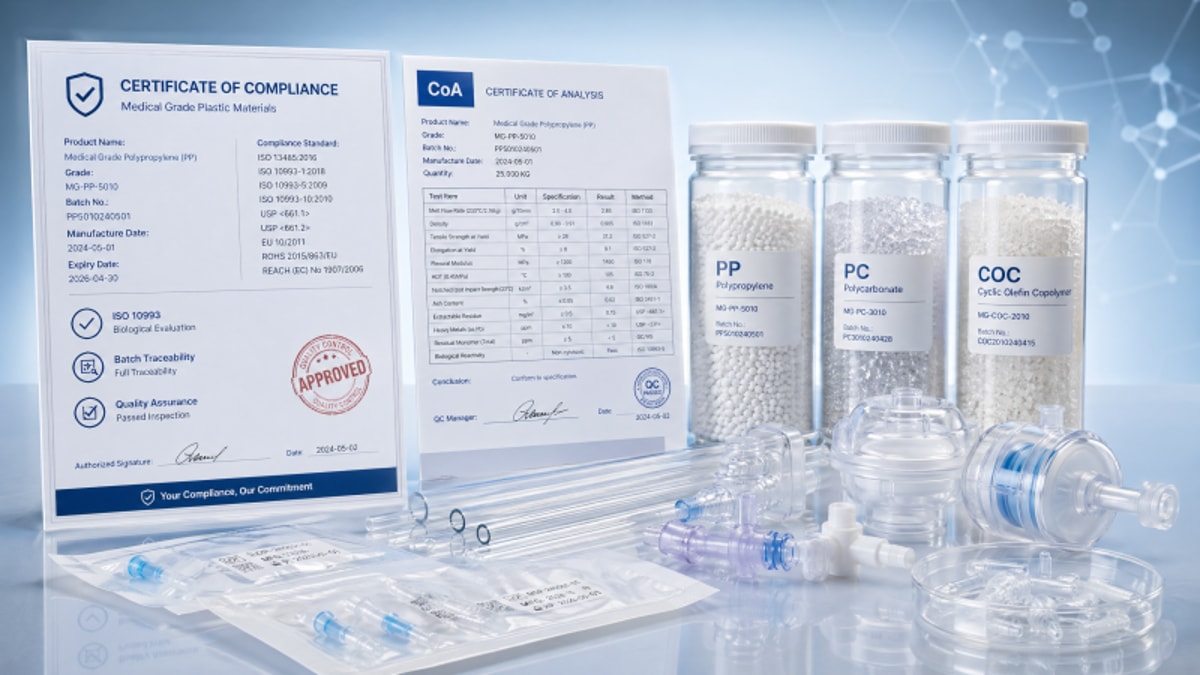
When evaluating materials for healthcare applications, medical grade plastic certificates are often the first proof of safety, traceability, and compliance. For quality control and safety managers, knowing which documents truly matter can reduce audit risk, prevent sourcing errors, and support confident decisions under MDR and IVDR expectations. This article highlights the certificates that carry the most weight and explains how to verify their real value.
What are medical grade plastic certificates, and why do they matter so much in healthcare sourcing?
In practical procurement, medical grade plastic certificates are not just paperwork attached to a resin, compound, molded part, or extruded tube. They are evidence packages showing whether a material can be traced, tested, processed, and documented in a way that supports healthcare use. For quality control teams, these documents often determine whether a supplier passes an audit in 1 visit or triggers weeks of corrective action requests.
The reason they matter is simple: in healthcare, a plastic material may contact skin for minutes, body fluids for hours, or sterilization cycles for months across repeated use. A certificate that proves only generic industrial quality is rarely enough. Safety managers usually need to confirm at least 4 dimensions: composition control, biocompatibility relevance, manufacturing consistency, and regulatory traceability. If one of these is missing, the sourcing decision becomes harder to defend.
This is especially important under MDR and IVDR-aligned expectations, where documentation quality affects supplier qualification as much as physical performance. A material may perform well in tensile strength, clarity, or chemical resistance, but if the supporting certificate set is incomplete, the risk profile changes. In many organizations, the gap between a “promising material” and an “approvable material” is entirely document-driven.
Which documents are usually grouped under this term?
The phrase medical grade plastic certificates can refer to several different records, and that is where confusion often starts. Some buyers use it to mean a certificate of analysis, while others expect compliance letters, sterilization compatibility data, ISO 10993 biocompatibility evidence, USP Class VI references, lot traceability statements, or declarations covering REACH and RoHS. These documents do not all serve the same purpose, and they should never be treated as interchangeable.
For example, a certificate of analysis may confirm batch-specific properties such as melt flow, moisture, appearance, or density. A declaration of compliance may confirm substance restrictions. A biocompatibility statement may refer to testing on a specific formulation, often under controlled conditions. Each document answers a different question, and quality teams should map them to the intended application rather than collecting them as a box-ticking exercise.
A quick way to separate document value
- Identity documents show what the material is and which lot was supplied.
- Compliance documents show whether restricted substances or quality systems are addressed.
- Application-supporting documents show whether the material has evidence relevant to healthcare contact and sterilization.
- Traceability documents show whether the supplier can connect shipment, batch, and change history across a typical 5- to 10-year record retention window.
For teams building a defensible supplier file, the strongest approach is not asking for “all certificates,” but asking for the right certificates linked to the intended risk class, contact duration, and processing route.
Which medical grade plastic certificates matter most for quality control and safety managers?
Not every document carries equal weight. In most supplier reviews, the highest-value medical grade plastic certificates are the ones that help answer an auditor’s likely questions within 2 to 3 minutes: What material was shipped? Was it made under a controlled quality system? Is there evidence relevant to healthcare use? Can changes be detected before they create downstream risk?
The table below summarizes the documents that usually matter most, what they prove, and where buyers should be cautious. This kind of comparison is useful when multiple suppliers offer similar polymers but very different documentation depth.
A useful reading of this table is that the most important medical grade plastic certificates are not always the most impressive-sounding ones. In many audits, a clear CoA, robust traceability, and a documented change control policy may be more actionable than a vague marketing statement claiming “medical suitability.”
What should be treated as essential versus supportive?
For many procurement and quality workflows, essential documents include CoA or CoC, lot traceability records, composition or grade identification, and some form of quality-system evidence. Supportive documents include sterilization compatibility data, extractables information, packaging controls, and previous biocompatibility references. The exact split depends on whether the material is used for packaging, disposable fluid handling, diagnostic consumables, or reusable device housings.
As a rule, the higher the patient-contact risk and the longer the expected lifecycle, the more carefully supportive documents move toward essential status. A housing component with indirect contact may be reviewed on a narrower document set. A fluid-contact part in an IVD workflow may require much deeper scrutiny, often including process cleanliness, additive disclosure boundaries, and sterilization-aging relevance over a 6- to 24-month validation horizon.
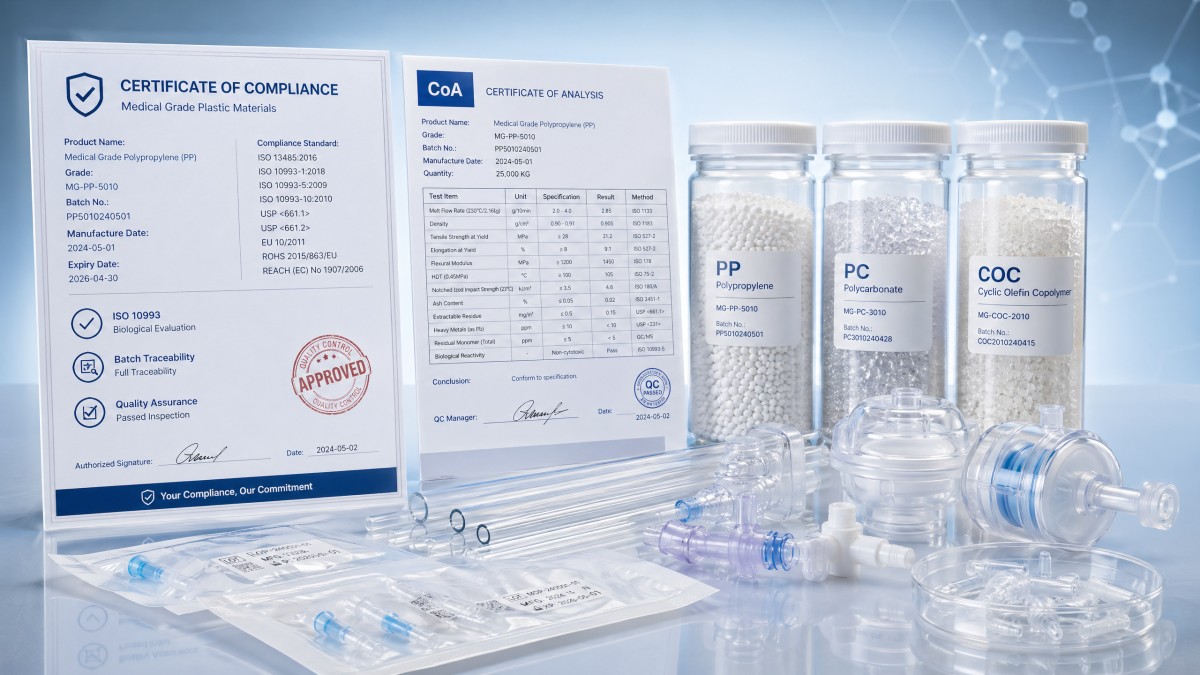
That is why VSM-style technical benchmarking matters: document completeness should be judged against real application stress, not only against supplier claims. The best sourcing decisions connect paper evidence to processing risk, field performance, and long-term change management.
How can you tell whether a certificate is truly useful or just a generic supplier document?
A common mistake is accepting any formal-looking PDF as valid proof. In reality, many documents are generic templates that provide little practical control value. For quality control and safety managers, the test is not whether a certificate exists, but whether it answers a sourcing question clearly, specifically, and traceably. If a document cannot be tied to a grade, lot, site, date, and scope, its audit value drops sharply.
One useful internal method is to score medical grade plastic certificates against 5 criteria: specificity, traceability, scope relevance, revision control, and change sensitivity. A certificate that scores 4 out of 5 or higher is often operationally useful. A document that scores 2 out of 5 may still be informative, but it should not be used as the main basis for approval.
What specific checks should be done during document review?
The checklist below can be used during incoming supplier qualification, annual review, or pre-audit preparation. It is especially helpful when reviewing medical grade plastic certificates for compounds, films, tubing, connectors, molded components, or custom assemblies.
- Confirm the exact material grade and verify that the document matches the purchased grade, not a family-level brochure.
- Check whether the lot number, manufacturing date, and release date are shown and legible.
- Verify whether the document refers to a specific production site, because multi-site supply can introduce process variation.
- Review whether test methods are identified, especially for critical release values such as melt flow or appearance criteria.
- Look for revision control and issue date; outdated certificates can remain in circulation for 12 months or more if document control is weak.
- Check whether biocompatibility references apply to the formulation itself, the final article, or only a historical test condition.
- Confirm whether change notification lead time is suitable for your validation cycle, which is often 30, 60, or 90 days at minimum.
These checks help separate credible medical grade plastic certificates from documents that mainly support sales conversations. A useful certificate reduces ambiguity. A weak certificate creates extra work for QC, RA, and supplier management teams downstream.
Common signs of low-value documentation
- The document says “medical grade” but does not define any test basis or compliance scope.
- The statement uses broad wording such as “typically complies” without identifying standard versions.
- The certificate references an old formulation code that no longer appears on labels or invoices.
- There is no signature, authorization trace, or digital release control.
For safety managers, these are not minor paperwork issues. They often indicate weak document governance, which can become a larger risk if a complaint, recall review, or post-market investigation occurs later.
Which certificates are often misunderstood, overvalued, or used incorrectly?
Some of the biggest sourcing mistakes happen when teams assume one document covers everything. In reality, medical grade plastic certificates often have narrow meanings. A common example is USP Class VI. It can be relevant as a historical screening reference, but it does not automatically prove that the final device or component meets all modern biocompatibility expectations for its intended use.
Another frequent misunderstanding involves ISO 10993 references. If a supplier says a resin “meets ISO 10993,” the immediate follow-up question should be: which part, which endpoints, under what contact condition, and on what form? Material-level statements and finished-device evaluations are not the same thing. The difference becomes critical when additives, colorants, processing aids, or sterilization exposure change the final biological profile.
REACH and RoHS declarations are also useful, but they should not be treated as healthcare-safety certificates by themselves. They mainly support restricted substance review. They do not prove cleanliness, extractables behavior, cytotoxicity relevance, or long-term process stability. Their value is real, but limited to specific compliance questions.
How do the most common documents compare in real decision-making?
The comparison below helps QC and safety teams decide how much weight each document should carry during approval. It is especially useful when reviewing material change requests, supplier onboarding files, or deviations involving alternative grades.
The key takeaway is that each certificate answers a narrow question. High-quality sourcing decisions come from combining them logically, not from over-relying on any single document. That is one of the most important discipline points for teams working across engineering, quality, and compliance.
How should teams build a practical review process for medical grade plastic certificates?
A practical process should be fast enough for operations, but deep enough for audit defense. In many healthcare supply chains, the most effective approach is a 3-stage review: pre-screening, application fit review, and change-control monitoring. This keeps the review burden proportionate while still protecting against supplier drift over time.
At the pre-screening stage, teams confirm whether the supplier can provide the basic medical grade plastic certificates needed for qualification. At the application-fit stage, they compare document scope to the actual contact profile, sterilization route, and intended service life. At the monitoring stage, they control updates, supplier notices, and annual re-checks. For many organizations, this cycle repeats every 12 months, with extra review after any material or process change.
What should be included in the review file?
A complete file usually includes the current grade datasheet, CoA or CoC, lot traceability support, compliance declarations, relevant biocompatibility references, sterilization compatibility information if applicable, and documented supplier change notification terms. If the material is critical to device function, teams may also include internal receiving criteria, deviation history, and risk-ranking notes.
It also helps to assign ownership clearly. Engineering may review mechanical or thermal fit. QC may verify incoming document accuracy and batch release alignment. Safety or regulatory personnel may assess restricted substances, contact classification, and document retention periods. Without role clarity, certificate review can become fragmented, and small gaps remain hidden until a customer audit exposes them.
A simple internal approval framework
- Approve: document set is complete, traceable, current, and aligned to use case.
- Approve with conditions: minor gaps exist, but compensating controls are defined within 30 days.
- Hold: key medical grade plastic certificates are missing, outdated, or not grade-specific.
- Reject: supplier cannot support traceability, change control, or minimum compliance expectations.
This kind of framework helps teams make repeatable decisions across multiple material families, from polycarbonate and polypropylene to specialty elastomers and transparent diagnostic polymers. It also reduces the risk of one-off approvals based on urgency rather than evidence.
Before buying or approving a material, what questions should you ask the supplier first?
The most effective supplier conversations begin with focused questions, not broad requests. Instead of asking, “Do you have medical grade plastic certificates?” ask which grade-specific certificates are available, how often they are updated, whether they are lot-linked, and whether the supplier offers advance notification of formulation or process changes. In many cases, the quality of the answers is as informative as the documents themselves.
For quality control and safety managers, it is also important to ask how the supplier handles requalification after a site transfer, additive adjustment, or test-method revision. Even a small change can affect clarity, bonding behavior, sterilization resistance, or biological assessment relevance. A supplier that can explain these controls clearly is usually easier to manage over a product lifecycle of 3 to 7 years.
Which questions create the strongest starting point?
- Can you provide grade-specific CoA or CoC documents for the last 3 released lots?
- What healthcare-relevant compliance or biocompatibility references exist for this exact formulation?
- What is your formal change notification period, and does it cover raw material, process, site, and specification changes?
- Which sterilization methods have supporting compatibility data: gamma, EtO, steam, or others?
- What document retention period applies to batches, testing, and release records?
- If a deviation occurs, how quickly can traceability and impact assessment be provided—24 hours, 72 hours, or longer?
These questions help turn medical grade plastic certificates from passive documents into active supplier controls. They also make it easier to compare suppliers on technical integrity rather than presentation quality alone.
Why choose us when certificate review needs to go beyond paperwork?
VitalSync Metrics supports healthcare decision-makers who need more than vendor language. We focus on engineering-based evaluation, document logic, and benchmark-oriented review so procurement, QC, and safety teams can judge whether medical grade plastic certificates actually support the intended application. Our perspective is especially useful when a material appears compliant on paper but still raises questions around validation burden, process consistency, or long-term reliability.
If you need help confirming certificate scope, comparing material options, reviewing supplier documentation, or understanding how a document set aligns with MDR or IVDR expectations, you can contact us for practical support. Typical discussion topics include parameter confirmation, material selection, delivery-cycle considerations, custom documentation needs, certification requirements, sample evaluation pathways, and quotation communication for benchmarking or review services.
The earlier these questions are clarified, the easier it becomes to reduce audit risk, avoid sourcing delays, and build a stronger evidence trail for healthcare procurement. If your team is currently comparing suppliers or preparing for a quality review, this is the right stage to verify not just whether certificates exist, but whether they truly matter.
Recommended News
- 2026.04.29Healthcare Analytics Metrics That Support Smarter Budget CallsLydia Vancini (Regulatory Compliance Lead)
- 2026.04.29Mobility Assist Selection Mistakes That Limit Long-Term UseSarah Jenkins (Laboratory Infrastructure Consultant)
- 2026.04.29Endoscope Image Resolution Benchmark for Vendor ComparisonDr. Alistair Thorne (Senior Biomedical Engineer)
The VitalSync Intelligence Brief
Receive daily deep-dives into MedTech innovations and regulatory shifts.